

Effect of Number of Passes and Pass Directions in Friction Stir …
213
Table 1 Grain size and UTS under different conditions
Parameter
Sample Id
A
B
C
D
E
No. of passes
Single
Double
Double
Triple
Triple
Direction
–
Same
Reverse
Same
Reverse
Grain size no.
6
9
8
7
7
UTS (MPa)
125
–
199
–
–
Peak temp. (°C) (in the 1st pass)
540
–
556
–
–
The number of passes and their directions was varied to investigate its effect on
copper using FSP. The number of passes and directions employed for experiments
is as mentioned in Table 1. The reversal of pass was done by rotating the plate by
180°. In the case of multiple passes, the plates were allowed to cool in the room
temperature, between each pass.
2 Materials and Methods
2.1 Workpiece and Fixture Setup
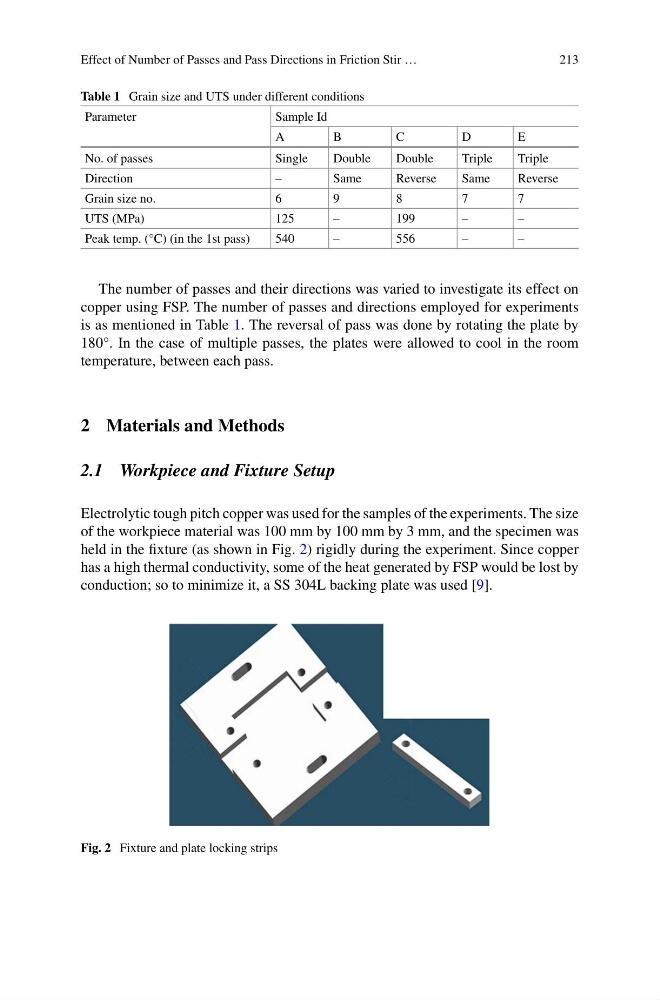
Electrolytic tough pitch copper was used for the samples of the experiments. The size
of the workpiece material was 100 mm by 100 mm by 3 mm, and the specimen was
held in the fixture (as shown in Fig. 2) rigidly during the experiment. Since copper
has a high thermal conductivity, some of the heat generated by FSP would be lost by
conduction; so to minimize it, a SS 304L backing plate was used [9].
Fig. 2 Fixture and plate locking strips
213
Table 1 Grain size and UTS under different conditions
Parameter
Sample Id
A
B
C
D
E
No. of passes
Single
Double
Double
Triple
Triple
Direction
–
Same
Reverse
Same
Reverse
Grain size no.
6
9
8
7
7
UTS (MPa)
125
–
199
–
–
Peak temp. (°C) (in the 1st pass)
540
–
556
–
–
The number of passes and their directions was varied to investigate its effect on
copper using FSP. The number of passes and directions employed for experiments
is as mentioned in Table 1. The reversal of pass was done by rotating the plate by
180°. In the case of multiple passes, the plates were allowed to cool in the room
temperature, between each pass.
2 Materials and Methods
2.1 Workpiece and Fixture Setup
Electrolytic tough pitch copper was used for the samples of the experiments. The size
of the workpiece material was 100 mm by 100 mm by 3 mm, and the specimen was
held in the fixture (as shown in Fig. 2) rigidly during the experiment. Since copper
has a high thermal conductivity, some of the heat generated by FSP would be lost by
conduction; so to minimize it, a SS 304L backing plate was used [9].
Fig. 2 Fixture and plate locking strips