

A Review of Challenges to Hastelloy – C Series Weld Overlay
161
requirements, is protected by more noble alloys’ weld overlay. The application of
single pass and multiple passes of sound quality weld overlay can be selected based on
the requirement of composition and microstructure that enable the required surface
protection against corrosive media and erosion. Rather than using solid noble and
expensive alloys, weld overlay is applied only on the exposed surface area with
generally 3 mm undiluted weld metal chemistry of the top surface. Weld overlay has
been providing a much effective and economical solution to the industries [5].
To improve various surface properties of the parent metal, weld overlay process is
used. Weld overlay is a process of overlaying more noble material than parent metal
with the appropriate and efficient welding process. Quality of weld overlay is the
basic requirement. It is judged on the base of weld bead height, weld bead width,
weld reinforcement, bead penetration, and bead overlap like geometry factors. These
factors are importantly used to study weld overlay dilution [12–15].
Dilution is defined as the ratio of the base metal and a mixture of base metal
and filler metal. In other words, it is defined as the amount base metal mixing with
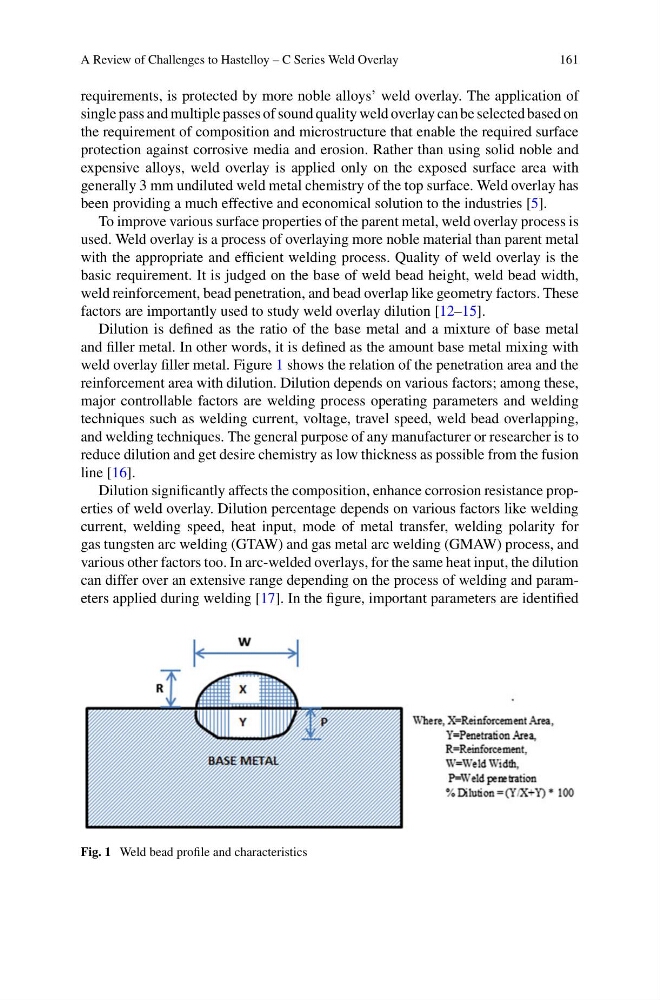
weld overlay filler metal. Figure 1 shows the relation of the penetration area and the
reinforcement area with dilution. Dilution depends on various factors; among these,
major controllable factors are welding process operating parameters and welding
techniques such as welding current, voltage, travel speed, weld bead overlapping,
and welding techniques. The general purpose of any manufacturer or researcher is to
reduce dilution and get desire chemistry as low thickness as possible from the fusion
line [16].
Dilution significantly affects the composition, enhance corrosion resistance properties of weld overlay. Dilution percentage depends on various factors like welding
current, welding speed, heat input, mode of metal transfer, welding polarity for
gas tungsten arc welding (GTAW) and gas metal arc welding (GMAW) process, and
various other factors too. In arc-welded overlays, for the same heat input, the dilution
can differ over an extensive range depending on the process of welding and parameters applied during welding [17]. In the figure, important parameters are identified
Fig. 1 Weld bead profile and characteristics
161
requirements, is protected by more noble alloys’ weld overlay. The application of
single pass and multiple passes of sound quality weld overlay can be selected based on
the requirement of composition and microstructure that enable the required surface
protection against corrosive media and erosion. Rather than using solid noble and
expensive alloys, weld overlay is applied only on the exposed surface area with
generally 3 mm undiluted weld metal chemistry of the top surface. Weld overlay has
been providing a much effective and economical solution to the industries [5].
To improve various surface properties of the parent metal, weld overlay process is
used. Weld overlay is a process of overlaying more noble material than parent metal
with the appropriate and efficient welding process. Quality of weld overlay is the
basic requirement. It is judged on the base of weld bead height, weld bead width,
weld reinforcement, bead penetration, and bead overlap like geometry factors. These
factors are importantly used to study weld overlay dilution [12–15].
Dilution is defined as the ratio of the base metal and a mixture of base metal
and filler metal. In other words, it is defined as the amount base metal mixing with
weld overlay filler metal. Figure 1 shows the relation of the penetration area and the
reinforcement area with dilution. Dilution depends on various factors; among these,
major controllable factors are welding process operating parameters and welding
techniques such as welding current, voltage, travel speed, weld bead overlapping,
and welding techniques. The general purpose of any manufacturer or researcher is to
reduce dilution and get desire chemistry as low thickness as possible from the fusion
line [16].
Dilution significantly affects the composition, enhance corrosion resistance properties of weld overlay. Dilution percentage depends on various factors like welding
current, welding speed, heat input, mode of metal transfer, welding polarity for
gas tungsten arc welding (GTAW) and gas metal arc welding (GMAW) process, and
various other factors too. In arc-welded overlays, for the same heat input, the dilution
can differ over an extensive range depending on the process of welding and parameters applied during welding [17]. In the figure, important parameters are identified
Fig. 1 Weld bead profile and characteristics