

160
M. V. Mehta et al.
Table 2 Chemical requirements of UNS N06455 (Hastelloy alloy C-4), UNS N06022 (Hastelloy
alloy C-22), UNS N10276 (Hastelloy alloy C-276), UNS N06200 (Hastelloy alloy C-2000), (wt%)
[10]
Ni
Mo
Fe
Cr
Co C
Mn Remark
Hastelloy C-4
Rem 14–17
3
14–18
2
0.015 1
Ti-0.7
Hastelloy C-22
Rem 12.5–14.5 2–6 20.0–22.5 2.5 0.015 0.5 W-2.5–3.5
Hastelloy C-276
Rem 15–17
4–7 14.5–15.5 2.5 0.01
1
W-3.5–4.5
Hastelloy C-2000 Rem 15–17
3
22.0–24.0 2
0.01
0.5 Cu-1.3–1.9
Note All chemical compositions are in percentage, and single value is maximum, Rem = Remainder.
For C-4 alloys, P, S, and Si are 0.04, 0.03, and 0.08, respectively, For C-22 alloy, V, P, S, and Si are
0.35, 0.02, 0.02, and 0.08, respectively. For C-276 alloy, V, P, S, and Si are 0.35, 0.03, 0.04, and
0.08 respectively. For C-2000 alloy, Al, P, S, and Si are 0.5, 0.025, 0.01, and 0.08, respectively
strength. For the understanding of the role of alloying elements on the mentioned
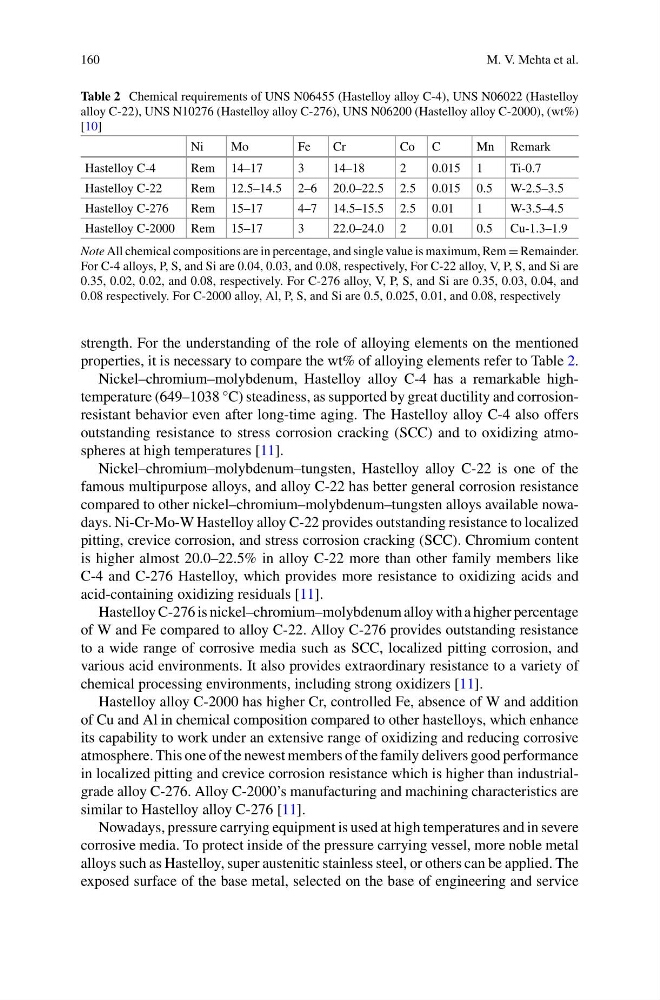
properties, it is necessary to compare the wt% of alloying elements refer to Table 2.
Nickel–chromium–molybdenum, Hastelloy alloy C-4 has a remarkable hightemperature (649–1038 °C) steadiness, as supported by great ductility and corrosionresistant behavior even after long-time aging. The Hastelloy alloy C-4 also offers
outstanding resistance to stress corrosion cracking (SCC) and to oxidizing atmospheres at high temperatures [11].
Nickel–chromium–molybdenum–tungsten, Hastelloy alloy C-22 is one of the
famous multipurpose alloys, and alloy C-22 has better general corrosion resistance
compared to other nickel–chromium–molybdenum–tungsten alloys available nowadays. Ni-Cr-Mo-W Hastelloy alloy C-22 provides outstanding resistance to localized
pitting, crevice corrosion, and stress corrosion cracking (SCC). Chromium content
is higher almost 20.0–22.5% in alloy C-22 more than other family members like
C-4 and C-276 Hastelloy, which provides more resistance to oxidizing acids and
acid-containing oxidizing residuals [11].
Hastelloy C-276 is nickel–chromium–molybdenum alloy with a higher percentage
of W and Fe compared to alloy C-22. Alloy C-276 provides outstanding resistance
to a wide range of corrosive media such as SCC, localized pitting corrosion, and
various acid environments. It also provides extraordinary resistance to a variety of
chemical processing environments, including strong oxidizers [11].
Hastelloy alloy C-2000 has higher Cr, controlled Fe, absence of W and addition
of Cu and Al in chemical composition compared to other hastelloys, which enhance
its capability to work under an extensive range of oxidizing and reducing corrosive
atmosphere. This one of the newest members of the family delivers good performance
in localized pitting and crevice corrosion resistance which is higher than industrialgrade alloy C-276. Alloy C-2000’s manufacturing and machining characteristics are
similar to Hastelloy alloy C-276 [11].
Nowadays, pressure carrying equipment is used at high temperatures and in severe
corrosive media. To protect inside of the pressure carrying vessel, more noble metal
alloys such as Hastelloy, super austenitic stainless steel, or others can be applied. The
exposed surface of the base metal, selected on the base of engineering and service
M. V. Mehta et al.
Table 2 Chemical requirements of UNS N06455 (Hastelloy alloy C-4), UNS N06022 (Hastelloy
alloy C-22), UNS N10276 (Hastelloy alloy C-276), UNS N06200 (Hastelloy alloy C-2000), (wt%)
[10]
Ni
Mo
Fe
Cr
Co C
Mn Remark
Hastelloy C-4
Rem 14–17
3
14–18
2
0.015 1
Ti-0.7
Hastelloy C-22
Rem 12.5–14.5 2–6 20.0–22.5 2.5 0.015 0.5 W-2.5–3.5
Hastelloy C-276
Rem 15–17
4–7 14.5–15.5 2.5 0.01
1
W-3.5–4.5
Hastelloy C-2000 Rem 15–17
3
22.0–24.0 2
0.01
0.5 Cu-1.3–1.9
Note All chemical compositions are in percentage, and single value is maximum, Rem = Remainder.
For C-4 alloys, P, S, and Si are 0.04, 0.03, and 0.08, respectively, For C-22 alloy, V, P, S, and Si are
0.35, 0.02, 0.02, and 0.08, respectively. For C-276 alloy, V, P, S, and Si are 0.35, 0.03, 0.04, and
0.08 respectively. For C-2000 alloy, Al, P, S, and Si are 0.5, 0.025, 0.01, and 0.08, respectively
strength. For the understanding of the role of alloying elements on the mentioned
properties, it is necessary to compare the wt% of alloying elements refer to Table 2.
Nickel–chromium–molybdenum, Hastelloy alloy C-4 has a remarkable hightemperature (649–1038 °C) steadiness, as supported by great ductility and corrosionresistant behavior even after long-time aging. The Hastelloy alloy C-4 also offers
outstanding resistance to stress corrosion cracking (SCC) and to oxidizing atmospheres at high temperatures [11].
Nickel–chromium–molybdenum–tungsten, Hastelloy alloy C-22 is one of the
famous multipurpose alloys, and alloy C-22 has better general corrosion resistance
compared to other nickel–chromium–molybdenum–tungsten alloys available nowadays. Ni-Cr-Mo-W Hastelloy alloy C-22 provides outstanding resistance to localized
pitting, crevice corrosion, and stress corrosion cracking (SCC). Chromium content
is higher almost 20.0–22.5% in alloy C-22 more than other family members like
C-4 and C-276 Hastelloy, which provides more resistance to oxidizing acids and
acid-containing oxidizing residuals [11].
Hastelloy C-276 is nickel–chromium–molybdenum alloy with a higher percentage
of W and Fe compared to alloy C-22. Alloy C-276 provides outstanding resistance
to a wide range of corrosive media such as SCC, localized pitting corrosion, and
various acid environments. It also provides extraordinary resistance to a variety of
chemical processing environments, including strong oxidizers [11].
Hastelloy alloy C-2000 has higher Cr, controlled Fe, absence of W and addition
of Cu and Al in chemical composition compared to other hastelloys, which enhance
its capability to work under an extensive range of oxidizing and reducing corrosive
atmosphere. This one of the newest members of the family delivers good performance
in localized pitting and crevice corrosion resistance which is higher than industrialgrade alloy C-276. Alloy C-2000’s manufacturing and machining characteristics are
similar to Hastelloy alloy C-276 [11].
Nowadays, pressure carrying equipment is used at high temperatures and in severe
corrosive media. To protect inside of the pressure carrying vessel, more noble metal
alloys such as Hastelloy, super austenitic stainless steel, or others can be applied. The
exposed surface of the base metal, selected on the base of engineering and service