

A Review of Challenges to Hastelloy – C Series Weld Overlay
159
Various conventional and advanced welding processes are employed to achieve
desire weld overlay dilution at economically. In the last decade, industry and
academia have seen considerable progress of Hastelloy – C series weld overlay,
the current chapter details about Hastelloy – C series weld overlay’s metallurgical
aspect, mechanical and physical properties, dilution effect, consumable for Hastelloy
– C Series weld overlay, and bead placement technique recommended for Hastelloy
– C series weld overlay.
2 Background
Proceeding recent development in industries like metallurgical and manufacturing
industries has promoted the development of Ni and Ni-based alloys. Making them
perfect choices for applications requiring chemical resistance and strength at elevated
temperatures, Ni and Ni-based alloys offer a combination of incredible corrosion
resistance, toughness, strength, metallurgical stability, weldability, and fabricability,
yet the cost of the nickel alloys is almost five to six times higher (depend on metal)
than the cost of stainless steel. Owing to the outstanding corrosion resistance of nickel
alloys, the primary cost premium can often be regained through long-term savings
because of extended equipment life, reduced maintenance, and less shutdowns [7].
Organized classification of the alloy is good to understand the family of alloys
such as for aluminum and steel, but in the case of Ni and their alloys, there is no
organized classification. Due to this, utmost nickel alloys are famous by the name
given by manufacturer or trade names, such as nickel–chromium–molybdenum alloys
Hastelloy. Nickel-based superalloys are generally classified into four groups commercially pure, solid-solution-strengthened alloy, precipitation strengthened alloy, and
specialty alloys. Our interested C series alloys are solid-solution-strengthened alloy
which are Ni-based and Hastelloy name derived from the Haynes Stellite alloy [8].
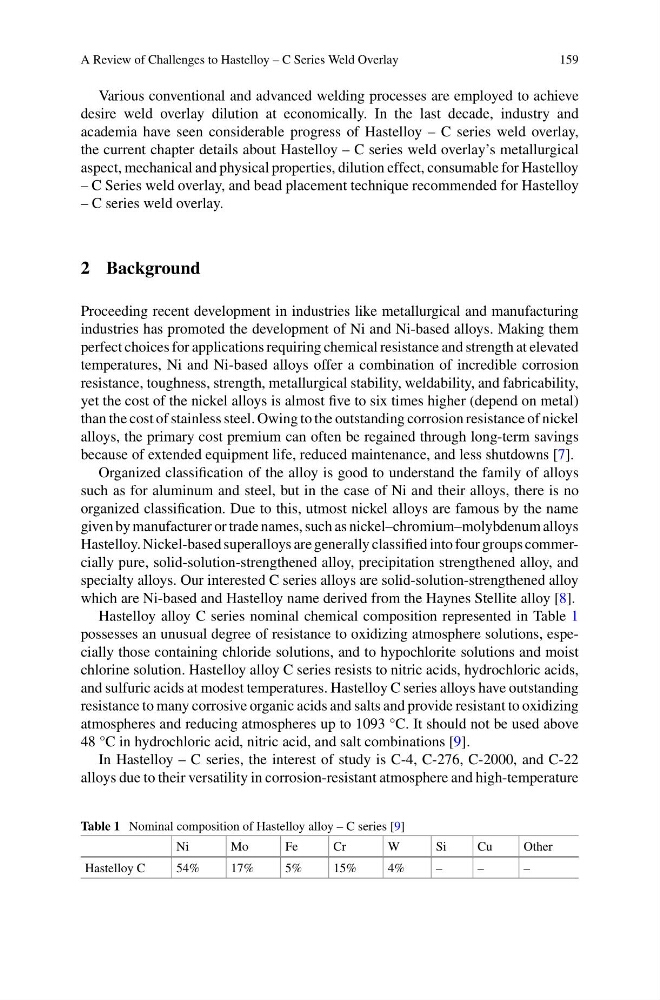
Hastelloy alloy C series nominal chemical composition represented in Table 1
possesses an unusual degree of resistance to oxidizing atmosphere solutions, especially those containing chloride solutions, and to hypochlorite solutions and moist
chlorine solution. Hastelloy alloy C series resists to nitric acids, hydrochloric acids,
and sulfuric acids at modest temperatures. Hastelloy C series alloys have outstanding
resistance to many corrosive organic acids and salts and provide resistant to oxidizing
atmospheres and reducing atmospheres up to 1093 °C. It should not be used above
48 °C in hydrochloric acid, nitric acid, and salt combinations [9].
In Hastelloy – C series, the interest of study is C-4, C-276, C-2000, and C-22
alloys due to their versatility in corrosion-resistant atmosphere and high-temperature
Table 1 Nominal composition of Hastelloy alloy – C series [9]
Ni
Mo
Fe
Cr
W
Si
Cu
Other
Hastelloy C
54%
17%
5%
15%
4%
–
–
–
159
Various conventional and advanced welding processes are employed to achieve
desire weld overlay dilution at economically. In the last decade, industry and
academia have seen considerable progress of Hastelloy – C series weld overlay,
the current chapter details about Hastelloy – C series weld overlay’s metallurgical
aspect, mechanical and physical properties, dilution effect, consumable for Hastelloy
– C Series weld overlay, and bead placement technique recommended for Hastelloy
– C series weld overlay.
2 Background
Proceeding recent development in industries like metallurgical and manufacturing
industries has promoted the development of Ni and Ni-based alloys. Making them
perfect choices for applications requiring chemical resistance and strength at elevated
temperatures, Ni and Ni-based alloys offer a combination of incredible corrosion
resistance, toughness, strength, metallurgical stability, weldability, and fabricability,
yet the cost of the nickel alloys is almost five to six times higher (depend on metal)
than the cost of stainless steel. Owing to the outstanding corrosion resistance of nickel
alloys, the primary cost premium can often be regained through long-term savings
because of extended equipment life, reduced maintenance, and less shutdowns [7].
Organized classification of the alloy is good to understand the family of alloys
such as for aluminum and steel, but in the case of Ni and their alloys, there is no
organized classification. Due to this, utmost nickel alloys are famous by the name
given by manufacturer or trade names, such as nickel–chromium–molybdenum alloys
Hastelloy. Nickel-based superalloys are generally classified into four groups commercially pure, solid-solution-strengthened alloy, precipitation strengthened alloy, and
specialty alloys. Our interested C series alloys are solid-solution-strengthened alloy
which are Ni-based and Hastelloy name derived from the Haynes Stellite alloy [8].
Hastelloy alloy C series nominal chemical composition represented in Table 1
possesses an unusual degree of resistance to oxidizing atmosphere solutions, especially those containing chloride solutions, and to hypochlorite solutions and moist
chlorine solution. Hastelloy alloy C series resists to nitric acids, hydrochloric acids,
and sulfuric acids at modest temperatures. Hastelloy C series alloys have outstanding
resistance to many corrosive organic acids and salts and provide resistant to oxidizing
atmospheres and reducing atmospheres up to 1093 °C. It should not be used above
48 °C in hydrochloric acid, nitric acid, and salt combinations [9].
In Hastelloy – C series, the interest of study is C-4, C-276, C-2000, and C-22
alloys due to their versatility in corrosion-resistant atmosphere and high-temperature
Table 1 Nominal composition of Hastelloy alloy – C series [9]
Ni
Mo
Fe
Cr
W
Si
Cu
Other
Hastelloy C
54%
17%
5%
15%
4%
–
–
–