

162
M. V. Mehta et al.
such as penetration of weld bead, weld width, weld reinforcement, and measured
[18].
Low dilution percentage generally prefers owing to less base metal involved or mix
in the weld metal. If dilution percentage is high, then the involvement of base metal
in weld metal will be high, which is affected adversely to the corrosion-resistant
properties of the weld metal. Dilution percentage is directly related to corrosionresistant properties. The relation between dilution and corrosion-resistant properties
is inverse, and as dilution decreased, corrosion-resistant properties enhanced and
vice versa. Hence, the welding process control dilution percentage is much preferred
[19].
Dilution is affected by the selection of welding parameters and the selection of
base metal [20]. Consequently, selecting the suitable weld overlay process to weld
overlay is essential to avoid unwanted metallurgical phases, the chemical composition
which will affect the corrosion properties of the material [21].
3 Key Aspects for Welding of Hastelloy – C Series
Hastelloy – C series weld overlay application depends on metallurgical aspects,
mechanical and physical properties, and corrosion resistance which need to discuss.
3.1 Metallurgical Aspects
Wide ranges of nickel-based alloys are available for various applications; due to
these, general alloying elements contributing to phase formation are needed to study,
and the role of elements are summarized in Table 3.
Microstructure plays a major role for nickel and nickel-based alloys. Microstructure imparts on corrosion resistance and properties of the material. The main phases
present in nickel-based alloys are summarized in Table 4.
Single γ-phase is present in solid solution alloys such as Inconel 600 and Hastelloy
C. All the above-mentioned phases are generally present in Ni-based high alloys,
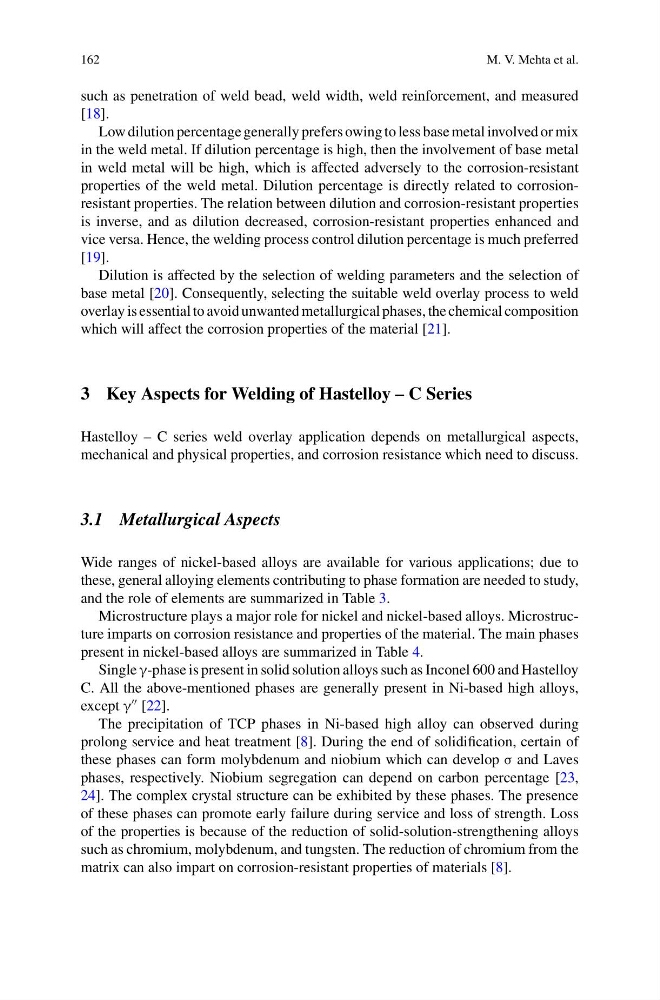
except γ
[22].
The precipitation of TCP phases in Ni-based high alloy can observed during
prolong service and heat treatment [8]. During the end of solidification, certain of
these phases can form molybdenum and niobium which can develop σ and Laves
phases, respectively. Niobium segregation can depend on carbon percentage [23,
24]. The complex crystal structure can be exhibited by these phases. The presence
of these phases can promote early failure during service and loss of strength. Loss
of the properties is because of the reduction of solid-solution-strengthening alloys
such as chromium, molybdenum, and tungsten. The reduction of chromium from the
matrix can also impart on corrosion-resistant properties of materials [8].
M. V. Mehta et al.
such as penetration of weld bead, weld width, weld reinforcement, and measured
[18].
Low dilution percentage generally prefers owing to less base metal involved or mix
in the weld metal. If dilution percentage is high, then the involvement of base metal
in weld metal will be high, which is affected adversely to the corrosion-resistant
properties of the weld metal. Dilution percentage is directly related to corrosionresistant properties. The relation between dilution and corrosion-resistant properties
is inverse, and as dilution decreased, corrosion-resistant properties enhanced and
vice versa. Hence, the welding process control dilution percentage is much preferred
[19].
Dilution is affected by the selection of welding parameters and the selection of
base metal [20]. Consequently, selecting the suitable weld overlay process to weld
overlay is essential to avoid unwanted metallurgical phases, the chemical composition
which will affect the corrosion properties of the material [21].
3 Key Aspects for Welding of Hastelloy – C Series
Hastelloy – C series weld overlay application depends on metallurgical aspects,
mechanical and physical properties, and corrosion resistance which need to discuss.
3.1 Metallurgical Aspects
Wide ranges of nickel-based alloys are available for various applications; due to
these, general alloying elements contributing to phase formation are needed to study,
and the role of elements are summarized in Table 3.
Microstructure plays a major role for nickel and nickel-based alloys. Microstructure imparts on corrosion resistance and properties of the material. The main phases
present in nickel-based alloys are summarized in Table 4.
Single γ-phase is present in solid solution alloys such as Inconel 600 and Hastelloy
C. All the above-mentioned phases are generally present in Ni-based high alloys,
except γ
[22].
The precipitation of TCP phases in Ni-based high alloy can observed during
prolong service and heat treatment [8]. During the end of solidification, certain of
these phases can form molybdenum and niobium which can develop σ and Laves
phases, respectively. Niobium segregation can depend on carbon percentage [23,
24]. The complex crystal structure can be exhibited by these phases. The presence
of these phases can promote early failure during service and loss of strength. Loss
of the properties is because of the reduction of solid-solution-strengthening alloys
such as chromium, molybdenum, and tungsten. The reduction of chromium from the
matrix can also impart on corrosion-resistant properties of materials [8].