

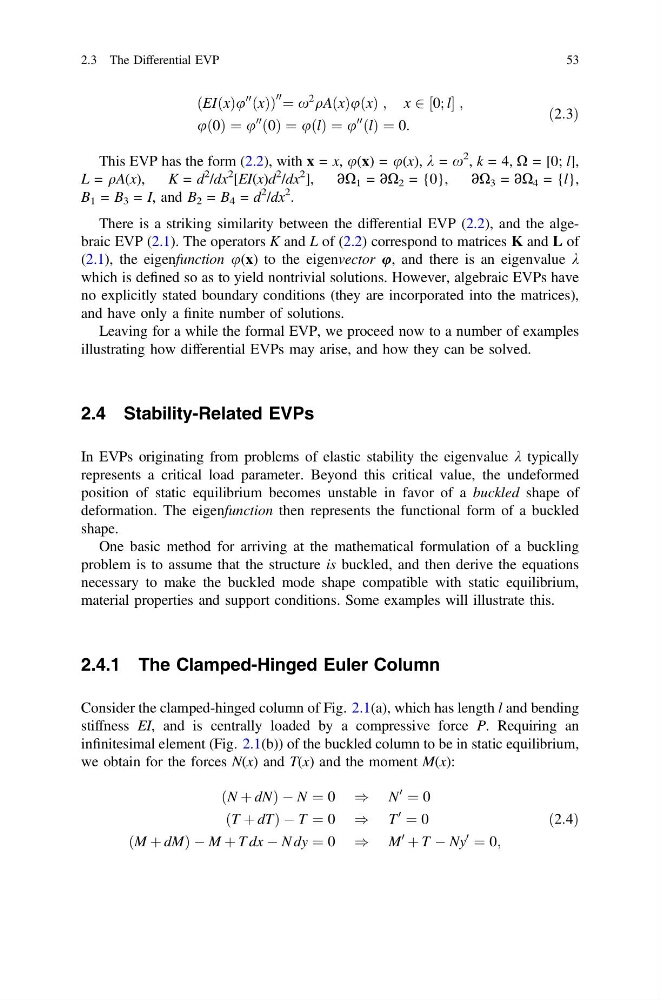
EIðxÞu
00
ðxÞ
ð
Þ
00 ¼ x
2 qAðxÞuðxÞ ; x 2 0; l
½ ;
uð0Þ ¼ u
00
ð0Þ ¼ uðlÞ ¼ u
00
ðlÞ ¼ 0:
ð2:3Þ
This EVP has the form (2.2), with x = x, u(x) = u(x), k = x
2 , k = 4, X = [0; l],
L = qA(x),
K = d
2 /dx
2
[EI(x)d
2 /dx
2 ],
∂X 1 = ∂X 2 = {0},
∂X 3 = ∂X 4 = {l},
B 1 = B 3 = I, and B 2 = B 4 = d
2 /dx
2 .
There is a striking similarity between the differential EVP (2.2), and the algebraic EVP (2.1). The operators K and L of (2.2) correspond to matrices K and L of
(2.1), the eigenfunction u(x) to the eigenvector u, and there is an eigenvalue k
which is defined so as to yield nontrivial solutions. However, algebraic EVPs have
no explicitly stated boundary conditions (they are incorporated into the matrices),
and have only a finite number of solutions.
Leaving for a while the formal EVP, we proceed now to a number of examples
illustrating how differential EVPs may arise, and how they can be solved.
2.4 Stability-Related EVPs
In EVPs originating from problems of elastic stability the eigenvalue k typically
represents a critical load parameter. Beyond this critical value, the undeformed
position of static equilibrium becomes unstable in favor of a buckled shape of
deformation. The eigenfunction then represents the functional form of a buckled
shape.
One basic method for arriving at the mathematical formulation of a buckling
problem is to assume that the structure is buckled, and then derive the equations
necessary to make the buckled mode shape compatible with static equilibrium,
material properties and support conditions. Some examples will illustrate this.
2.4.1 The Clamped-Hinged Euler Column
Consider the clamped-hinged column of Fig. 2.1(a), which has length l and bending
stiffness EI, and is centrally loaded by a compressive force P. Requiring an
infinitesimal element (Fig. 2.1(b)) of the buckled column to be in static equilibrium,
we obtain for the forces N(x) and T(x) and the moment M(x):
ðN þ dNÞ À N ¼ 0 ) N
0
¼ 0
ðT þ dTÞ À T ¼ 0 ) T
0
¼ 0
ðM þ dMÞ À M þ T dx À N dy ¼ 0 ) M
0
þ T À Ny
0
¼ 0;
ð2:4Þ
2.3 The Differential EVP
53
00
ðxÞ
ð
Þ
00 ¼ x
2 qAðxÞuðxÞ ; x 2 0; l
½ ;
uð0Þ ¼ u
00
ð0Þ ¼ uðlÞ ¼ u
00
ðlÞ ¼ 0:
ð2:3Þ
This EVP has the form (2.2), with x = x, u(x) = u(x), k = x
2 , k = 4, X = [0; l],
L = qA(x),
K = d
2 /dx
2
[EI(x)d
2 /dx
2 ],
∂X 1 = ∂X 2 = {0},
∂X 3 = ∂X 4 = {l},
B 1 = B 3 = I, and B 2 = B 4 = d
2 /dx
2 .
There is a striking similarity between the differential EVP (2.2), and the algebraic EVP (2.1). The operators K and L of (2.2) correspond to matrices K and L of
(2.1), the eigenfunction u(x) to the eigenvector u, and there is an eigenvalue k
which is defined so as to yield nontrivial solutions. However, algebraic EVPs have
no explicitly stated boundary conditions (they are incorporated into the matrices),
and have only a finite number of solutions.
Leaving for a while the formal EVP, we proceed now to a number of examples
illustrating how differential EVPs may arise, and how they can be solved.
2.4 Stability-Related EVPs
In EVPs originating from problems of elastic stability the eigenvalue k typically
represents a critical load parameter. Beyond this critical value, the undeformed
position of static equilibrium becomes unstable in favor of a buckled shape of
deformation. The eigenfunction then represents the functional form of a buckled
shape.
One basic method for arriving at the mathematical formulation of a buckling
problem is to assume that the structure is buckled, and then derive the equations
necessary to make the buckled mode shape compatible with static equilibrium,
material properties and support conditions. Some examples will illustrate this.
2.4.1 The Clamped-Hinged Euler Column
Consider the clamped-hinged column of Fig. 2.1(a), which has length l and bending
stiffness EI, and is centrally loaded by a compressive force P. Requiring an
infinitesimal element (Fig. 2.1(b)) of the buckled column to be in static equilibrium,
we obtain for the forces N(x) and T(x) and the moment M(x):
ðN þ dNÞ À N ¼ 0 ) N
0
¼ 0
ðT þ dTÞ À T ¼ 0 ) T
0
¼ 0
ðM þ dMÞ À M þ T dx À N dy ¼ 0 ) M
0
þ T À Ny
0
¼ 0;
ð2:4Þ
2.3 The Differential EVP
53