

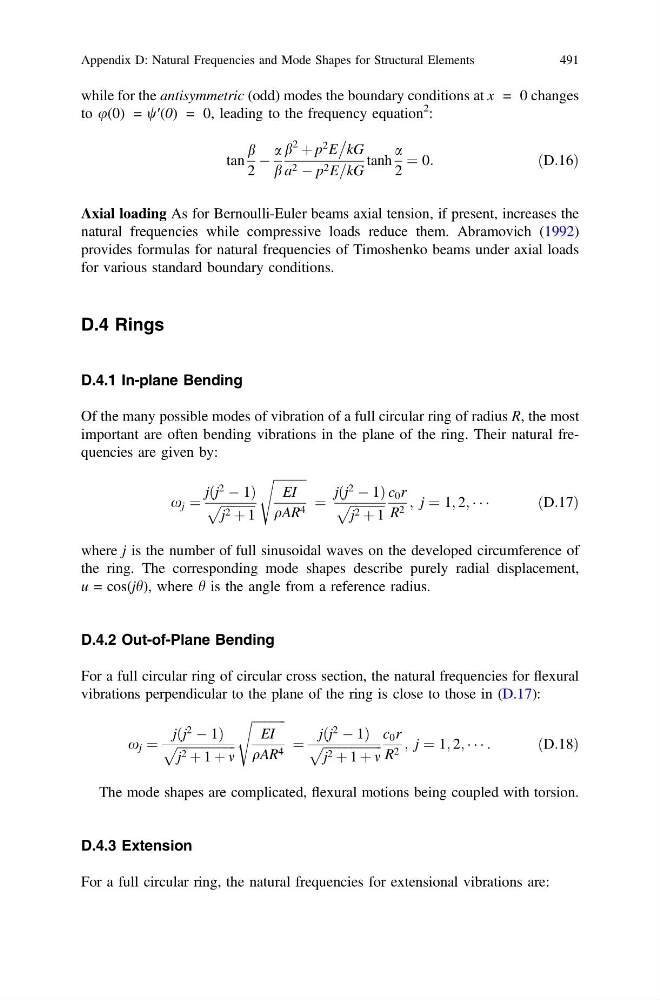
while for the antisymmetric (odd) modes the boundary conditions at x = 0 changes
to u(0) = w′(0) = 0, leading to the frequency equation
2 :
tan
b
2
À
a
b
b
2
þ p
2 E
kG
a 2 À p 2 E=kG
tanh
a
2
¼ 0:
ðD:16Þ
Axial loading As for Bernoulli-Euler beams axial tension, if present, increases the
natural frequencies while compressive loads reduce them. Abramovich (1992)
provides formulas for natural frequencies of Timoshenko beams under axial loads
for various standard boundary conditions.
D.4 Rings
D.4.1 In-plane Bending
Of the many possible modes of vibration of a full circular ring of radius R, the most
important are often bending vibrations in the plane of the ring. Their natural frequencies are given by:
x j ¼
jðj
2
À 1Þ
ffiffiffiffiffiffiffiffiffiffiffi
j 2 þ 1
p
ffiffiffiffiffiffiffiffiffiffi ffi
EI
qAR 4
s
¼
jðj
2
À 1Þ
ffiffiffiffiffiffiffiffiffiffiffi
j 2 þ 1
p
c 0 r
R 2 ; j ¼ 1; 2; Á Á Á
ðD:17Þ
where j is the number of full sinusoidal waves on the developed circumference of
the ring. The corresponding mode shapes describe purely radial displacement,
u = cos(jh), where h is the angle from a reference radius.
D.4.2 Out-of-Plane Bending
For a full circular ring of circular cross section, the natural frequencies for flexural
vibrations perpendicular to the plane of the ring is close to those in (D.17):
x j ¼
jðj
2
À 1Þ
ffiffiffiffiffiffiffiffiffiffiffiffiffiffiffiffiffiffi ffi
j 2 þ 1 þ m
p
ffiffiffiffiffiffiffiffiffiffi ffi
EI
qAR 4
s
¼
jðj
2
À 1Þ
ffiffiffiffiffiffiffiffiffiffiffiffiffiffiffiffiffiffi ffi
j 2 þ 1 þ m
p
c 0 r
R 2 ; j ¼ 1; 2; Á Á Á :
ðD:18Þ
The mode shapes are complicated, flexural motions being coupled with torsion.
D.4.3 Extension
For a full circular ring, the natural frequencies for extensional vibrations are:
Appendix D: Natural Frequencies and Mode Shapes for Structural Elements
491
to u(0) = w′(0) = 0, leading to the frequency equation
2 :
tan
b
2
À
a
b
b
2
þ p
2 E
kG
a 2 À p 2 E=kG
tanh
a
2
¼ 0:
ðD:16Þ
Axial loading As for Bernoulli-Euler beams axial tension, if present, increases the
natural frequencies while compressive loads reduce them. Abramovich (1992)
provides formulas for natural frequencies of Timoshenko beams under axial loads
for various standard boundary conditions.
D.4 Rings
D.4.1 In-plane Bending
Of the many possible modes of vibration of a full circular ring of radius R, the most
important are often bending vibrations in the plane of the ring. Their natural frequencies are given by:
x j ¼
jðj
2
À 1Þ
ffiffiffiffiffiffiffiffiffiffiffi
j 2 þ 1
p
ffiffiffiffiffiffiffiffiffiffi ffi
EI
qAR 4
s
¼
jðj
2
À 1Þ
ffiffiffiffiffiffiffiffiffiffiffi
j 2 þ 1
p
c 0 r
R 2 ; j ¼ 1; 2; Á Á Á
ðD:17Þ
where j is the number of full sinusoidal waves on the developed circumference of
the ring. The corresponding mode shapes describe purely radial displacement,
u = cos(jh), where h is the angle from a reference radius.
D.4.2 Out-of-Plane Bending
For a full circular ring of circular cross section, the natural frequencies for flexural
vibrations perpendicular to the plane of the ring is close to those in (D.17):
x j ¼
jðj
2
À 1Þ
ffiffiffiffiffiffiffiffiffiffiffiffiffiffiffiffiffiffi ffi
j 2 þ 1 þ m
p
ffiffiffiffiffiffiffiffiffiffi ffi
EI
qAR 4
s
¼
jðj
2
À 1Þ
ffiffiffiffiffiffiffiffiffiffiffiffiffiffiffiffiffiffi ffi
j 2 þ 1 þ m
p
c 0 r
R 2 ; j ¼ 1; 2; Á Á Á :
ðD:18Þ
The mode shapes are complicated, flexural motions being coupled with torsion.
D.4.3 Extension
For a full circular ring, the natural frequencies for extensional vibrations are:
Appendix D: Natural Frequencies and Mode Shapes for Structural Elements
491