

x j ¼
ffiffiffiffiffiffiffiffiffiffiffi
j 2 þ 1
p
c 0
R
; j ¼ 0; 1; Á Á Á :
ðD:19Þ
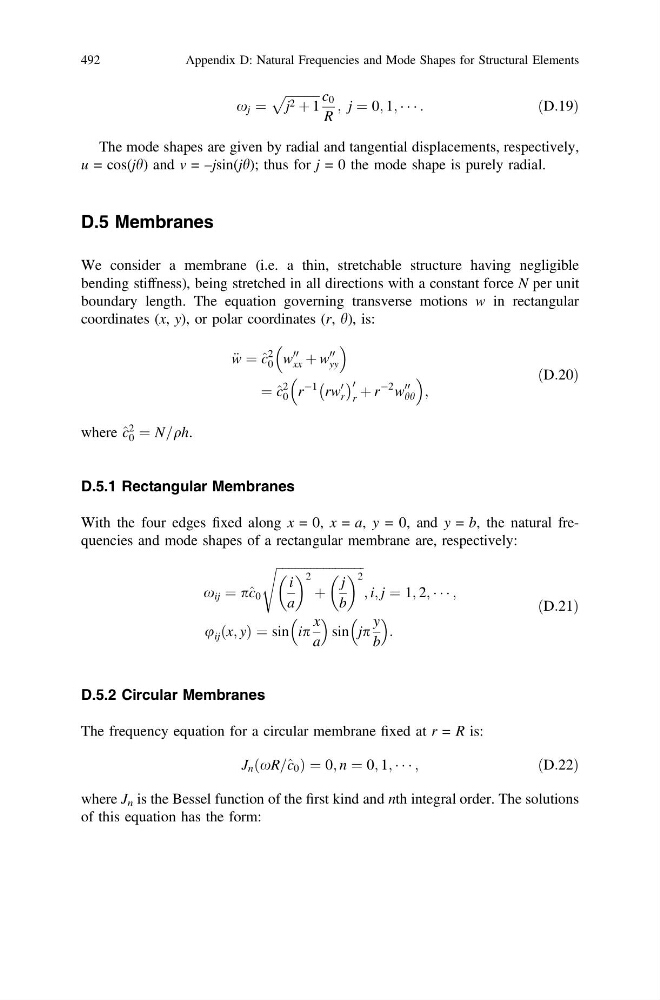
The mode shapes are given by radial and tangential displacements, respectively,
u = cos(jh) and v = –jsin(jh); thus for j = 0 the mode shape is purely radial.
D.5 Membranes
We consider a membrane (i.e. a thin, stretchable structure having negligible
bending stiffness), being stretched in all directions with a constant force N per unit
boundary length. The equation governing transverse motions w in rectangular
coordinates (x, y), or polar coordinates (r, h), is:
€
w ¼ ^ c
2
0 w
00
xx þ w
00
yy
¼ ^ c
2
0 r
À1 rw
0
r
À Á 0
r
þ r
À2 w
00
hh
;
ðD:20Þ
where ^ c
2
0 ¼ N=qh.
D.5.1 Rectangular Membranes
With the four edges fixed along x = 0, x = a, y = 0, and y = b, the natural frequencies and mode shapes of a rectangular membrane are, respectively:
x ij ¼ p^ c 0
ffiffiffiffiffiffiffiffiffiffiffiffiffiffiffiffiffiffiffiffiffiffiffiffiffiffiffiffi
i
a
2
þ
j
b
2
s
; i; j ¼ 1; 2; Á Á Á ;
u ij ðx; yÞ ¼ sin ip
x
a
sin jp
y
b
:
ðD:21Þ
D.5.2 Circular Membranes
The frequency equation for a circular membrane fixed at r = R is:
J n ðxR=^ c 0 Þ ¼ 0; n ¼ 0; 1; Á Á Á ;
ðD:22Þ
where J n is the Bessel function of the first kind and nth integral order. The solutions
of this equation has the form:
492
Appendix D: Natural Frequencies and Mode Shapes for Structural Elements
ffiffiffiffiffiffiffiffiffiffiffi
j 2 þ 1
p
c 0
R
; j ¼ 0; 1; Á Á Á :
ðD:19Þ
The mode shapes are given by radial and tangential displacements, respectively,
u = cos(jh) and v = –jsin(jh); thus for j = 0 the mode shape is purely radial.
D.5 Membranes
We consider a membrane (i.e. a thin, stretchable structure having negligible
bending stiffness), being stretched in all directions with a constant force N per unit
boundary length. The equation governing transverse motions w in rectangular
coordinates (x, y), or polar coordinates (r, h), is:
€
w ¼ ^ c
2
0 w
00
xx þ w
00
yy
¼ ^ c
2
0 r
À1 rw
0
r
À Á 0
r
þ r
À2 w
00
hh
;
ðD:20Þ
where ^ c
2
0 ¼ N=qh.
D.5.1 Rectangular Membranes
With the four edges fixed along x = 0, x = a, y = 0, and y = b, the natural frequencies and mode shapes of a rectangular membrane are, respectively:
x ij ¼ p^ c 0
ffiffiffiffiffiffiffiffiffiffiffiffiffiffiffiffiffiffiffiffiffiffiffiffiffiffiffiffi
i
a
2
þ
j
b
2
s
; i; j ¼ 1; 2; Á Á Á ;
u ij ðx; yÞ ¼ sin ip
x
a
sin jp
y
b
:
ðD:21Þ
D.5.2 Circular Membranes
The frequency equation for a circular membrane fixed at r = R is:
J n ðxR=^ c 0 Þ ¼ 0; n ¼ 0; 1; Á Á Á ;
ðD:22Þ
where J n is the Bessel function of the first kind and nth integral order. The solutions
of this equation has the form:
492
Appendix D: Natural Frequencies and Mode Shapes for Structural Elements