

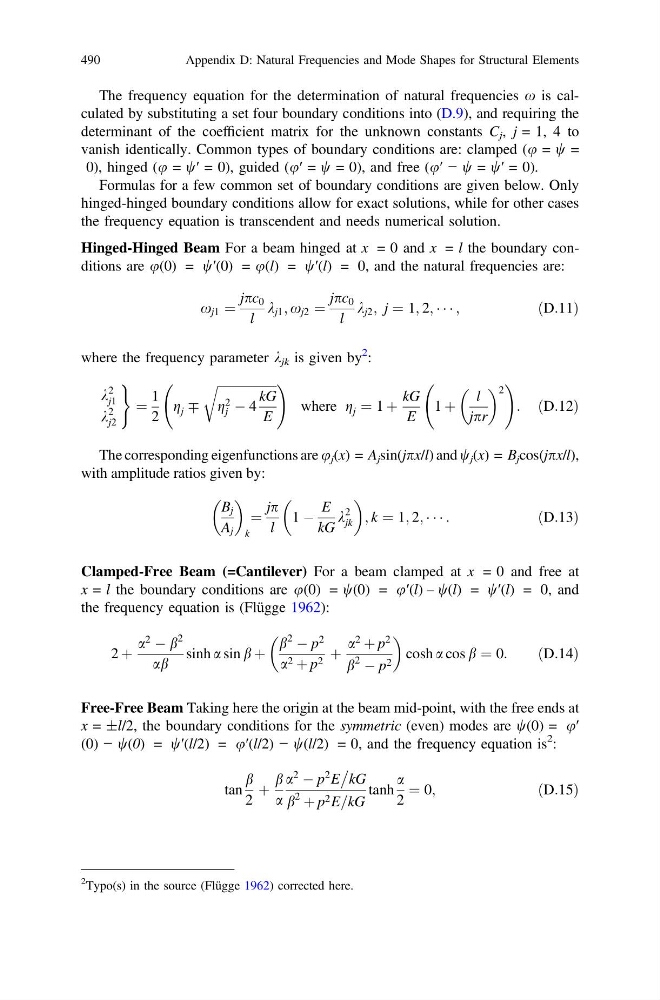
The frequency equation for the determination of natural frequencies x is calculated by substituting a set four boundary conditions into (D.9), and requiring the
determinant of the coefficient matrix for the unknown constants C j , j = 1, 4 to
vanish identically. Common types of boundary conditions are: clamped (u = w =
0), hinged (u = w′ = 0), guided (u′ = w = 0), and free (u′ − w = w′ = 0).
Formulas for a few common set of boundary conditions are given below. Only
hinged-hinged boundary conditions allow for exact solutions, while for other cases
the frequency equation is transcendent and needs numerical solution.
Hinged-Hinged Beam For a beam hinged at x = 0 and x = l the boundary conditions are u(0) = w′(0) = u(l) = w′(l) = 0, and the natural frequencies are:
x j1 ¼
jpc 0
l
k j1 ; x j2 ¼
jpc 0
l
k j2 ; j ¼ 1; 2; Á Á Á ;
ðD:11Þ
where the frequency parameter k jk is given by
2 :
k
2
j1
k
2
j2
)
¼
1
2
g j Ç
ffiffiffiffiffiffiffiffiffiffiffiffiffiffiffiffiffiffiffi
g 2
j À 4
kG
E
r
!
where g j ¼ 1 þ
kG
E
1 þ
l
jpr
2
!
: ðD:12Þ
The corresponding eigenfunctions are u j (x) = A j sin(jpx/l) and w j (x) = B j cos(jpx/l),
with amplitude ratios given by:
B j
A j
k
¼
jp
l
1 À
E
kG
k
2
jk
; k ¼ 1; 2; Á Á Á :
ðD:13Þ
Clamped-Free Beam (=Cantilever) For a beam clamped at x = 0 and free at
x = l the boundary conditions are u(0) = w(0) = u′(l) – w(l) = w′(l) = 0, and
the frequency equation is (Flügge 1962):
2 þ
a
2
À b
2
ab
sinh a sin b þ
b
2
À p
2
a 2 þ p 2 þ
a
2
þ p
2
b
2
À p 2
cosh a cos b ¼ 0:
ðD:14Þ
Free-Free Beam Taking here the origin at the beam mid-point, with the free ends at
x = ±l/2, the boundary conditions for the symmetric (even) modes are w(0) = u′
(0) − w(0) = w′(l/2) = u′(l/2) − w(l/2) = 0, and the frequency equation is
2 :
tan
b
2
þ
b
a
a
2
À p
2 E
kG
b
2
þ p 2 E=kG
tanh
a
2
¼ 0;
ðD:15Þ
2
Typo(s) in the source (Flügge 1962) corrected here.
490
Appendix D: Natural Frequencies and Mode Shapes for Structural Elements
determinant of the coefficient matrix for the unknown constants C j , j = 1, 4 to
vanish identically. Common types of boundary conditions are: clamped (u = w =
0), hinged (u = w′ = 0), guided (u′ = w = 0), and free (u′ − w = w′ = 0).
Formulas for a few common set of boundary conditions are given below. Only
hinged-hinged boundary conditions allow for exact solutions, while for other cases
the frequency equation is transcendent and needs numerical solution.
Hinged-Hinged Beam For a beam hinged at x = 0 and x = l the boundary conditions are u(0) = w′(0) = u(l) = w′(l) = 0, and the natural frequencies are:
x j1 ¼
jpc 0
l
k j1 ; x j2 ¼
jpc 0
l
k j2 ; j ¼ 1; 2; Á Á Á ;
ðD:11Þ
where the frequency parameter k jk is given by
2 :
k
2
j1
k
2
j2
)
¼
1
2
g j Ç
ffiffiffiffiffiffiffiffiffiffiffiffiffiffiffiffiffiffiffi
g 2
j À 4
kG
E
r
!
where g j ¼ 1 þ
kG
E
1 þ
l
jpr
2
!
: ðD:12Þ
The corresponding eigenfunctions are u j (x) = A j sin(jpx/l) and w j (x) = B j cos(jpx/l),
with amplitude ratios given by:
B j
A j
k
¼
jp
l
1 À
E
kG
k
2
jk
; k ¼ 1; 2; Á Á Á :
ðD:13Þ
Clamped-Free Beam (=Cantilever) For a beam clamped at x = 0 and free at
x = l the boundary conditions are u(0) = w(0) = u′(l) – w(l) = w′(l) = 0, and
the frequency equation is (Flügge 1962):
2 þ
a
2
À b
2
ab
sinh a sin b þ
b
2
À p
2
a 2 þ p 2 þ
a
2
þ p
2
b
2
À p 2
cosh a cos b ¼ 0:
ðD:14Þ
Free-Free Beam Taking here the origin at the beam mid-point, with the free ends at
x = ±l/2, the boundary conditions for the symmetric (even) modes are w(0) = u′
(0) − w(0) = w′(l/2) = u′(l/2) − w(l/2) = 0, and the frequency equation is
2 :
tan
b
2
þ
b
a
a
2
À p
2 E
kG
b
2
þ p 2 E=kG
tanh
a
2
¼ 0;
ðD:15Þ
2
Typo(s) in the source (Flügge 1962) corrected here.
490
Appendix D: Natural Frequencies and Mode Shapes for Structural Elements