

D.3.2 Timoshenko Beam Theory
Timoshenko theory is used when the spatial wavelength of the vibration is not large
compared to the beam height. This means that effects of rotary inertia and shear
deflections need to be accounted for. Use Timoshenko theory for thick beams or
higher vibration modes. For slender beams vibrating in lower modes, the simpler
Bernoulli-Euler theory can be used instead (Sect. D.3.1).
The free vibrations of a uniform Timoshenko beam are governed by a pair of
coupled equations (Flügge 1962; Marguerre and Wölfel 1979; Elishakoff et al.
2015; Brøns and Thomsen 2019):
qA€ w ¼ kGA w
0
À h
ð
Þ
0 ;
J € h ¼ EIh
00
þ kGA w
0
À h
ð
Þ;
ðD:8Þ
where w(x,t) is the total transverse deflection of the beam (due to both bending and
shear) and h(x,t) is the slope due to bending. The general expression for the
eigenfunctions u(x) and w(x) corresponding, respectively, to the w- and the hmotions, are
1 :
uðxÞ ¼ C 1 cosh
ax
l
þ C 2 sinh
ax
l
þ C 3 cos
bx
l
þ C 4 sin
bx
l
;
wðxÞ ¼
p
2 E
kG þ a
2
al
C 2 cosh
ax
l
þ C 1 sinh
ax
l
þ
p
2 E
kG À b
2
bl
ÀC 4 cos
bx
l
þ C 3 sin
bx
l
;
ðD:9Þ
where:
a
2
b
2
'
¼
p
2
2
Ç 1 þ
E
kG
þ
ffiffiffiffiffiffiffiffiffiffiffiffiffiffiffiffiffiffiffiffiffiffiffiffiffiffiffiffiffiffiffiffiffiffiffiffiffiffiffiffiffi ffi
1 À
E
kG
2
þ
2l
pr
2
s
2
4
3
5 ; p ¼
xl
c 0
:
ðD:10Þ
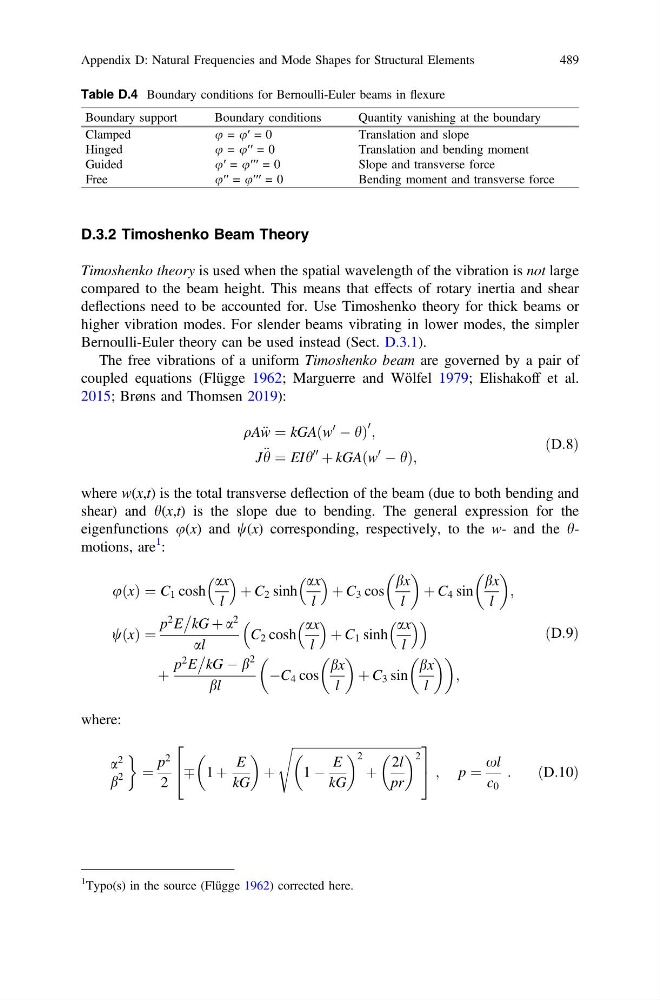
Table D.4 Boundary conditions for Bernoulli-Euler beams in flexure
Boundary support
Boundary conditions
Quantity vanishing at the boundary
Clamped
u = u′ = 0
Translation and slope
Hinged
u = u′′ = 0
Translation and bending moment
Guided
u′ = u′′′ = 0
Slope and transverse force
Free
u′′ = u′′′ = 0
Bending moment and transverse force
1
Typo(s) in the source (Flügge 1962) corrected here.
Appendix D: Natural Frequencies and Mode Shapes for Structural Elements
489
Timoshenko theory is used when the spatial wavelength of the vibration is not large
compared to the beam height. This means that effects of rotary inertia and shear
deflections need to be accounted for. Use Timoshenko theory for thick beams or
higher vibration modes. For slender beams vibrating in lower modes, the simpler
Bernoulli-Euler theory can be used instead (Sect. D.3.1).
The free vibrations of a uniform Timoshenko beam are governed by a pair of
coupled equations (Flügge 1962; Marguerre and Wölfel 1979; Elishakoff et al.
2015; Brøns and Thomsen 2019):
qA€ w ¼ kGA w
0
À h
ð
Þ
0 ;
J € h ¼ EIh
00
þ kGA w
0
À h
ð
Þ;
ðD:8Þ
where w(x,t) is the total transverse deflection of the beam (due to both bending and
shear) and h(x,t) is the slope due to bending. The general expression for the
eigenfunctions u(x) and w(x) corresponding, respectively, to the w- and the hmotions, are
1 :
uðxÞ ¼ C 1 cosh
ax
l
þ C 2 sinh
ax
l
þ C 3 cos
bx
l
þ C 4 sin
bx
l
;
wðxÞ ¼
p
2 E
kG þ a
2
al
C 2 cosh
ax
l
þ C 1 sinh
ax
l
þ
p
2 E
kG À b
2
bl
ÀC 4 cos
bx
l
þ C 3 sin
bx
l
;
ðD:9Þ
where:
a
2
b
2
'
¼
p
2
2
Ç 1 þ
E
kG
þ
ffiffiffiffiffiffiffiffiffiffiffiffiffiffiffiffiffiffiffiffiffiffiffiffiffiffiffiffiffiffiffiffiffiffiffiffiffiffiffiffiffi ffi
1 À
E
kG
2
þ
2l
pr
2
s
2
4
3
5 ; p ¼
xl
c 0
:
ðD:10Þ
Table D.4 Boundary conditions for Bernoulli-Euler beams in flexure
Boundary support
Boundary conditions
Quantity vanishing at the boundary
Clamped
u = u′ = 0
Translation and slope
Hinged
u = u′′ = 0
Translation and bending moment
Guided
u′ = u′′′ = 0
Slope and transverse force
Free
u′′ = u′′′ = 0
Bending moment and transverse force
1
Typo(s) in the source (Flügge 1962) corrected here.
Appendix D: Natural Frequencies and Mode Shapes for Structural Elements
489