

d ¼
4
X
2
x
2
À b
2
À
Á ; 2e ¼
4q
X
2
:
ðC:15Þ
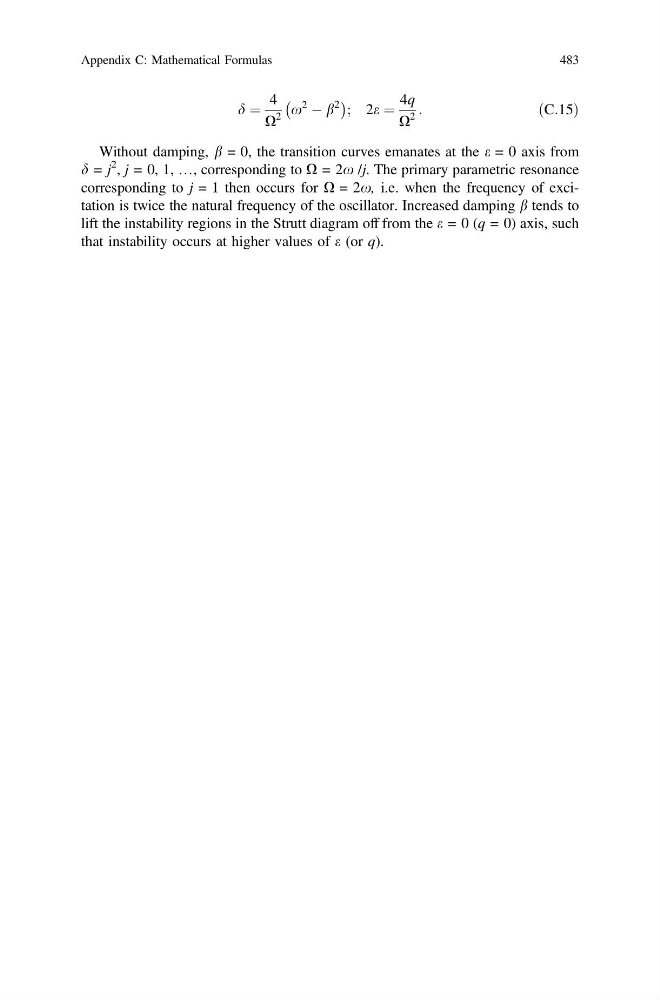
Without damping, b = 0, the transition curves emanates at the e = 0 axis from
d = j
2 , j = 0, 1, …, corresponding to X = 2x /j. The primary parametric resonance
corresponding to j = 1 then occurs for X = 2x, i.e. when the frequency of excitation is twice the natural frequency of the oscillator. Increased damping b tends to
lift the instability regions in the Strutt diagram off from the e = 0 (q = 0) axis, such
that instability occurs at higher values of e (or q).
Appendix C: Mathematical Formulas
483
4
X
2
x
2
À b
2
À
Á ; 2e ¼
4q
X
2
:
ðC:15Þ
Without damping, b = 0, the transition curves emanates at the e = 0 axis from
d = j
2 , j = 0, 1, …, corresponding to X = 2x /j. The primary parametric resonance
corresponding to j = 1 then occurs for X = 2x, i.e. when the frequency of excitation is twice the natural frequency of the oscillator. Increased damping b tends to
lift the instability regions in the Strutt diagram off from the e = 0 (q = 0) axis, such
that instability occurs at higher values of e (or q).
Appendix C: Mathematical Formulas
483