

Appendix D: Natural Frequencies
and Mode Shapes for Structural
Elements
Natural frequencies and mode shapes are provided here for some basic structural
members: strings, rods, beams, rings, membranes, and plates. The main sources are
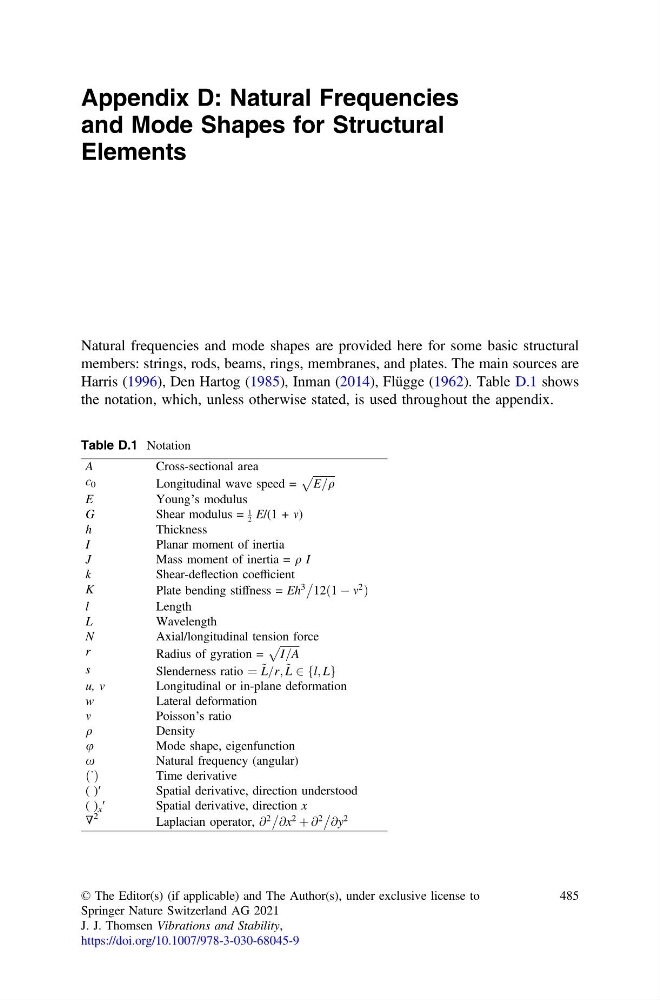
Harris (1996), Den Hartog (1985), Inman (2014), Flügge (1962). Table D.1 shows
the notation, which, unless otherwise stated, is used throughout the appendix.
Table D.1 Notation
A
Cross-sectional area
c 0
Longitudinal wave speed =
ffiffiffiffiffiffiffiffi ffi
E=q
p
E
Young’s modulus
G
Shear modulus =
1
2 E/(1 + m)
h
Thickness
I
Planar moment of inertia
J
Mass moment of inertia = q I
k
Shear-deflection coefficient
K
Plate bending stiffness = Eh
3
12ð1 À m
2 Þ
l
Length
L
Wavelength
N
Axial/longitudinal tension force
r
Radius of gyration =
ffiffiffiffiffiffiffi ffi
I=A
p
s
Slenderness ratio ¼ ~
L=r; ~
L 2 l; L
f g
u, v
Longitudinal or in-plane deformation
w
Lateral deformation
m
Poisson’s ratio
q
Density
u
Mode shape, eigenfunction
x
Natural frequency (angular)
ð_Þ
Time derivative
( )′
Spatial derivative, direction understood
( ) x ′
Spatial derivative, direction x
∇
2
Laplacian operator, @
2
@x
2 þ @
2
@y
2
© The Editor(s) (if applicable) and The Author(s), under exclusive license to
Springer Nature Switzerland AG 2021
J. J. Thomsen Vibrations and Stability,
https://doi.org/10.1007/978-3-030-68045-9
485
and Mode Shapes for Structural
Elements
Natural frequencies and mode shapes are provided here for some basic structural
members: strings, rods, beams, rings, membranes, and plates. The main sources are
Harris (1996), Den Hartog (1985), Inman (2014), Flügge (1962). Table D.1 shows
the notation, which, unless otherwise stated, is used throughout the appendix.
Table D.1 Notation
A
Cross-sectional area
c 0
Longitudinal wave speed =
ffiffiffiffiffiffiffiffi ffi
E=q
p
E
Young’s modulus
G
Shear modulus =
1
2 E/(1 + m)
h
Thickness
I
Planar moment of inertia
J
Mass moment of inertia = q I
k
Shear-deflection coefficient
K
Plate bending stiffness = Eh
3
12ð1 À m
2 Þ
l
Length
L
Wavelength
N
Axial/longitudinal tension force
r
Radius of gyration =
ffiffiffiffiffiffiffi ffi
I=A
p
s
Slenderness ratio ¼ ~
L=r; ~
L 2 l; L
f g
u, v
Longitudinal or in-plane deformation
w
Lateral deformation
m
Poisson’s ratio
q
Density
u
Mode shape, eigenfunction
x
Natural frequency (angular)
ð_Þ
Time derivative
( )′
Spatial derivative, direction understood
( ) x ′
Spatial derivative, direction x
∇
2
Laplacian operator, @
2
@x
2 þ @
2
@y
2
© The Editor(s) (if applicable) and The Author(s), under exclusive license to
Springer Nature Switzerland AG 2021
J. J. Thomsen Vibrations and Stability,
https://doi.org/10.1007/978-3-030-68045-9
485