

where the real-valued Fourier coefficients a k and b k are given:
a k ¼
2
T
Z T
0
f ðtÞ cosðkxtÞdt; b k ¼
2
T
Z T
0
f ðtÞ sinðkxtÞdt:
ðC:8Þ
If f and df/dt are piecewise continuous, then the series in (C.5) or (C.7) converges
to f(t) if t is a point of continuity, and to
1
2 ðf ðt þ Þ þ f ðt À ÞÞ if t is a point of
discontinuity.
C.2 Formulas Used in Stability Analysis
C.2.1 Sylvester’s Criterion
Sylvester’s criterion provides an often convenient way to determine if an
n  n Hermitian/self-adjoint matrix A ¼
A
T is positive-definite. It says that A is
positive definite if and only if |A j | > 0 for all j = 1, n, where A j is A’s leading
principal minor of order n (i.e. the j  j upper left corner of A).
C.2.2 the Routh-Hurwitz Criterion
The Routh-Hurwitz criterion can be used to determine whether all the roots of a
polynomial have negative real parts. This is relevant in stability analysis, which
often boils down to checking the sign of the real parts of eigenvalues, which in turn
are roots of a characteristic polynomial.
Let f(x) = a 0 x
n + a 1 x
n−1 + ÁÁÁ + a n−1 x + a n be the polynomial, where a 0 > 0 and
a j 2 R, j = 0, n. Then a necessary condition that all roots x of f = 0 have negative
real parts is that a j > 0, j = 0, n. The Routh-Hurwitz criterion states a necessary and
sufficient condition (e.g., Flügge 1962; Pearson 1974; Pedersen 1986; Ziegler
1968): All roots of f = 0 have negative real parts if and only if D j > 0, j = 1, n,
where D n is the Hurwitz determinant of order n, and D j , j = 1, n–1 is D n ’s principal
minor of order j. The Hurwitz determinant is formed as follows:
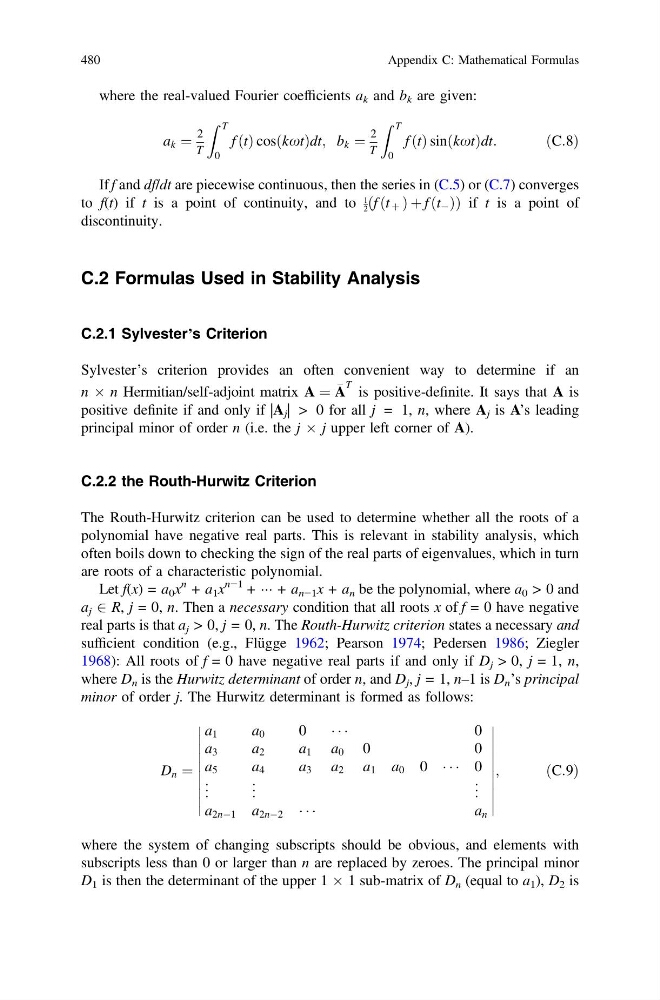
D n ¼
a 1
a 0
0
Á Á Á
0
a 3
a 2
a 1 a 0 0
0
a 5
a 4
a 3 a 2 a 1 a 0 0 Á Á Á 0
. .
.
. .
.
. .
.
a 2nÀ1 a 2nÀ2 Á Á Á
a n
;
ðC:9Þ
where the system of changing subscripts should be obvious, and elements with
subscripts less than 0 or larger than n are replaced by zeroes. The principal minor
D 1 is then the determinant of the upper 1 Â 1 sub-matrix of D n (equal to a 1 ), D 2 is
480
Appendix C: Mathematical Formulas
a k ¼
2
T
Z T
0
f ðtÞ cosðkxtÞdt; b k ¼
2
T
Z T
0
f ðtÞ sinðkxtÞdt:
ðC:8Þ
If f and df/dt are piecewise continuous, then the series in (C.5) or (C.7) converges
to f(t) if t is a point of continuity, and to
1
2 ðf ðt þ Þ þ f ðt À ÞÞ if t is a point of
discontinuity.
C.2 Formulas Used in Stability Analysis
C.2.1 Sylvester’s Criterion
Sylvester’s criterion provides an often convenient way to determine if an
n  n Hermitian/self-adjoint matrix A ¼
A
T is positive-definite. It says that A is
positive definite if and only if |A j | > 0 for all j = 1, n, where A j is A’s leading
principal minor of order n (i.e. the j  j upper left corner of A).
C.2.2 the Routh-Hurwitz Criterion
The Routh-Hurwitz criterion can be used to determine whether all the roots of a
polynomial have negative real parts. This is relevant in stability analysis, which
often boils down to checking the sign of the real parts of eigenvalues, which in turn
are roots of a characteristic polynomial.
Let f(x) = a 0 x
n + a 1 x
n−1 + ÁÁÁ + a n−1 x + a n be the polynomial, where a 0 > 0 and
a j 2 R, j = 0, n. Then a necessary condition that all roots x of f = 0 have negative
real parts is that a j > 0, j = 0, n. The Routh-Hurwitz criterion states a necessary and
sufficient condition (e.g., Flügge 1962; Pearson 1974; Pedersen 1986; Ziegler
1968): All roots of f = 0 have negative real parts if and only if D j > 0, j = 1, n,
where D n is the Hurwitz determinant of order n, and D j , j = 1, n–1 is D n ’s principal
minor of order j. The Hurwitz determinant is formed as follows:
D n ¼
a 1
a 0
0
Á Á Á
0
a 3
a 2
a 1 a 0 0
0
a 5
a 4
a 3 a 2 a 1 a 0 0 Á Á Á 0
. .
.
. .
.
. .
.
a 2nÀ1 a 2nÀ2 Á Á Á
a n
;
ðC:9Þ
where the system of changing subscripts should be obvious, and elements with
subscripts less than 0 or larger than n are replaced by zeroes. The principal minor
D 1 is then the determinant of the upper 1 Â 1 sub-matrix of D n (equal to a 1 ), D 2 is
480
Appendix C: Mathematical Formulas