

c) Compute the Rayleigh quotients R[u j ] for the test functions u j = sin(jpx), j = 1,
2, …
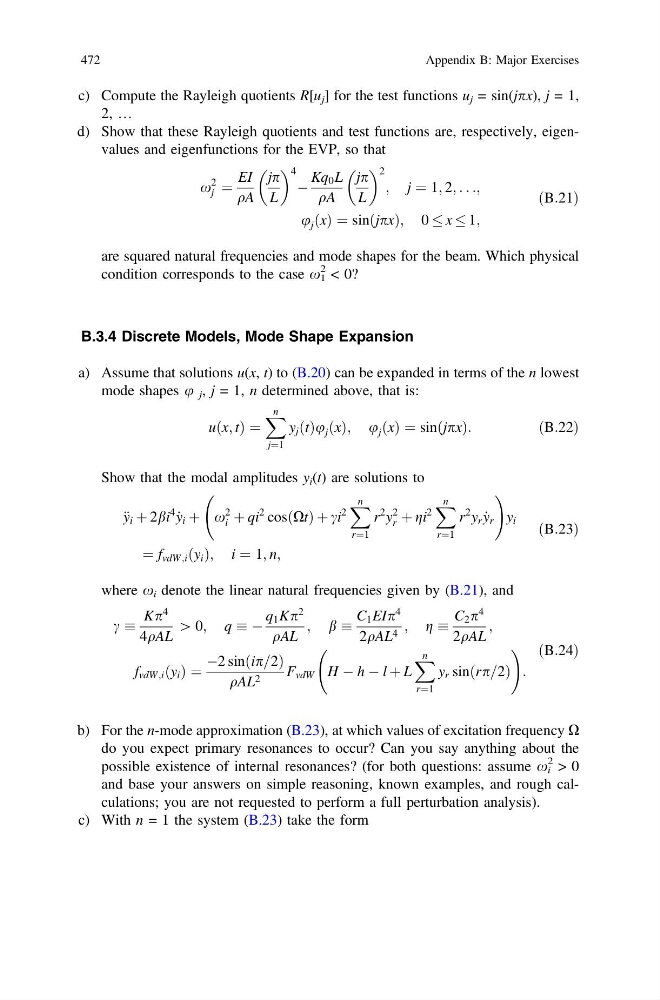
d) Show that these Rayleigh quotients and test functions are, respectively, eigenvalues and eigenfunctions for the EVP, so that
x
2
j ¼
EI
qA
jp
L
4
À
Kq 0 L
qA
jp
L
2
; j ¼ 1; 2; . . .;
u j ðxÞ ¼ sinðjpxÞ; 0 x 1;
ðB:21Þ
are squared natural frequencies and mode shapes for the beam. Which physical
condition corresponds to the case x 1
2 < 0?
B.3.4 Discrete Models, Mode Shape Expansion
a) Assume that solutions u(x, t) to (B.20) can be expanded in terms of the n lowest
mode shapes u j , j = 1, n determined above, that is:
uðx; tÞ ¼
X n
j¼1
y j ðtÞu j ðxÞ; u j ðxÞ ¼ sinðjpxÞ:
ðB:22Þ
Show that the modal amplitudes y i (t) are solutions to
€ y i þ 2bi
4
_
y i þ x
2
i þ qi
2 cosðXtÞ þ ci
2
X n
r¼1
r
2 y
2
r þ gi
2
X n
r¼1
r
2 y r _
y r
!
y i
¼ f vdW;i ðy i Þ; i ¼ 1; n;
ðB:23Þ
where x i denote the linear natural frequencies given by (B.21), and
c
Kp
4
4qAL
[ 0; q À
q 1 Kp
2
qAL
; b
C 1 EIp
4
2qAL 4 ; g
C 2 p
4
2qAL
;
f vdW;i ðy i Þ ¼
À2 sin ip=2
ð
Þ
qAL 2
F vdW H À h À l þ L
X n
r¼1
y r sin rp=2
ð
Þ
!
:
ðB:24Þ
b) For the n-mode approximation (B.23), at which values of excitation frequency X
do you expect primary resonances to occur? Can you say anything about the
possible existence of internal resonances? (for both questions: assume x i
2 > 0
and base your answers on simple reasoning, known examples, and rough calculations; you are not requested to perform a full perturbation analysis).
c) With n = 1 the system (B.23) take the form
472
Appendix B: Major Exercises
2, …
d) Show that these Rayleigh quotients and test functions are, respectively, eigenvalues and eigenfunctions for the EVP, so that
x
2
j ¼
EI
qA
jp
L
4
À
Kq 0 L
qA
jp
L
2
; j ¼ 1; 2; . . .;
u j ðxÞ ¼ sinðjpxÞ; 0 x 1;
ðB:21Þ
are squared natural frequencies and mode shapes for the beam. Which physical
condition corresponds to the case x 1
2 < 0?
B.3.4 Discrete Models, Mode Shape Expansion
a) Assume that solutions u(x, t) to (B.20) can be expanded in terms of the n lowest
mode shapes u j , j = 1, n determined above, that is:
uðx; tÞ ¼
X n
j¼1
y j ðtÞu j ðxÞ; u j ðxÞ ¼ sinðjpxÞ:
ðB:22Þ
Show that the modal amplitudes y i (t) are solutions to
€ y i þ 2bi
4
_
y i þ x
2
i þ qi
2 cosðXtÞ þ ci
2
X n
r¼1
r
2 y
2
r þ gi
2
X n
r¼1
r
2 y r _
y r
!
y i
¼ f vdW;i ðy i Þ; i ¼ 1; n;
ðB:23Þ
where x i denote the linear natural frequencies given by (B.21), and
c
Kp
4
4qAL
[ 0; q À
q 1 Kp
2
qAL
; b
C 1 EIp
4
2qAL 4 ; g
C 2 p
4
2qAL
;
f vdW;i ðy i Þ ¼
À2 sin ip=2
ð
Þ
qAL 2
F vdW H À h À l þ L
X n
r¼1
y r sin rp=2
ð
Þ
!
:
ðB:24Þ
b) For the n-mode approximation (B.23), at which values of excitation frequency X
do you expect primary resonances to occur? Can you say anything about the
possible existence of internal resonances? (for both questions: assume x i
2 > 0
and base your answers on simple reasoning, known examples, and rough calculations; you are not requested to perform a full perturbation analysis).
c) With n = 1 the system (B.23) take the form
472
Appendix B: Major Exercises