

possibilities, the proposal involves coupling the moveable beam support to the fixed
boundary through a linear viscous damper with coefficient C 2 .
The AFM tip at the middle of the beam has negligible mass (( qAL) and length
l, and has instantaneous distance d(t) above the actual scan point of the sample (this
corresponds to the distance the outer atoms of the tip can be moved before experiencing strong “contacting” interaction forces with the atoms of sample, cf.
Fig. B.5. The sample to be scanned is positioned on a base a distance H beneath the
beam base. Using piezoelectric linear drives the AFM adjusts this distance all the
time, however, at a rate that can be considered quasi-static as compared to the rapid
vibrations of the beam. Thus, ignoring small horizontal movements of the tip due to
beam bending, the tip-to-sample distance is d(t) = U(L/2, t) + H − h − l.
B.3.2 Mathematical Model
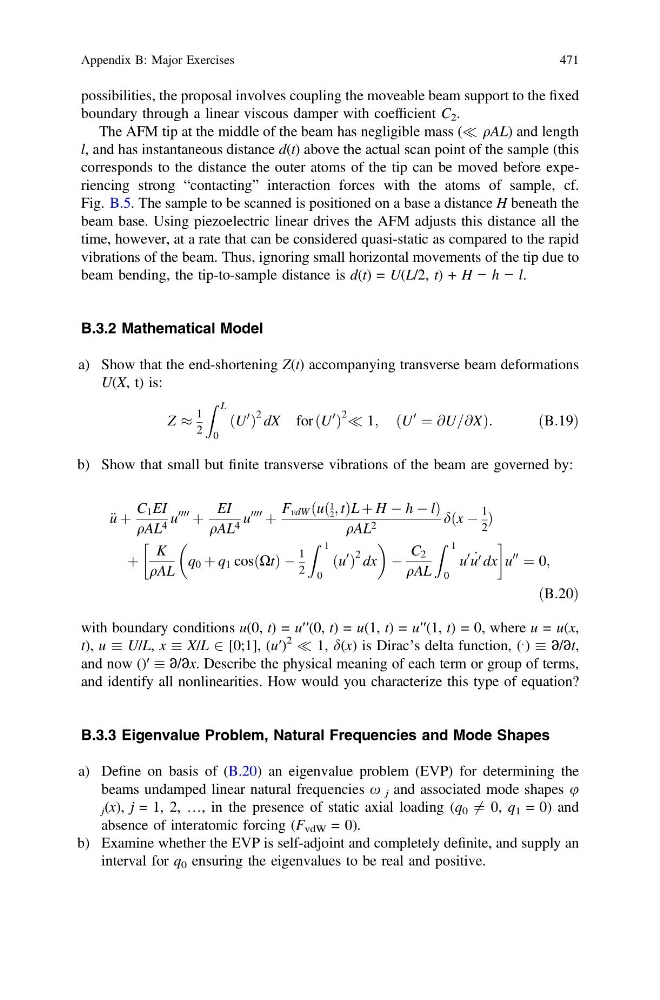
a) Show that the end-shortening Z(t) accompanying transverse beam deformations
U(X, t) is:
Z %
1
2
Z L
0
U
0
ð Þ
2 dX for U
0
ð Þ
2 ( 1; ðU
0
¼ @U=@XÞ:
ðB:19Þ
b) Show that small but finite transverse vibrations of the beam are governed by:
€ u þ
C 1 EI
qAL 4 u
0000
þ
EI
qAL 4 u
0000
þ
F vdW uð
1
2 ; tÞL þ H À h À l
ð
Þ
qAL 2
dðx À
1
2
Þ
þ
K
qAL
q 0 þ q 1 cosðXtÞ À
1
2
Z 1
0
u
0
ð Þ
2 dx
À
C 2
qAL
Z 1
0
u
0 _
u 0 dx
!
u
00
¼ 0;
ðB:20Þ
with boundary conditions u(0, t) = u′′(0, t) = u(1, t) = u′′(1, t) = 0, where u = u(x,
t), u U/L, x X/L 2 [0;1], (u′)
2
( 1, d(x) is Dirac’s delta function, (
: ) ∂/∂t,
and now ()′ ∂/∂x. Describe the physical meaning of each term or group of terms,
and identify all nonlinearities. How would you characterize this type of equation?
B.3.3 Eigenvalue Problem, Natural Frequencies and Mode Shapes
a) Define on basis of (B.20) an eigenvalue problem (EVP) for determining the
beams undamped linear natural frequencies x j and associated mode shapes u
j (x), j = 1, 2, …, in the presence of static axial loading (q 0 6 ¼ 0, q 1 = 0) and
absence of interatomic forcing (F vdW = 0).
b) Examine whether the EVP is self-adjoint and completely definite, and supply an
interval for q 0 ensuring the eigenvalues to be real and positive.
Appendix B: Major Exercises
471
boundary through a linear viscous damper with coefficient C 2 .
The AFM tip at the middle of the beam has negligible mass (( qAL) and length
l, and has instantaneous distance d(t) above the actual scan point of the sample (this
corresponds to the distance the outer atoms of the tip can be moved before experiencing strong “contacting” interaction forces with the atoms of sample, cf.
Fig. B.5. The sample to be scanned is positioned on a base a distance H beneath the
beam base. Using piezoelectric linear drives the AFM adjusts this distance all the
time, however, at a rate that can be considered quasi-static as compared to the rapid
vibrations of the beam. Thus, ignoring small horizontal movements of the tip due to
beam bending, the tip-to-sample distance is d(t) = U(L/2, t) + H − h − l.
B.3.2 Mathematical Model
a) Show that the end-shortening Z(t) accompanying transverse beam deformations
U(X, t) is:
Z %
1
2
Z L
0
U
0
ð Þ
2 dX for U
0
ð Þ
2 ( 1; ðU
0
¼ @U=@XÞ:
ðB:19Þ
b) Show that small but finite transverse vibrations of the beam are governed by:
€ u þ
C 1 EI
qAL 4 u
0000
þ
EI
qAL 4 u
0000
þ
F vdW uð
1
2 ; tÞL þ H À h À l
ð
Þ
qAL 2
dðx À
1
2
Þ
þ
K
qAL
q 0 þ q 1 cosðXtÞ À
1
2
Z 1
0
u
0
ð Þ
2 dx
À
C 2
qAL
Z 1
0
u
0 _
u 0 dx
!
u
00
¼ 0;
ðB:20Þ
with boundary conditions u(0, t) = u′′(0, t) = u(1, t) = u′′(1, t) = 0, where u = u(x,
t), u U/L, x X/L 2 [0;1], (u′)
2
( 1, d(x) is Dirac’s delta function, (
: ) ∂/∂t,
and now ()′ ∂/∂x. Describe the physical meaning of each term or group of terms,
and identify all nonlinearities. How would you characterize this type of equation?
B.3.3 Eigenvalue Problem, Natural Frequencies and Mode Shapes
a) Define on basis of (B.20) an eigenvalue problem (EVP) for determining the
beams undamped linear natural frequencies x j and associated mode shapes u
j (x), j = 1, 2, …, in the presence of static axial loading (q 0 6 ¼ 0, q 1 = 0) and
absence of interatomic forcing (F vdW = 0).
b) Examine whether the EVP is self-adjoint and completely definite, and supply an
interval for q 0 ensuring the eigenvalues to be real and positive.
Appendix B: Major Exercises
471