

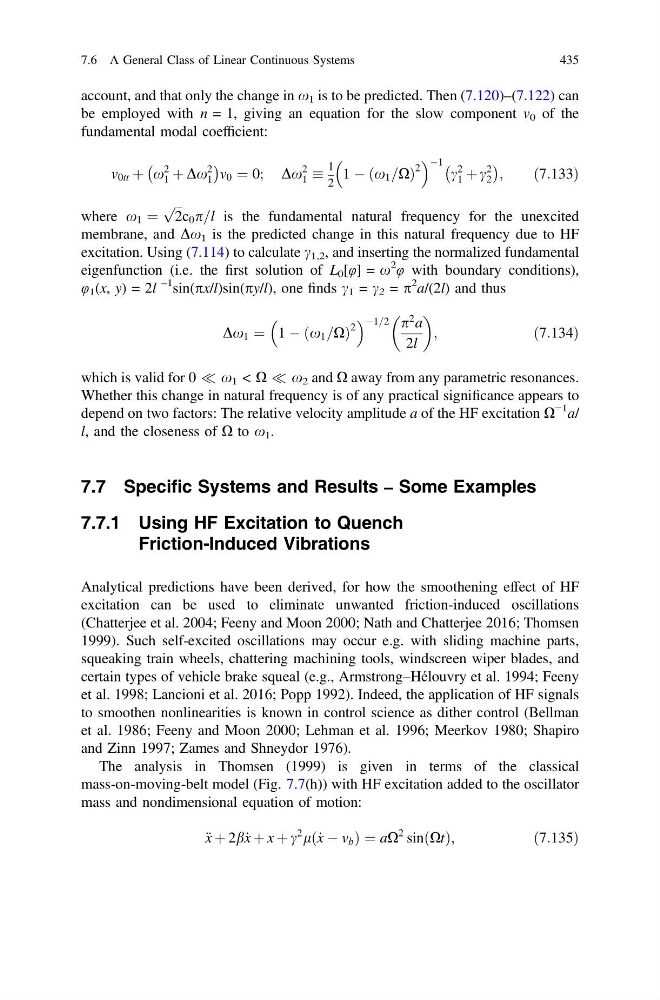
account, and that only the change in x 1 is to be predicted. Then (7.120)–(7.122) can
be employed with n = 1, giving an equation for the slow component v 0 of the
fundamental modal coefficient:
v 0tt þ x
2
1 þ Dx
2
1
À
Á
v 0 ¼ 0; Dx
2
1
1
2
1 À ðx 1 =XÞ
2
À1
c
2
1 þ c
2
2
À
Á ;
ð7:133Þ
where x 1 ¼
ffiffi ffi
2
p
c 0 p=l is the fundamental natural frequency for the unexcited
membrane, and Dx 1 is the predicted change in this natural frequency due to HF
excitation. Using (7.114) to calculate c 1,2 , and inserting the normalized fundamental
eigenfunction (i.e. the first solution of L 0 [φ] = x
2
φ with boundary conditions),
φ 1 (x, y) = 2l
–1 sin(px/l)sin(py/l), one finds c 1 = c 2 = p
2 a/(2l) and thus
Dx 1 ¼ 1 À ðx 1 =XÞ
2
À1=2 p
2 a
2l
;
ð7:134Þ
which is valid for 0 ( x 1 < X ( x 2 and X away from any parametric resonances.
Whether this change in natural frequency is of any practical significance appears to
depend on two factors: The relative velocity amplitude a of the HF excitation X
−1 a/
l, and the closeness of X to x 1 .
7.7 Specific Systems and Results – Some Examples
7.7.1 Using HF Excitation to Quench
Friction-Induced Vibrations
Analytical predictions have been derived, for how the smoothening effect of HF
excitation can be used to eliminate unwanted friction-induced oscillations
(Chatterjee et al. 2004; Feeny and Moon 2000; Nath and Chatterjee 2016; Thomsen
1999). Such self-excited oscillations may occur e.g. with sliding machine parts,
squeaking train wheels, chattering machining tools, windscreen wiper blades, and
certain types of vehicle brake squeal (e.g., Armstrong–Hélouvry et al. 1994; Feeny
et al. 1998; Lancioni et al. 2016; Popp 1992). Indeed, the application of HF signals
to smoothen nonlinearities is known in control science as dither control (Bellman
et al. 1986; Feeny and Moon 2000; Lehman et al. 1996; Meerkov 1980; Shapiro
and Zinn 1997; Zames and Shneydor 1976).
The analysis in Thomsen (1999) is given in terms of the classical
mass-on-moving-belt model (Fig. 7.7(h)) with HF excitation added to the oscillator
mass and nondimensional equation of motion:
€ x þ 2b_ x þ x þ c
2 lð_ x À v b Þ ¼ aX
2 sinðXtÞ;
ð7:135Þ
7.6 A General Class of Linear Continuous Systems
435
be employed with n = 1, giving an equation for the slow component v 0 of the
fundamental modal coefficient:
v 0tt þ x
2
1 þ Dx
2
1
À
Á
v 0 ¼ 0; Dx
2
1
1
2
1 À ðx 1 =XÞ
2
À1
c
2
1 þ c
2
2
À
Á ;
ð7:133Þ
where x 1 ¼
ffiffi ffi
2
p
c 0 p=l is the fundamental natural frequency for the unexcited
membrane, and Dx 1 is the predicted change in this natural frequency due to HF
excitation. Using (7.114) to calculate c 1,2 , and inserting the normalized fundamental
eigenfunction (i.e. the first solution of L 0 [φ] = x
2
φ with boundary conditions),
φ 1 (x, y) = 2l
–1 sin(px/l)sin(py/l), one finds c 1 = c 2 = p
2 a/(2l) and thus
Dx 1 ¼ 1 À ðx 1 =XÞ
2
À1=2 p
2 a
2l
;
ð7:134Þ
which is valid for 0 ( x 1 < X ( x 2 and X away from any parametric resonances.
Whether this change in natural frequency is of any practical significance appears to
depend on two factors: The relative velocity amplitude a of the HF excitation X
−1 a/
l, and the closeness of X to x 1 .
7.7 Specific Systems and Results – Some Examples
7.7.1 Using HF Excitation to Quench
Friction-Induced Vibrations
Analytical predictions have been derived, for how the smoothening effect of HF
excitation can be used to eliminate unwanted friction-induced oscillations
(Chatterjee et al. 2004; Feeny and Moon 2000; Nath and Chatterjee 2016; Thomsen
1999). Such self-excited oscillations may occur e.g. with sliding machine parts,
squeaking train wheels, chattering machining tools, windscreen wiper blades, and
certain types of vehicle brake squeal (e.g., Armstrong–Hélouvry et al. 1994; Feeny
et al. 1998; Lancioni et al. 2016; Popp 1992). Indeed, the application of HF signals
to smoothen nonlinearities is known in control science as dither control (Bellman
et al. 1986; Feeny and Moon 2000; Lehman et al. 1996; Meerkov 1980; Shapiro
and Zinn 1997; Zames and Shneydor 1976).
The analysis in Thomsen (1999) is given in terms of the classical
mass-on-moving-belt model (Fig. 7.7(h)) with HF excitation added to the oscillator
mass and nondimensional equation of motion:
€ x þ 2b_ x þ x þ c
2 lð_ x À v b Þ ¼ aX
2 sinðXtÞ;
ð7:135Þ
7.6 A General Class of Linear Continuous Systems
435