

where x is the position of the mass, c
2 a measure of the normal load, b the damping
ratio, v b the belt speed, X ) 1 the HF excitation frequency, and a ( 1 its displacement amplitude. The friction coefficient l versus sliding velocity v r is:
lðv r Þ ¼ l s sgnðv r Þ À
3
2
ðl s À l m Þ v r =v m À
1
3
v r =v m
ð
Þ
3
;
ð7:136Þ
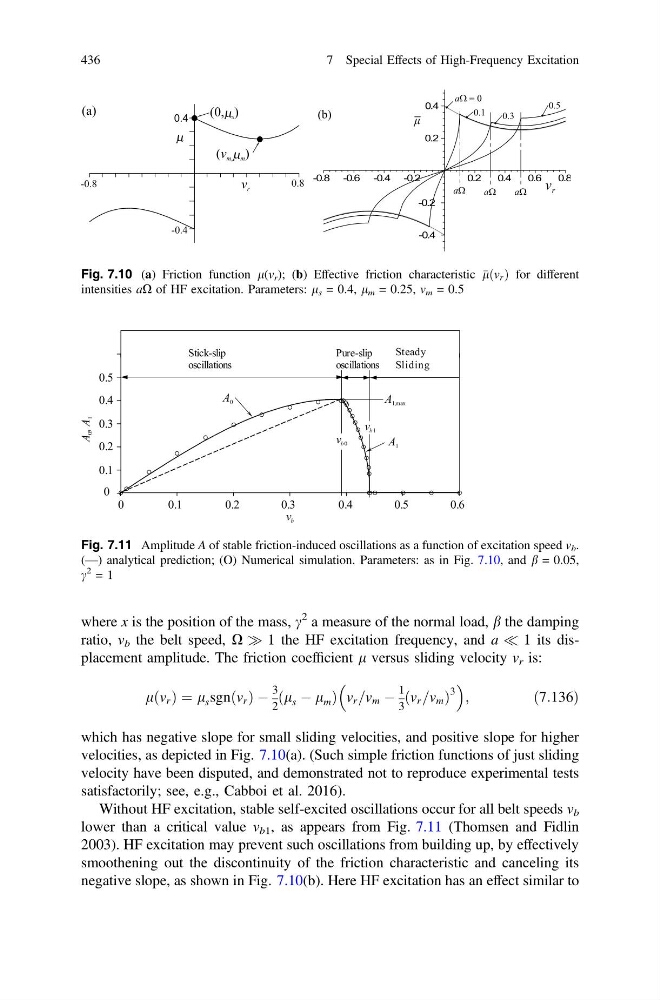
which has negative slope for small sliding velocities, and positive slope for higher
velocities, as depicted in Fig. 7.10(a). (Such simple friction functions of just sliding
velocity have been disputed, and demonstrated not to reproduce experimental tests
satisfactorily; see, e.g., Cabboi et al. 2016).
Without HF excitation, stable self-excited oscillations occur for all belt speeds v b
lower than a critical value v b1 , as appears from Fig. 7.11 (Thomsen and Fidlin
2003). HF excitation may prevent such oscillations from building up, by effectively
smoothening out the discontinuity of the friction characteristic and canceling its
negative slope, as shown in Fig. 7.10(b). Here HF excitation has an effect similar to
Fig. 7.10 (a) Friction function l(v r ); (b) Effective friction characteristic
lðv r Þ for different
intensities aX of HF excitation. Parameters: l s = 0.4, l m = 0.25, v m = 0.5
Fig. 7.11 Amplitude A of stable friction-induced oscillations as a function of excitation speed v b .
(—) analytical prediction; (O) Numerical simulation. Parameters: as in Fig. 7.10, and b = 0.05,
c
2 = 1
436
7 Special Effects of High-Frequency Excitation
2 a measure of the normal load, b the damping
ratio, v b the belt speed, X ) 1 the HF excitation frequency, and a ( 1 its displacement amplitude. The friction coefficient l versus sliding velocity v r is:
lðv r Þ ¼ l s sgnðv r Þ À
3
2
ðl s À l m Þ v r =v m À
1
3
v r =v m
ð
Þ
3
;
ð7:136Þ
which has negative slope for small sliding velocities, and positive slope for higher
velocities, as depicted in Fig. 7.10(a). (Such simple friction functions of just sliding
velocity have been disputed, and demonstrated not to reproduce experimental tests
satisfactorily; see, e.g., Cabboi et al. 2016).
Without HF excitation, stable self-excited oscillations occur for all belt speeds v b
lower than a critical value v b1 , as appears from Fig. 7.11 (Thomsen and Fidlin
2003). HF excitation may prevent such oscillations from building up, by effectively
smoothening out the discontinuity of the friction characteristic and canceling its
negative slope, as shown in Fig. 7.10(b). Here HF excitation has an effect similar to
Fig. 7.10 (a) Friction function l(v r ); (b) Effective friction characteristic
lðv r Þ for different
intensities aX of HF excitation. Parameters: l s = 0.4, l m = 0.25, v m = 0.5
Fig. 7.11 Amplitude A of stable friction-induced oscillations as a function of excitation speed v b .
(—) analytical prediction; (O) Numerical simulation. Parameters: as in Fig. 7.10, and b = 0.05,
c
2 = 1
436
7 Special Effects of High-Frequency Excitation