

deformations can be ignored, the boundary tension N 0 can be held approximately
constant and the equation of transverse motion becomes:
u tt À c
2
0 þ ðl À xÞXa sinðXtÞ
À
Á
u x
À
Á
x
À c
2
0 þ ðl À xÞXa cosðXtÞ
À
Á
u y
À
Á
y
¼ 0; ð7:130Þ
where c 0
2
N 0 /qh is a squared wave speed, and the boundary conditions are u(0, y,
t) = u(l, y, t) = u(x, 0, t) = u(x, l, t) = 0. This equation is of the form (7.102) with
N = 2, L c = 0, L 0 = − c 0
2 (() xx + () yy ), L 11 = −a((l − x)() x ) x , L 12 = –a((l − y)() y ) y ,
m 1 = m 2 = 1, w 1 = 0, w 2 = p/2, and f 0 = f 1 = 0.
The slow component u 0 of the far-from-resonance response is given by the
GNRP, for which application of (7.109)–(7.110) gives:
u 0tt þ
L 0 u 0
½ ¼ OðX
À1
Þ; X ) 1;
ð7:131Þ
where the effective stiffness operator
L 0 can be written:
L 0 ¼ L 0 þ
1
2
ðL
2
11 þ L
2
12 Þ
¼ Àc
2
0 ð Þ xx þ ð Þ yy
þ
1
2
a
2
ðl À xÞ
2 ð Þ xx
xx
þ ðl À yÞ
2 ð Þ yy
yy
!
:
ð7:132Þ
As appears, in the presence of HF excitation (a 6 ¼ 0) the membrane exhibits
bending-like stiffness (fourth order derivative terms) in addition to the stiffness
already provided by stretching (second order derivative terms). This in turn implies,
e.g., that more boundary conditions are required to solve for u 0 , and that traveling
waves will appear dispersive instead of non-dispersive.
The GARP is applicable to illustrate how the stiffness might be affected when
resonances cannot be ignored, as will typically be the case. For brevity we assume
here that 0 ( x 1 < X ( x 2 , so that only the first resonance needs to be taken into
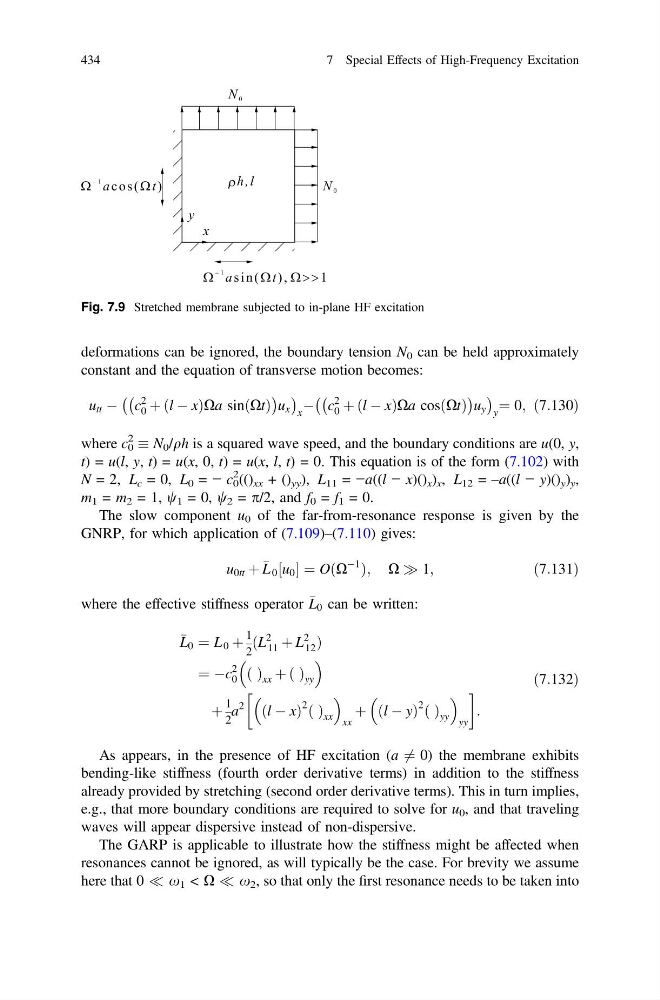
Fig. 7.9 Stretched membrane subjected to in-plane HF excitation
434
7 Special Effects of High-Frequency Excitation
constant and the equation of transverse motion becomes:
u tt À c
2
0 þ ðl À xÞXa sinðXtÞ
À
Á
u x
À
Á
x
À c
2
0 þ ðl À xÞXa cosðXtÞ
À
Á
u y
À
Á
y
¼ 0; ð7:130Þ
where c 0
2
N 0 /qh is a squared wave speed, and the boundary conditions are u(0, y,
t) = u(l, y, t) = u(x, 0, t) = u(x, l, t) = 0. This equation is of the form (7.102) with
N = 2, L c = 0, L 0 = − c 0
2 (() xx + () yy ), L 11 = −a((l − x)() x ) x , L 12 = –a((l − y)() y ) y ,
m 1 = m 2 = 1, w 1 = 0, w 2 = p/2, and f 0 = f 1 = 0.
The slow component u 0 of the far-from-resonance response is given by the
GNRP, for which application of (7.109)–(7.110) gives:
u 0tt þ
L 0 u 0
½ ¼ OðX
À1
Þ; X ) 1;
ð7:131Þ
where the effective stiffness operator
L 0 can be written:
L 0 ¼ L 0 þ
1
2
ðL
2
11 þ L
2
12 Þ
¼ Àc
2
0 ð Þ xx þ ð Þ yy
þ
1
2
a
2
ðl À xÞ
2 ð Þ xx
xx
þ ðl À yÞ
2 ð Þ yy
yy
!
:
ð7:132Þ
As appears, in the presence of HF excitation (a 6 ¼ 0) the membrane exhibits
bending-like stiffness (fourth order derivative terms) in addition to the stiffness
already provided by stretching (second order derivative terms). This in turn implies,
e.g., that more boundary conditions are required to solve for u 0 , and that traveling
waves will appear dispersive instead of non-dispersive.
The GARP is applicable to illustrate how the stiffness might be affected when
resonances cannot be ignored, as will typically be the case. For brevity we assume
here that 0 ( x 1 < X ( x 2 , so that only the first resonance needs to be taken into
Fig. 7.9 Stretched membrane subjected to in-plane HF excitation
434
7 Special Effects of High-Frequency Excitation