

effect of the HF excitation; this part drops off quadratically with x towards the string
tip. To an observer filtering out the small overlay of HF excitation, the additional
apparent stiffness caused by the HF excitation cannot be distinguished from real
structural stiffness with the equivalencing distribution.
Weakly resonant behavior is taken into account by using the GARP expressions
(7.120)–(7.122) to compute equations governing the slow component v 0 of the
modal coefficients v(t); the results become (see Thomsen 2003b for details):
v 0tt þ cv 0t þ x
2
þ Dx
2
À
Á v 0 ¼ Àgb;
ð7:128Þ
where x is a diagonal matrix holding the squared natural frequencies of the string,
b
f g i ¼
R l
0 u i dx
. R l
0 u
2
i dx where φ i (x) is the i’th mode shape, and the matrix Dx
2
describes the change in effective stiffness due to the HF excitation:
Dx
2
1
2
a
2
c I À X
À2
x
2
À
Á À1 c;
ð7:129Þ
where c
½ ij ¼
R l
0 ðl À xÞu ix u jx dx
. R l
0 u
2
i dx. Such expressions can be used directly
for predicting apparent changes in stiffness and related quantities, or along with
(7.112) (with u 0 substituted for u) to predict the slow component u 0 (x, t) of the
displacement field.
7.6.4 Example 2: Square Membrane with In-Plane HF
Excitation
Next we consider predicting the free transverse vibrations of a square membrane,
stretched in the (x, y) plane (Fig. 7.9). The membrane has density q and thickness h,
and is clamped along the boundary lines x = 0 and y = 0, while held with tension N 0
per unit length along the two other boundary lines x = l and y = l. The whole
arrangement is shaken in the plane, so that points on the clamped boundary lines
are translated at high angular frequency X along circular paths of small radius X
−1 a,
X ) 1, a = O(1). Assuming small out-of-plane vibrations u(x, y, t), so that in-plane
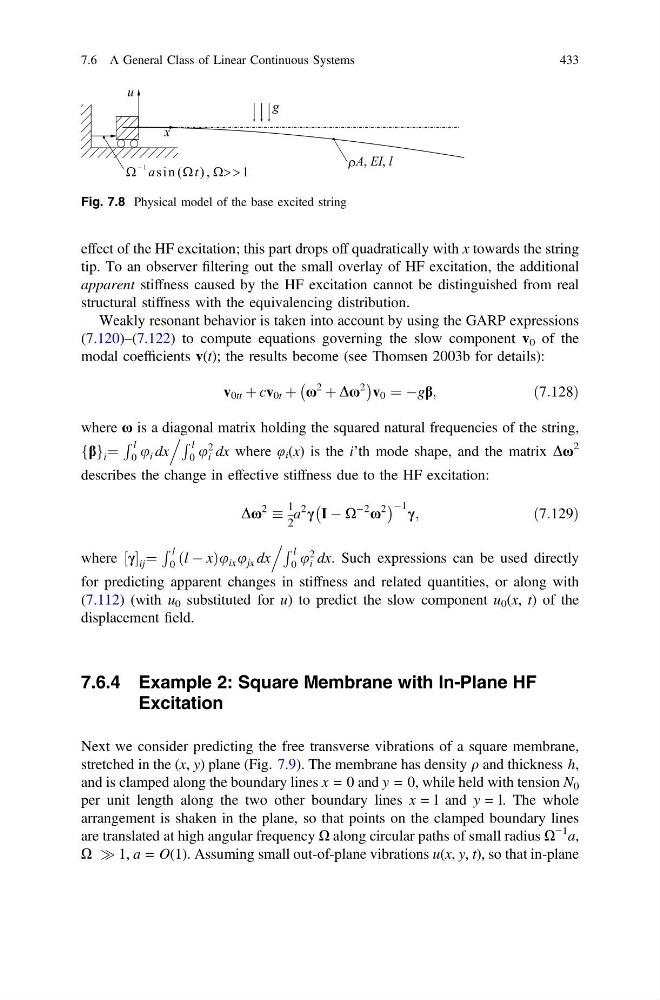
Fig. 7.8 Physical model of the base excited string
7.6 A General Class of Linear Continuous Systems
433
tip. To an observer filtering out the small overlay of HF excitation, the additional
apparent stiffness caused by the HF excitation cannot be distinguished from real
structural stiffness with the equivalencing distribution.
Weakly resonant behavior is taken into account by using the GARP expressions
(7.120)–(7.122) to compute equations governing the slow component v 0 of the
modal coefficients v(t); the results become (see Thomsen 2003b for details):
v 0tt þ cv 0t þ x
2
þ Dx
2
À
Á v 0 ¼ Àgb;
ð7:128Þ
where x is a diagonal matrix holding the squared natural frequencies of the string,
b
f g i ¼
R l
0 u i dx
. R l
0 u
2
i dx where φ i (x) is the i’th mode shape, and the matrix Dx
2
describes the change in effective stiffness due to the HF excitation:
Dx
2
1
2
a
2
c I À X
À2
x
2
À
Á À1 c;
ð7:129Þ
where c
½ ij ¼
R l
0 ðl À xÞu ix u jx dx
. R l
0 u
2
i dx. Such expressions can be used directly
for predicting apparent changes in stiffness and related quantities, or along with
(7.112) (with u 0 substituted for u) to predict the slow component u 0 (x, t) of the
displacement field.
7.6.4 Example 2: Square Membrane with In-Plane HF
Excitation
Next we consider predicting the free transverse vibrations of a square membrane,
stretched in the (x, y) plane (Fig. 7.9). The membrane has density q and thickness h,
and is clamped along the boundary lines x = 0 and y = 0, while held with tension N 0
per unit length along the two other boundary lines x = l and y = l. The whole
arrangement is shaken in the plane, so that points on the clamped boundary lines
are translated at high angular frequency X along circular paths of small radius X
−1 a,
X ) 1, a = O(1). Assuming small out-of-plane vibrations u(x, y, t), so that in-plane
Fig. 7.8 Physical model of the base excited string
7.6 A General Class of Linear Continuous Systems
433