

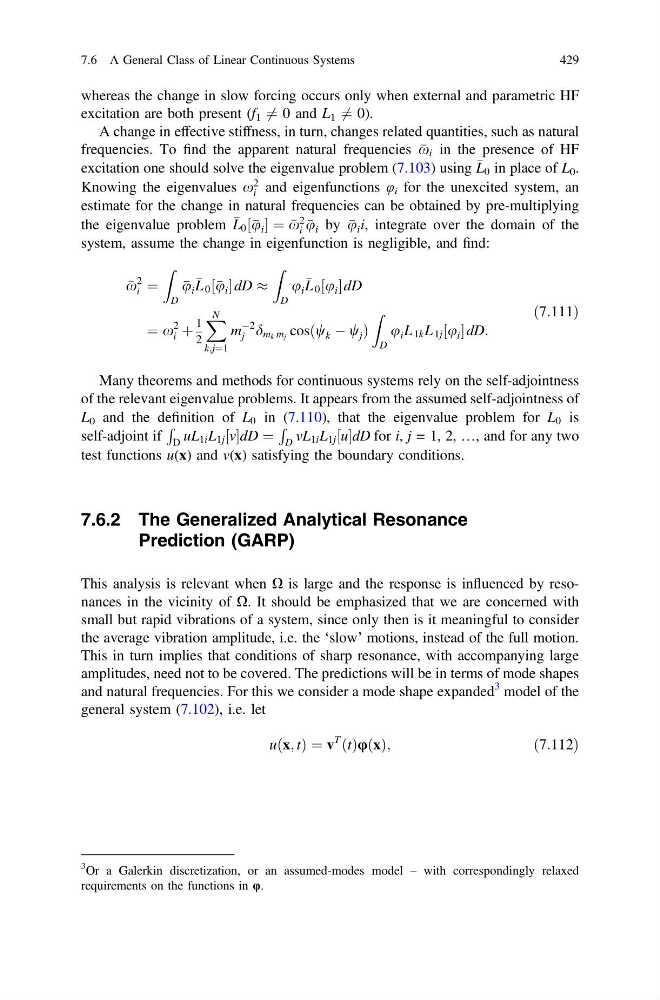
whereas the change in slow forcing occurs only when external and parametric HF
excitation are both present (f 1 6 ¼ 0 and L 1 6 ¼ 0).
A change in effective stiffness, in turn, changes related quantities, such as natural
frequencies. To find the apparent natural frequencies
x i in the presence of HF
excitation one should solve the eigenvalue problem (7.103) using
L 0 in place of L 0 .
Knowing the eigenvalues x
2
i and eigenfunctions φ i for the unexcited system, an
estimate for the change in natural frequencies can be obtained by pre-multiplying
the eigenvalue problem
L 0
u i
½ ¼
x
2
i
u i by
u i i, integrate over the domain of the
system, assume the change in eigenfunction is negligible, and find:
x
2
i ¼
Z
D
u i
L 0
u i
½ dD %
Z
D
u i
L 0 u i
½ dD
¼ x
2
i þ
1
2
X N
k;j¼1
m
À2
j d m k m j cosðw k À w j Þ
Z
D
u i L 1k L 1j u i
½ dD:
ð7:111Þ
Many theorems and methods for continuous systems rely on the self-adjointness
of the relevant eigenvalue problems. It appears from the assumed self-adjointness of
L 0 and the definition of
L 0 in (7.110), that the eigenvalue problem for
L 0 is
self-adjoint if
R
D uL 1i L 1j ½vdD ¼
R
D vL 1i L 1j ½udD for i, j = 1, 2, …, and for any two
test functions u(x) and v(x) satisfying the boundary conditions.
7.6.2 The Generalized Analytical Resonance
Prediction (GARP)
This analysis is relevant when X is large and the response is influenced by resonances in the vicinity of X. It should be emphasized that we are concerned with
small but rapid vibrations of a system, since only then is it meaningful to consider
the average vibration amplitude, i.e. the ‘slow’ motions, instead of the full motion.
This in turn implies that conditions of sharp resonance, with accompanying large
amplitudes, need not to be covered. The predictions will be in terms of mode shapes
and natural frequencies. For this we consider a mode shape expanded
3 model of the
general system (7.102), i.e. let
uðx; tÞ ¼ v
T
ðtÞuðxÞ;
ð7:112Þ
3
Or a Galerkin discretization, or an assumed-modes model – with correspondingly relaxed
requirements on the functions in φ.
7.6 A General Class of Linear Continuous Systems
429
excitation are both present (f 1 6 ¼ 0 and L 1 6 ¼ 0).
A change in effective stiffness, in turn, changes related quantities, such as natural
frequencies. To find the apparent natural frequencies
x i in the presence of HF
excitation one should solve the eigenvalue problem (7.103) using
L 0 in place of L 0 .
Knowing the eigenvalues x
2
i and eigenfunctions φ i for the unexcited system, an
estimate for the change in natural frequencies can be obtained by pre-multiplying
the eigenvalue problem
L 0
u i
½ ¼
x
2
i
u i by
u i i, integrate over the domain of the
system, assume the change in eigenfunction is negligible, and find:
x
2
i ¼
Z
D
u i
L 0
u i
½ dD %
Z
D
u i
L 0 u i
½ dD
¼ x
2
i þ
1
2
X N
k;j¼1
m
À2
j d m k m j cosðw k À w j Þ
Z
D
u i L 1k L 1j u i
½ dD:
ð7:111Þ
Many theorems and methods for continuous systems rely on the self-adjointness
of the relevant eigenvalue problems. It appears from the assumed self-adjointness of
L 0 and the definition of
L 0 in (7.110), that the eigenvalue problem for
L 0 is
self-adjoint if
R
D uL 1i L 1j ½vdD ¼
R
D vL 1i L 1j ½udD for i, j = 1, 2, …, and for any two
test functions u(x) and v(x) satisfying the boundary conditions.
7.6.2 The Generalized Analytical Resonance
Prediction (GARP)
This analysis is relevant when X is large and the response is influenced by resonances in the vicinity of X. It should be emphasized that we are concerned with
small but rapid vibrations of a system, since only then is it meaningful to consider
the average vibration amplitude, i.e. the ‘slow’ motions, instead of the full motion.
This in turn implies that conditions of sharp resonance, with accompanying large
amplitudes, need not to be covered. The predictions will be in terms of mode shapes
and natural frequencies. For this we consider a mode shape expanded
3 model of the
general system (7.102), i.e. let
uðx; tÞ ¼ v
T
ðtÞuðxÞ;
ð7:112Þ
3
Or a Galerkin discretization, or an assumed-modes model – with correspondingly relaxed
requirements on the functions in φ.
7.6 A General Class of Linear Continuous Systems
429