

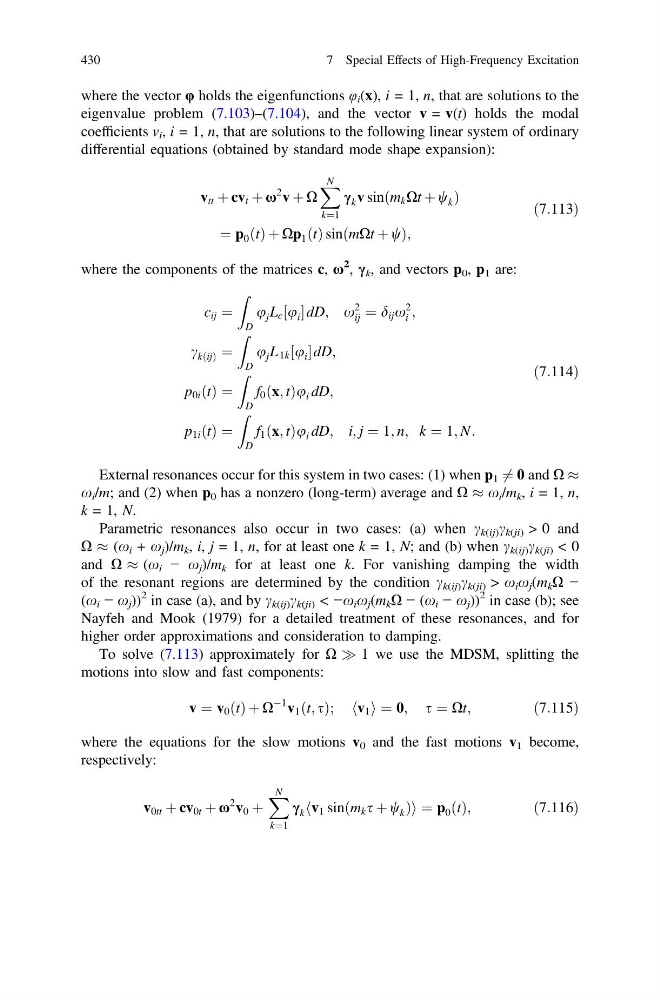
where the vector φ holds the eigenfunctions φ i (x), i = 1, n, that are solutions to the
eigenvalue problem (7.103)–(7.104), and the vector v = v(t) holds the modal
coefficients v i , i = 1, n, that are solutions to the following linear system of ordinary
differential equations (obtained by standard mode shape expansion):
v tt þ cv t þ x
2
v þ X
X N
k¼1
c k v sinðm k Xt þ w k Þ
¼ p 0 ðtÞ þ Xp 1 ðtÞ sinðmXt þ wÞ;
ð7:113Þ
where the components of the matrices c, x
2 , c k , and vectors p 0 , p 1 are:
c ij ¼
Z
D
u j L c u i
½ dD; x
2
ij ¼ d ij x
2
i ;
c kðijÞ ¼
Z
D
u j L 1k u i
½ dD;
p 0i ðtÞ ¼
Z
D
f 0 ðx; tÞu i dD;
p 1i ðtÞ ¼
Z
D
f 1 ðx; tÞu i dD; i; j ¼ 1; n; k ¼ 1; N:
ð7:114Þ
External resonances occur for this system in two cases: (1) when p 1 6 ¼ 0 and X %
x i /m; and (2) when p 0 has a nonzero (long-term) average and X % x i /m k , i = 1, n,
k = 1, N.
Parametric resonances also occur in two cases: (a) when c k(ij) c k(ji) > 0 and
X % (x i + x j )/m k , i, j = 1, n, for at least one k = 1, N; and (b) when c k(ij) c k(ji) < 0
and X % (x i − x j )/m k for at least one k. For vanishing damping the width
of the resonant regions are determined by the condition c k(ij) c k(ji) > x i x j (m k X −
(x i − x j ))
2 in case (a), and by c k(ij) c k(ji) < −x i x j (m k X − (x i − x j ))
2 in case (b); see
Nayfeh and Mook (1979) for a detailed treatment of these resonances, and for
higher order approximations and consideration to damping.
To solve (7.113) approximately for X ) 1 we use the MDSM, splitting the
motions into slow and fast components:
v ¼ v 0 ðtÞ þ X
À1
v 1 ðt; sÞ;
v 1
h i ¼ 0; s ¼ Xt;
ð7:115Þ
where the equations for the slow motions v 0 and the fast motions v 1 become,
respectively:
v 0tt þ cv 0t þ x
2
v 0 þ
X N
k¼1
c k v 1 sinðm k s þ w k Þ
h
i ¼ p 0 ðtÞ;
ð7:116Þ
430
7 Special Effects of High-Frequency Excitation
eigenvalue problem (7.103)–(7.104), and the vector v = v(t) holds the modal
coefficients v i , i = 1, n, that are solutions to the following linear system of ordinary
differential equations (obtained by standard mode shape expansion):
v tt þ cv t þ x
2
v þ X
X N
k¼1
c k v sinðm k Xt þ w k Þ
¼ p 0 ðtÞ þ Xp 1 ðtÞ sinðmXt þ wÞ;
ð7:113Þ
where the components of the matrices c, x
2 , c k , and vectors p 0 , p 1 are:
c ij ¼
Z
D
u j L c u i
½ dD; x
2
ij ¼ d ij x
2
i ;
c kðijÞ ¼
Z
D
u j L 1k u i
½ dD;
p 0i ðtÞ ¼
Z
D
f 0 ðx; tÞu i dD;
p 1i ðtÞ ¼
Z
D
f 1 ðx; tÞu i dD; i; j ¼ 1; n; k ¼ 1; N:
ð7:114Þ
External resonances occur for this system in two cases: (1) when p 1 6 ¼ 0 and X %
x i /m; and (2) when p 0 has a nonzero (long-term) average and X % x i /m k , i = 1, n,
k = 1, N.
Parametric resonances also occur in two cases: (a) when c k(ij) c k(ji) > 0 and
X % (x i + x j )/m k , i, j = 1, n, for at least one k = 1, N; and (b) when c k(ij) c k(ji) < 0
and X % (x i − x j )/m k for at least one k. For vanishing damping the width
of the resonant regions are determined by the condition c k(ij) c k(ji) > x i x j (m k X −
(x i − x j ))
2 in case (a), and by c k(ij) c k(ji) < −x i x j (m k X − (x i − x j ))
2 in case (b); see
Nayfeh and Mook (1979) for a detailed treatment of these resonances, and for
higher order approximations and consideration to damping.
To solve (7.113) approximately for X ) 1 we use the MDSM, splitting the
motions into slow and fast components:
v ¼ v 0 ðtÞ þ X
À1
v 1 ðt; sÞ;
v 1
h i ¼ 0; s ¼ Xt;
ð7:115Þ
where the equations for the slow motions v 0 and the fast motions v 1 become,
respectively:
v 0tt þ cv 0t þ x
2
v 0 þ
X N
k¼1
c k v 1 sinðm k s þ w k Þ
h
i ¼ p 0 ðtÞ;
ð7:116Þ
430
7 Special Effects of High-Frequency Excitation