

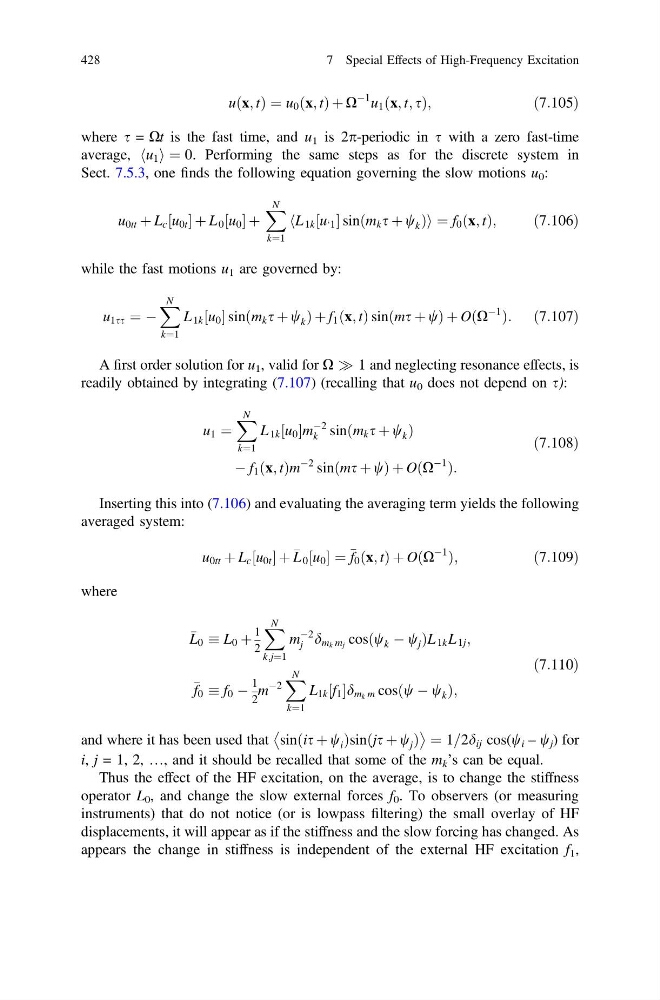
uðx; tÞ ¼ u 0 ðx; tÞ þ X
À1 u 1 ðx; t; sÞ;
ð7:105Þ
where s = Xt is the fast time, and u 1 is 2p-periodic in s with a zero fast-time
average, u 1
h i ¼ 0. Performing the same steps as for the discrete system in
Sect. 7.5.3, one finds the following equation governing the slow motions u 0 :
u 0tt þ L c u 0t
½ þL 0 u 0
½ þ
X N
k¼1
L 1k u ‘1
½ sinðm k s þ w k Þ
h
i ¼ f 0 ðx; tÞ;
ð7:106Þ
while the fast motions u 1 are governed by:
u 1ss ¼ À
X N
k¼1
L 1k u 0
½ sinðm k s þ w k Þ þ f 1 ðx; tÞ sinðms þ wÞ þ OðX
À1
Þ: ð7:107Þ
A first order solution for u 1 , valid for X ) 1 and neglecting resonance effects, is
readily obtained by integrating (7.107) (recalling that u 0 does not depend on s):
u 1 ¼
X N
k¼1
L 1k u 0
½ m
À2
k sinðm k s þ w k Þ
À f 1 ðx; tÞm
À2 sinðms þ wÞ þ OðX
À1
Þ:
ð7:108Þ
Inserting this into (7.106) and evaluating the averaging term yields the following
averaged system:
u 0tt þ L c u 0t
½ þ
L 0 u 0
½ ¼ f 0 ðx; tÞ þ OðX
À1
Þ;
ð7:109Þ
where
L 0 L 0 þ
1
2
X N
k;j¼1
m
À2
j d m k m j cosðw k À w j ÞL 1k L 1j ;
f 0 f 0 À
1
2
m
À2
X N
k¼1
L 1k f 1
½ d m k m cosðw À w k Þ;
ð7:110Þ
and where it has been used that sinðis þ w i Þsinðjs þ w j Þ
¼ 1=2d ij cos(w i – w j ) for
i, j = 1, 2, …, and it should be recalled that some of the m k ’s can be equal.
Thus the effect of the HF excitation, on the average, is to change the stiffness
operator L 0 , and change the slow external forces f 0 . To observers (or measuring
instruments) that do not notice (or is lowpass filtering) the small overlay of HF
displacements, it will appear as if the stiffness and the slow forcing has changed. As
appears the change in stiffness is independent of the external HF excitation f 1 ,
428
7 Special Effects of High-Frequency Excitation
À1 u 1 ðx; t; sÞ;
ð7:105Þ
where s = Xt is the fast time, and u 1 is 2p-periodic in s with a zero fast-time
average, u 1
h i ¼ 0. Performing the same steps as for the discrete system in
Sect. 7.5.3, one finds the following equation governing the slow motions u 0 :
u 0tt þ L c u 0t
½ þL 0 u 0
½ þ
X N
k¼1
L 1k u ‘1
½ sinðm k s þ w k Þ
h
i ¼ f 0 ðx; tÞ;
ð7:106Þ
while the fast motions u 1 are governed by:
u 1ss ¼ À
X N
k¼1
L 1k u 0
½ sinðm k s þ w k Þ þ f 1 ðx; tÞ sinðms þ wÞ þ OðX
À1
Þ: ð7:107Þ
A first order solution for u 1 , valid for X ) 1 and neglecting resonance effects, is
readily obtained by integrating (7.107) (recalling that u 0 does not depend on s):
u 1 ¼
X N
k¼1
L 1k u 0
½ m
À2
k sinðm k s þ w k Þ
À f 1 ðx; tÞm
À2 sinðms þ wÞ þ OðX
À1
Þ:
ð7:108Þ
Inserting this into (7.106) and evaluating the averaging term yields the following
averaged system:
u 0tt þ L c u 0t
½ þ
L 0 u 0
½ ¼ f 0 ðx; tÞ þ OðX
À1
Þ;
ð7:109Þ
where
L 0 L 0 þ
1
2
X N
k;j¼1
m
À2
j d m k m j cosðw k À w j ÞL 1k L 1j ;
f 0 f 0 À
1
2
m
À2
X N
k¼1
L 1k f 1
½ d m k m cosðw À w k Þ;
ð7:110Þ
and where it has been used that sinðis þ w i Þsinðjs þ w j Þ
¼ 1=2d ij cos(w i – w j ) for
i, j = 1, 2, …, and it should be recalled that some of the m k ’s can be equal.
Thus the effect of the HF excitation, on the average, is to change the stiffness
operator L 0 , and change the slow external forces f 0 . To observers (or measuring
instruments) that do not notice (or is lowpass filtering) the small overlay of HF
displacements, it will appear as if the stiffness and the slow forcing has changed. As
appears the change in stiffness is independent of the external HF excitation f 1 ,
428
7 Special Effects of High-Frequency Excitation