

variations. The two HF excitation terms are written with X as a factor, to indicate they
are assumed to be “strong”. Specifying the excitation in terms of harmonic time
functions implies that the following results will appear much more transparent than if
generalized time functions were used. Still, quite general time functions can be
described for the parametric excitation in (7.102), by using the sum to describe a
Fourier expansion of the time function. The system description is completed by
specifying initial conditions u(x, 0) and u t (x, 0), and linear homogeneous boundary
conditions B r [u] = 0, r = 1, …, 2q for x 2 ∂D r , where ∂D r ∂D denote parts of the
boundary of D, q is the order of (7.102), and B r contain spatial derivatives of order 0
through q − 1. The extension to the multivariable case can be performed by replacing
the scalar functions u, f 0 , and f 1 with suitable vectors, and is thus trivial.
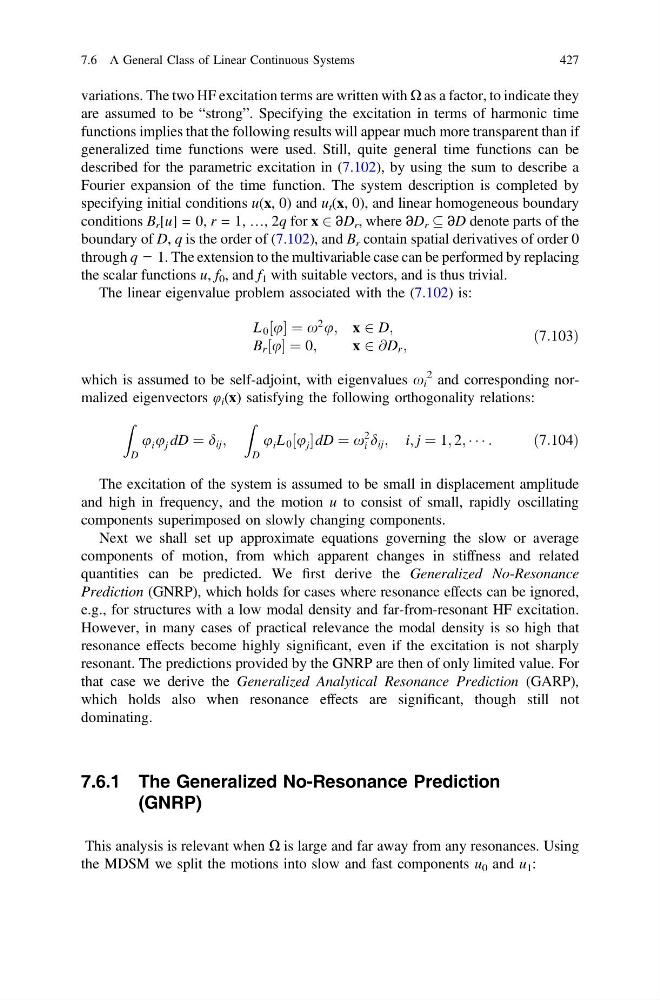
The linear eigenvalue problem associated with the (7.102) is:
L 0 ½u ¼ x
2 u; x 2 D;
B r ½u ¼ 0;
x 2 @D r ;
ð7:103Þ
which is assumed to be self-adjoint, with eigenvalues x i
2 and corresponding normalized eigenvectors φ i (x) satisfying the following orthogonality relations:
Z
D
u i u j dD ¼ d ij ;
Z
D
u i L 0 ½u j dD ¼ x
2
i d ij ; i; j ¼ 1; 2; Á Á Á :
ð7:104Þ
The excitation of the system is assumed to be small in displacement amplitude
and high in frequency, and the motion u to consist of small, rapidly oscillating
components superimposed on slowly changing components.
Next we shall set up approximate equations governing the slow or average
components of motion, from which apparent changes in stiffness and related
quantities can be predicted. We first derive the Generalized No-Resonance
Prediction (GNRP), which holds for cases where resonance effects can be ignored,
e.g., for structures with a low modal density and far-from-resonant HF excitation.
However, in many cases of practical relevance the modal density is so high that
resonance effects become highly significant, even if the excitation is not sharply
resonant. The predictions provided by the GNRP are then of only limited value. For
that case we derive the Generalized Analytical Resonance Prediction (GARP),
which holds also when resonance effects are significant, though still not
dominating.
7.6.1 The Generalized No-Resonance Prediction
(GNRP)
This analysis is relevant when X is large and far away from any resonances. Using
the MDSM we split the motions into slow and fast components u 0 and u 1 :
7.6 A General Class of Linear Continuous Systems
427
are assumed to be “strong”. Specifying the excitation in terms of harmonic time
functions implies that the following results will appear much more transparent than if
generalized time functions were used. Still, quite general time functions can be
described for the parametric excitation in (7.102), by using the sum to describe a
Fourier expansion of the time function. The system description is completed by
specifying initial conditions u(x, 0) and u t (x, 0), and linear homogeneous boundary
conditions B r [u] = 0, r = 1, …, 2q for x 2 ∂D r , where ∂D r ∂D denote parts of the
boundary of D, q is the order of (7.102), and B r contain spatial derivatives of order 0
through q − 1. The extension to the multivariable case can be performed by replacing
the scalar functions u, f 0 , and f 1 with suitable vectors, and is thus trivial.
The linear eigenvalue problem associated with the (7.102) is:
L 0 ½u ¼ x
2 u; x 2 D;
B r ½u ¼ 0;
x 2 @D r ;
ð7:103Þ
which is assumed to be self-adjoint, with eigenvalues x i
2 and corresponding normalized eigenvectors φ i (x) satisfying the following orthogonality relations:
Z
D
u i u j dD ¼ d ij ;
Z
D
u i L 0 ½u j dD ¼ x
2
i d ij ; i; j ¼ 1; 2; Á Á Á :
ð7:104Þ
The excitation of the system is assumed to be small in displacement amplitude
and high in frequency, and the motion u to consist of small, rapidly oscillating
components superimposed on slowly changing components.
Next we shall set up approximate equations governing the slow or average
components of motion, from which apparent changes in stiffness and related
quantities can be predicted. We first derive the Generalized No-Resonance
Prediction (GNRP), which holds for cases where resonance effects can be ignored,
e.g., for structures with a low modal density and far-from-resonant HF excitation.
However, in many cases of practical relevance the modal density is so high that
resonance effects become highly significant, even if the excitation is not sharply
resonant. The predictions provided by the GNRP are then of only limited value. For
that case we derive the Generalized Analytical Resonance Prediction (GARP),
which holds also when resonance effects are significant, though still not
dominating.
7.6.1 The Generalized No-Resonance Prediction
(GNRP)
This analysis is relevant when X is large and far away from any resonances. Using
the MDSM we split the motions into slow and fast components u 0 and u 1 :
7.6 A General Class of Linear Continuous Systems
427