

7.5.10 Effects of Strong Damping
With vibrating systems damping is typically rather low; otherwise the vibration
level would be too low to be of concern, or useful. But in some cases damping is
inherently strong, e.g. with controlled structures (velocity feedback effectively acts
as damping), and for micro/nano systems (the relative significance of damping
increase with downsizing). With additional HF excitation nontrivial effects show
up, of which the most important seems to be a change of equilibrium state with the
level of damping (Fidlin and Thomsen 2007). For example, a strongly damped
pendulum, with a hinge vibrated at high frequency along an elliptical path, will line
up along a line offset from the vertical; the offset vanishes for very light or very
strong damping, attaining a maximum that can be substantial, depending on the
strength of the HF excitation. Such an effect could provide a key for explaining
several experimental observations of effects of microwave radiation on large
molecules (like proteins) and nanostructures in solvents.
7.6 A General Class of Linear Continuous Systems
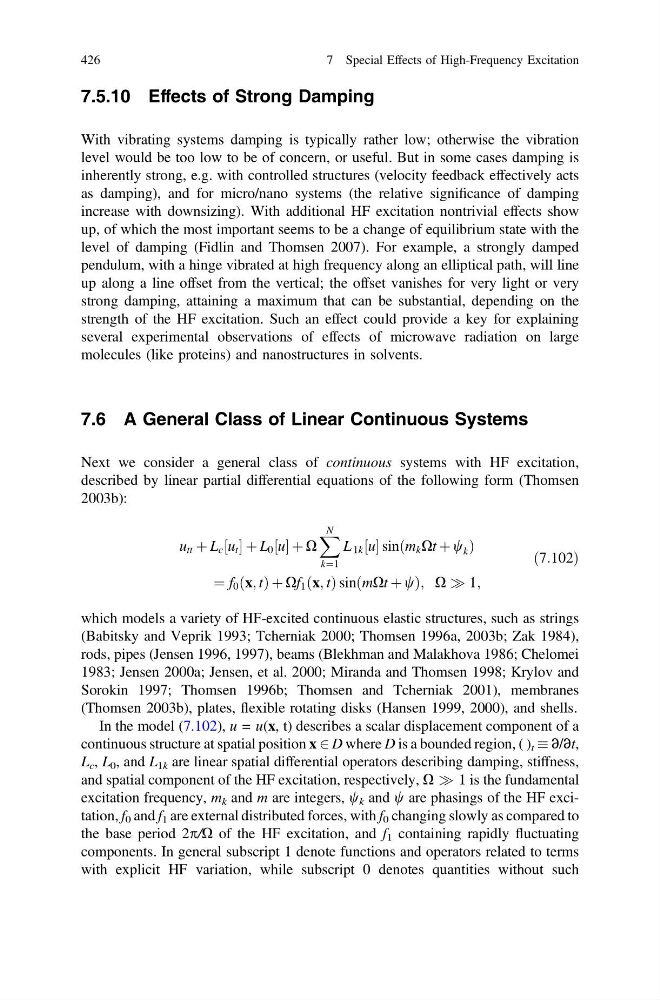
Next we consider a general class of continuous systems with HF excitation,
described by linear partial differential equations of the following form (Thomsen
2003b):
u tt þ L c u t
½ þL 0 u
½ þ X
X N
k¼1
L 1k u
½ sinðm k Xt þ w k Þ
¼ f 0 ðx; tÞ þ Xf 1 ðx; tÞ sinðmXt þ wÞ; X ) 1;
ð7:102Þ
which models a variety of HF-excited continuous elastic structures, such as strings
(Babitsky and Veprik 1993; Tcherniak 2000; Thomsen 1996a, 2003b; Zak 1984),
rods, pipes (Jensen 1996, 1997), beams (Blekhman and Malakhova 1986; Chelomei
1983; Jensen 2000a; Jensen, et al. 2000; Miranda and Thomsen 1998; Krylov and
Sorokin 1997; Thomsen 1996b; Thomsen and Tcherniak 2001), membranes
(Thomsen 2003b), plates, flexible rotating disks (Hansen 1999, 2000), and shells.
In the model (7.102), u = u(x, t) describes a scalar displacement component of a
continuous structure at spatial position x 2 D where D is a bounded region, ( ) t ∂/∂t,
L c , L 0 , and L 1k are linear spatial differential operators describing damping, stiffness,
and spatial component of the HF excitation, respectively, X ) 1 is the fundamental
excitation frequency, m k and m are integers, w k and w are phasings of the HF excitation, f 0 and f 1 are external distributed forces, with f 0 changing slowly as compared to
the base period 2p/X of the HF excitation, and f 1 containing rapidly fluctuating
components. In general subscript 1 denote functions and operators related to terms
with explicit HF variation, while subscript 0 denotes quantities without such
426
7 Special Effects of High-Frequency Excitation
With vibrating systems damping is typically rather low; otherwise the vibration
level would be too low to be of concern, or useful. But in some cases damping is
inherently strong, e.g. with controlled structures (velocity feedback effectively acts
as damping), and for micro/nano systems (the relative significance of damping
increase with downsizing). With additional HF excitation nontrivial effects show
up, of which the most important seems to be a change of equilibrium state with the
level of damping (Fidlin and Thomsen 2007). For example, a strongly damped
pendulum, with a hinge vibrated at high frequency along an elliptical path, will line
up along a line offset from the vertical; the offset vanishes for very light or very
strong damping, attaining a maximum that can be substantial, depending on the
strength of the HF excitation. Such an effect could provide a key for explaining
several experimental observations of effects of microwave radiation on large
molecules (like proteins) and nanostructures in solvents.
7.6 A General Class of Linear Continuous Systems
Next we consider a general class of continuous systems with HF excitation,
described by linear partial differential equations of the following form (Thomsen
2003b):
u tt þ L c u t
½ þL 0 u
½ þ X
X N
k¼1
L 1k u
½ sinðm k Xt þ w k Þ
¼ f 0 ðx; tÞ þ Xf 1 ðx; tÞ sinðmXt þ wÞ; X ) 1;
ð7:102Þ
which models a variety of HF-excited continuous elastic structures, such as strings
(Babitsky and Veprik 1993; Tcherniak 2000; Thomsen 1996a, 2003b; Zak 1984),
rods, pipes (Jensen 1996, 1997), beams (Blekhman and Malakhova 1986; Chelomei
1983; Jensen 2000a; Jensen, et al. 2000; Miranda and Thomsen 1998; Krylov and
Sorokin 1997; Thomsen 1996b; Thomsen and Tcherniak 2001), membranes
(Thomsen 2003b), plates, flexible rotating disks (Hansen 1999, 2000), and shells.
In the model (7.102), u = u(x, t) describes a scalar displacement component of a
continuous structure at spatial position x 2 D where D is a bounded region, ( ) t ∂/∂t,
L c , L 0 , and L 1k are linear spatial differential operators describing damping, stiffness,
and spatial component of the HF excitation, respectively, X ) 1 is the fundamental
excitation frequency, m k and m are integers, w k and w are phasings of the HF excitation, f 0 and f 1 are external distributed forces, with f 0 changing slowly as compared to
the base period 2p/X of the HF excitation, and f 1 containing rapidly fluctuating
components. In general subscript 1 denote functions and operators related to terms
with explicit HF variation, while subscript 0 denotes quantities without such
426
7 Special Effects of High-Frequency Excitation