

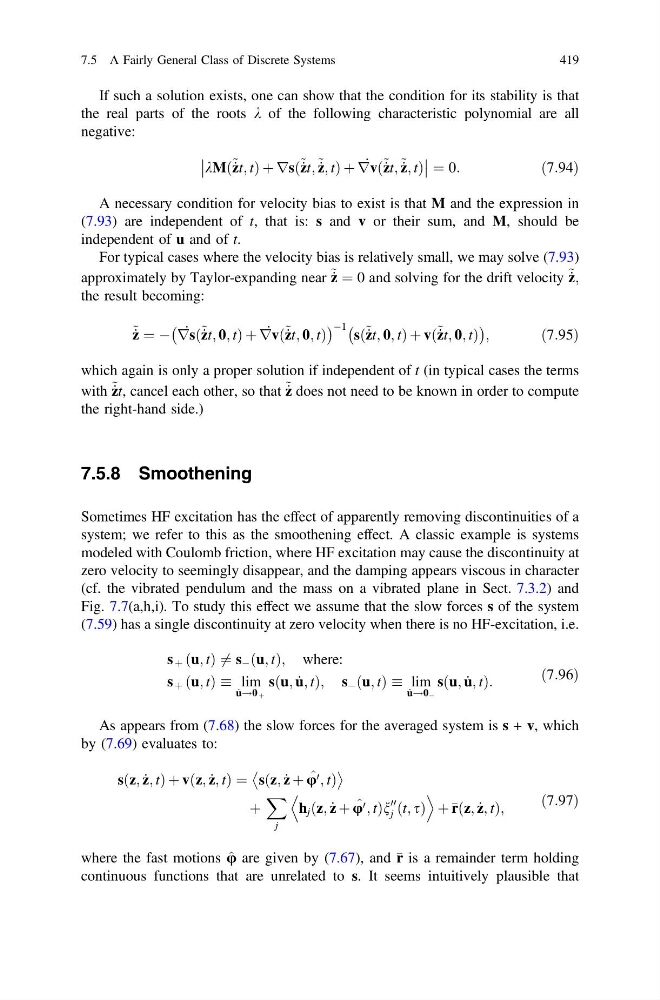
If such a solution exists, one can show that the condition for its stability is that
the real parts of the roots k of the following characteristic polynomial are all
negative:
kMð ~ _
zt; tÞ þ rsð ~ _
zt; ~ _
z; tÞ þ _
rvð ~ _
zt; ~ _
z; tÞ
¼ 0:
ð7:94Þ
A necessary condition for velocity bias to exist is that M and the expression in
(7.93) are independent of t, that is: s and v or their sum, and M, should be
independent of u and of t.
For typical cases where the velocity bias is relatively small, we may solve (7.93)
approximately by Taylor-expanding near ~ _
z ¼ 0 and solving for the drift velocity ~ _
z;
the result becoming:
~ _
z ¼ À _
rsð ~ _
zt; 0; tÞ þ _
rvð ~ _
zt; 0; tÞ
À
Á À1 sð ~ _
zt; 0; tÞ þ vð ~ _
zt; 0; tÞ
À
Á
;
ð7:95Þ
which again is only a proper solution if independent of t (in typical cases the terms
with ~ _
zt, cancel each other, so that ~ _
z does not need to be known in order to compute
the right-hand side.)
7.5.8 Smoothening
Sometimes HF excitation has the effect of apparently removing discontinuities of a
system; we refer to this as the smoothening effect. A classic example is systems
modeled with Coulomb friction, where HF excitation may cause the discontinuity at
zero velocity to seemingly disappear, and the damping appears viscous in character
(cf. the vibrated pendulum and the mass on a vibrated plane in Sect. 7.3.2) and
Fig. 7.7(a,h,i). To study this effect we assume that the slow forces s of the system
(7.59) has a single discontinuity at zero velocity when there is no HF-excitation, i.e.
s þ ðu; tÞ 6 ¼ s À ðu; tÞ; where:
s þ ðu; tÞ lim
_
u!0 þ
sðu; _
u; tÞ; s À ðu; tÞ lim
_
u!0 À
sðu; _
u; tÞ:
ð7:96Þ
As appears from (7.68) the slow forces for the averaged system is s + v, which
by (7.69) evaluates to:
sðz; _
z; tÞ þ vðz; _
z; tÞ ¼ sðz; _
z þ ^
u 0 ; tÞ
þ
X
j
h j ðz; _
z þ ^
u 0 ; tÞn
00
j ðt; sÞ
D
E
þ rðz; _
z; tÞ;
ð7:97Þ
where the fast motions ^
u are given by (7.67), and r is a remainder term holding
continuous functions that are unrelated to s. It seems intuitively plausible that
7.5 A Fairly General Class of Discrete Systems
419
the real parts of the roots k of the following characteristic polynomial are all
negative:
kMð ~ _
zt; tÞ þ rsð ~ _
zt; ~ _
z; tÞ þ _
rvð ~ _
zt; ~ _
z; tÞ
¼ 0:
ð7:94Þ
A necessary condition for velocity bias to exist is that M and the expression in
(7.93) are independent of t, that is: s and v or their sum, and M, should be
independent of u and of t.
For typical cases where the velocity bias is relatively small, we may solve (7.93)
approximately by Taylor-expanding near ~ _
z ¼ 0 and solving for the drift velocity ~ _
z;
the result becoming:
~ _
z ¼ À _
rsð ~ _
zt; 0; tÞ þ _
rvð ~ _
zt; 0; tÞ
À
Á À1 sð ~ _
zt; 0; tÞ þ vð ~ _
zt; 0; tÞ
À
Á
;
ð7:95Þ
which again is only a proper solution if independent of t (in typical cases the terms
with ~ _
zt, cancel each other, so that ~ _
z does not need to be known in order to compute
the right-hand side.)
7.5.8 Smoothening
Sometimes HF excitation has the effect of apparently removing discontinuities of a
system; we refer to this as the smoothening effect. A classic example is systems
modeled with Coulomb friction, where HF excitation may cause the discontinuity at
zero velocity to seemingly disappear, and the damping appears viscous in character
(cf. the vibrated pendulum and the mass on a vibrated plane in Sect. 7.3.2) and
Fig. 7.7(a,h,i). To study this effect we assume that the slow forces s of the system
(7.59) has a single discontinuity at zero velocity when there is no HF-excitation, i.e.
s þ ðu; tÞ 6 ¼ s À ðu; tÞ; where:
s þ ðu; tÞ lim
_
u!0 þ
sðu; _
u; tÞ; s À ðu; tÞ lim
_
u!0 À
sðu; _
u; tÞ:
ð7:96Þ
As appears from (7.68) the slow forces for the averaged system is s + v, which
by (7.69) evaluates to:
sðz; _
z; tÞ þ vðz; _
z; tÞ ¼ sðz; _
z þ ^
u 0 ; tÞ
þ
X
j
h j ðz; _
z þ ^
u 0 ; tÞn
00
j ðt; sÞ
D
E
þ rðz; _
z; tÞ;
ð7:97Þ
where the fast motions ^
u are given by (7.67), and r is a remainder term holding
continuous functions that are unrelated to s. It seems intuitively plausible that
7.5 A Fairly General Class of Discrete Systems
419