

DK
f
ð0Þ ¼
X
j;k
n
0
j n
0
k
D
E @ ðrf j Þf k
À
Á
@u
u¼z¼0
¼
X
j;k
n
0
j n
0
k
D
E
rf j rf k þ f
T
k r
2
f j
À
Á
u¼z¼0
;
ð7:79Þ
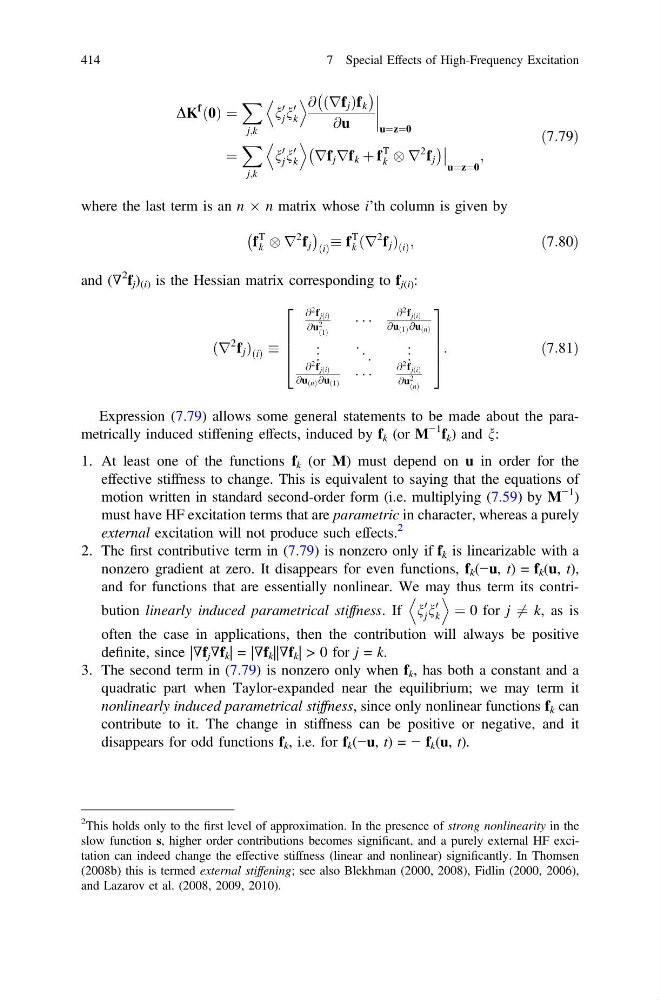
where the last term is an n  n matrix whose i’th column is given by
f
T
k r
2
f j
À
Á
ðiÞ
f
T
k ðr
2
f j Þ ðiÞ ;
ð7:80Þ
and (∇
2
f j ) (i) is the Hessian matrix corresponding to f j(i) :
ðr
2
f j Þ ðiÞ
@
2 f jðiÞ
@u 2
ð1Þ
Á Á Á
@
2 f jðiÞ
@u ð1Þ @u ðnÞ
. .
.
. .
.
. .
.
@
2 f jðiÞ
@u ðnÞ @u ð1Þ
Á Á Á
@
2 f jðiÞ
@u 2
ðnÞ
2
6
6
6
4
3
7
7
7
5
:
ð7:81Þ
Expression (7.79) allows some general statements to be made about the parametrically induced stiffening effects, induced by f k (or M
−1
f k ) and n:
1. At least one of the functions f k (or M) must depend on u in order for the
effective stiffness to change. This is equivalent to saying that the equations of
motion written in standard second-order form (i.e. multiplying (7.59) by M
−1 )
must have HF excitation terms that are parametric in character, whereas a purely
external excitation will not produce such effects.
2
2. The first contributive term in (7.79) is nonzero only if f k is linearizable with a
nonzero gradient at zero. It disappears for even functions, f k (−u, t) = f k (u, t),
and for functions that are essentially nonlinear. We may thus term its contribution linearly induced parametrical stiffness. If n
0
j n
0
k
D
E
¼ 0 for j 6 ¼ k, as is
often the case in applications, then the contribution will always be positive
definite, since |∇f j ∇f k | = |∇f k ||∇f k | > 0 for j = k.
3. The second term in (7.79) is nonzero only when f k , has both a constant and a
quadratic part when Taylor-expanded near the equilibrium; we may term it
nonlinearly induced parametrical stiffness, since only nonlinear functions f k can
contribute to it. The change in stiffness can be positive or negative, and it
disappears for odd functions f k , i.e. for f k (−u, t) = − f k (u, t).
2
This holds only to the first level of approximation. In the presence of strong nonlinearity in the
slow function s, higher order contributions becomes significant, and a purely external HF excitation can indeed change the effective stiffness (linear and nonlinear) significantly. In Thomsen
(2008b) this is termed external stiffening; see also Blekhman (2000, 2008), Fidlin (2000, 2006),
and Lazarov et al. (2008, 2009, 2010).
414
7 Special Effects of High-Frequency Excitation
f
ð0Þ ¼
X
j;k
n
0
j n
0
k
D
E @ ðrf j Þf k
À
Á
@u
u¼z¼0
¼
X
j;k
n
0
j n
0
k
D
E
rf j rf k þ f
T
k r
2
f j
À
Á
u¼z¼0
;
ð7:79Þ
where the last term is an n  n matrix whose i’th column is given by
f
T
k r
2
f j
À
Á
ðiÞ
f
T
k ðr
2
f j Þ ðiÞ ;
ð7:80Þ
and (∇
2
f j ) (i) is the Hessian matrix corresponding to f j(i) :
ðr
2
f j Þ ðiÞ
@
2 f jðiÞ
@u 2
ð1Þ
Á Á Á
@
2 f jðiÞ
@u ð1Þ @u ðnÞ
. .
.
. .
.
. .
.
@
2 f jðiÞ
@u ðnÞ @u ð1Þ
Á Á Á
@
2 f jðiÞ
@u 2
ðnÞ
2
6
6
6
4
3
7
7
7
5
:
ð7:81Þ
Expression (7.79) allows some general statements to be made about the parametrically induced stiffening effects, induced by f k (or M
−1
f k ) and n:
1. At least one of the functions f k (or M) must depend on u in order for the
effective stiffness to change. This is equivalent to saying that the equations of
motion written in standard second-order form (i.e. multiplying (7.59) by M
−1 )
must have HF excitation terms that are parametric in character, whereas a purely
external excitation will not produce such effects.
2
2. The first contributive term in (7.79) is nonzero only if f k is linearizable with a
nonzero gradient at zero. It disappears for even functions, f k (−u, t) = f k (u, t),
and for functions that are essentially nonlinear. We may thus term its contribution linearly induced parametrical stiffness. If n
0
j n
0
k
D
E
¼ 0 for j 6 ¼ k, as is
often the case in applications, then the contribution will always be positive
definite, since |∇f j ∇f k | = |∇f k ||∇f k | > 0 for j = k.
3. The second term in (7.79) is nonzero only when f k , has both a constant and a
quadratic part when Taylor-expanded near the equilibrium; we may term it
nonlinearly induced parametrical stiffness, since only nonlinear functions f k can
contribute to it. The change in stiffness can be positive or negative, and it
disappears for odd functions f k , i.e. for f k (−u, t) = − f k (u, t).
2
This holds only to the first level of approximation. In the presence of strong nonlinearity in the
slow function s, higher order contributions becomes significant, and a purely external HF excitation can indeed change the effective stiffness (linear and nonlinear) significantly. In Thomsen
(2008b) this is termed external stiffening; see also Blekhman (2000, 2008), Fidlin (2000, 2006),
and Lazarov et al. (2008, 2009, 2010).
414
7 Special Effects of High-Frequency Excitation