

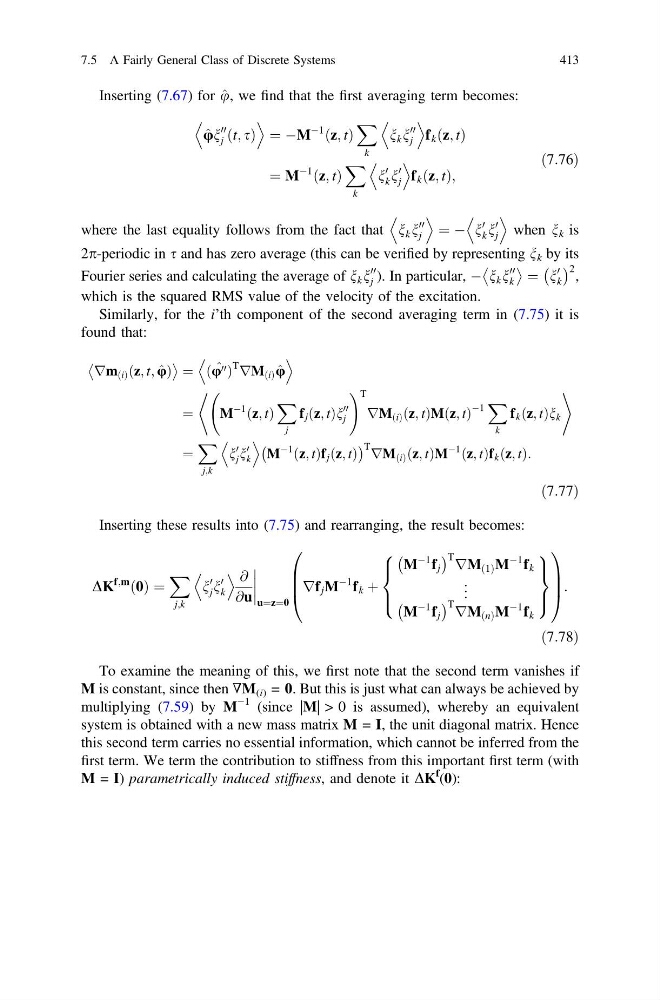
Inserting (7.67) for ^
u, we find that the first averaging term becomes:
^
un
00
j ðt; sÞ
D
E
¼ ÀM
À1
ðz; tÞ
X
k
n k n
00
j
D
E
f k ðz; tÞ
¼ M
À1
ðz; tÞ
X
k
n
0
k n
0
j
D
E
f k ðz; tÞ;
ð7:76Þ
where the last equality follows from the fact that n k n
00
j
D
E
¼ À n
0
k n
0
j
D
E
when n k is
2p-periodic in s and has zero average (this can be verified by representing n k by its
Fourier series and calculating the average of n k n
00
j ). In particular, À n k n
00
k
¼ n
0
k
À Á 2 ,
which is the squared RMS value of the velocity of the excitation.
Similarly, for the i’th component of the second averaging term in (7.75) it is
found that:
rm ðiÞ ðz; t; ^
uÞ
¼ ð ^
u 00 Þ
T rM ðiÞ ^
u
D
E
¼
M
À1
ðz; tÞ
X
j
f j ðz; tÞn
00
j
! T
rM ðiÞ ðz; tÞMðz; tÞ
À1
X
k
f k ðz; tÞn k
*
+
¼
X
j;k
n
0
j n
0
k
D
E
M
À1
ðz; tÞf j ðz; tÞ
À
Á T rM ðiÞ ðz; tÞM
À1
ðz; tÞf k ðz; tÞ:
ð7:77Þ
Inserting these results into (7.75) and rearranging, the result becomes:
DK
f;m
ð0Þ ¼
X
j;k
n
0
j n
0
k
D
E @
@u
u¼z¼0
rf j M
À1
f k þ
M
À1
f j
À
Á T rM ð1Þ M
À1
f k
. .
.
M
À1
f j
À
Á T rM ðnÞ M
À1
f k
8
> <
> :
9
> =
> ;
0
B
B
@
1
C
C
A :
ð7:78Þ
To examine the meaning of this, we first note that the second term vanishes if
M is constant, since then ∇M (i) = 0. But this is just what can always be achieved by
multiplying (7.59) by M
−1 (since |M| > 0 is assumed), whereby an equivalent
system is obtained with a new mass matrix M = I, the unit diagonal matrix. Hence
this second term carries no essential information, which cannot be inferred from the
first term. We term the contribution to stiffness from this important first term (with
M = I) parametrically induced stiffness, and denote it DK
f (0):
7.5 A Fairly General Class of Discrete Systems
413
u, we find that the first averaging term becomes:
^
un
00
j ðt; sÞ
D
E
¼ ÀM
À1
ðz; tÞ
X
k
n k n
00
j
D
E
f k ðz; tÞ
¼ M
À1
ðz; tÞ
X
k
n
0
k n
0
j
D
E
f k ðz; tÞ;
ð7:76Þ
where the last equality follows from the fact that n k n
00
j
D
E
¼ À n
0
k n
0
j
D
E
when n k is
2p-periodic in s and has zero average (this can be verified by representing n k by its
Fourier series and calculating the average of n k n
00
j ). In particular, À n k n
00
k
¼ n
0
k
À Á 2 ,
which is the squared RMS value of the velocity of the excitation.
Similarly, for the i’th component of the second averaging term in (7.75) it is
found that:
rm ðiÞ ðz; t; ^
uÞ
¼ ð ^
u 00 Þ
T rM ðiÞ ^
u
D
E
¼
M
À1
ðz; tÞ
X
j
f j ðz; tÞn
00
j
! T
rM ðiÞ ðz; tÞMðz; tÞ
À1
X
k
f k ðz; tÞn k
*
+
¼
X
j;k
n
0
j n
0
k
D
E
M
À1
ðz; tÞf j ðz; tÞ
À
Á T rM ðiÞ ðz; tÞM
À1
ðz; tÞf k ðz; tÞ:
ð7:77Þ
Inserting these results into (7.75) and rearranging, the result becomes:
DK
f;m
ð0Þ ¼
X
j;k
n
0
j n
0
k
D
E @
@u
u¼z¼0
rf j M
À1
f k þ
M
À1
f j
À
Á T rM ð1Þ M
À1
f k
. .
.
M
À1
f j
À
Á T rM ðnÞ M
À1
f k
8
> <
> :
9
> =
> ;
0
B
B
@
1
C
C
A :
ð7:78Þ
To examine the meaning of this, we first note that the second term vanishes if
M is constant, since then ∇M (i) = 0. But this is just what can always be achieved by
multiplying (7.59) by M
−1 (since |M| > 0 is assumed), whereby an equivalent
system is obtained with a new mass matrix M = I, the unit diagonal matrix. Hence
this second term carries no essential information, which cannot be inferred from the
first term. We term the contribution to stiffness from this important first term (with
M = I) parametrically induced stiffness, and denote it DK
f (0):
7.5 A Fairly General Class of Discrete Systems
413