

where, using derivative operators rgðu; _
uÞ @g=@u and _
rgðu; _
uÞ @g=@ _
u:
Kð~ zÞ ¼ rsð~ z; 0; tÞ; DKð~ zÞ ¼ rvð~ z; 0; tÞ;
Cð~ zÞ ¼ _
rsð~ z; 0; tÞ; DCð~ zÞ ¼ _
rvð~ z; 0; tÞ:
ð7:73Þ
7.5.6 Stiffening
By stiffness we refer to the change in resistive static force per unit deformation near
a static equilibrium. Stiffening then refers to a situation where the stiffness of an
equilibrium of the equation of slow motions differs from the stiffness of the same
equilibrium of the original equation of motion. Examples of stiffening appeared in
the vibrated pendulum example (Sect. 7.3.1), and in Fig. 7.7(b,e,f,g).
For convenience we assume that, in absence of HF excitation, the general system
(7.59) has a static equilibrium at u = 0, so that s(0,0,t) = 0 (other equilibriums
u ¼ ~
u 6 ¼ 0 are treated by first applying a transform of coordinates, u ! u − ~
u),
and that s has continuous derivatives with respect to u at that equilibrium. It is also
assumed that this equilibrium remains an equilibrium in the presence of HF excitation, i.e. v(0, 0, 0) = 0 (the case v(0, 0, 0) 6 ¼ 0 is treated in the section on biasing
further below).
We define the stiffening effect of HF excitation as the additional infinitesimal
change in effective (generalized) force, be it positive or negative, which appears in
response to an infinitesimal change in position near the equilibrium. Using (7.72)–
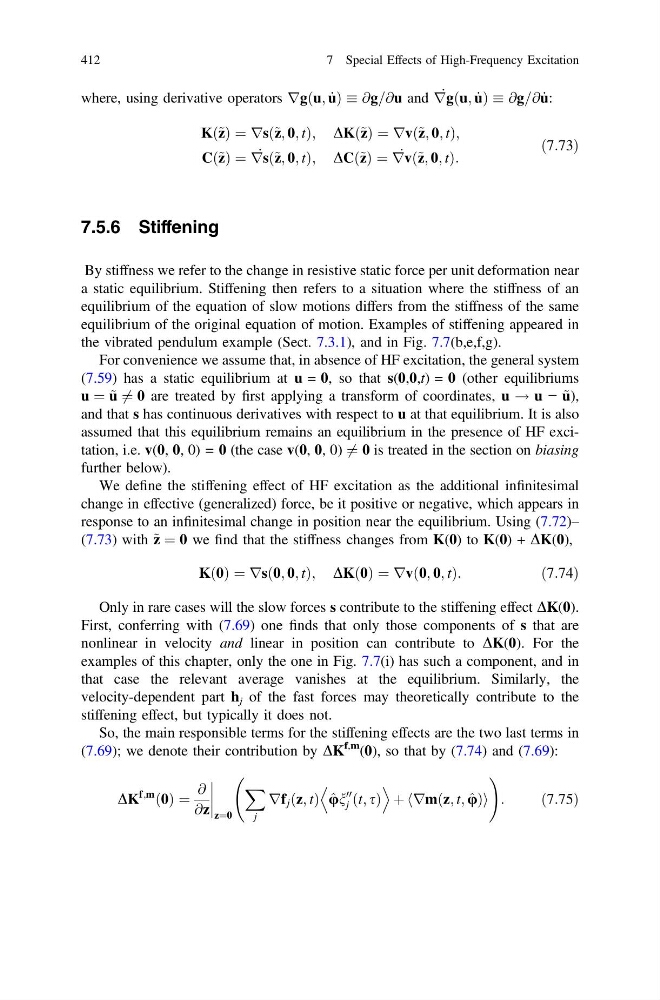
(7.73) with ~ z ¼ 0 we find that the stiffness changes from K(0) to K(0) + DK(0),
Kð0Þ ¼ rsð0; 0; tÞ; DKð0Þ ¼ rvð0; 0; tÞ:
ð7:74Þ
Only in rare cases will the slow forces s contribute to the stiffening effect DK(0).
First, conferring with (7.69) one finds that only those components of s that are
nonlinear in velocity and linear in position can contribute to DK(0). For the
examples of this chapter, only the one in Fig. 7.7(i) has such a component, and in
that case the relevant average vanishes at the equilibrium. Similarly, the
velocity-dependent part h j of the fast forces may theoretically contribute to the
stiffening effect, but typically it does not.
So, the main responsible terms for the stiffening effects are the two last terms in
(7.69); we denote their contribution by DK
f,m (0), so that by (7.74) and (7.69):
DK
f;m
ð0Þ ¼
@
@z
z¼0
X
j
rf j ðz; tÞ ^
un
00
j ðt; sÞ
D
E
þ rmðz; t; ^
uÞ
h
i
!
:
ð7:75Þ
412
7 Special Effects of High-Frequency Excitation
uÞ @g=@u and _
rgðu; _
uÞ @g=@ _
u:
Kð~ zÞ ¼ rsð~ z; 0; tÞ; DKð~ zÞ ¼ rvð~ z; 0; tÞ;
Cð~ zÞ ¼ _
rsð~ z; 0; tÞ; DCð~ zÞ ¼ _
rvð~ z; 0; tÞ:
ð7:73Þ
7.5.6 Stiffening
By stiffness we refer to the change in resistive static force per unit deformation near
a static equilibrium. Stiffening then refers to a situation where the stiffness of an
equilibrium of the equation of slow motions differs from the stiffness of the same
equilibrium of the original equation of motion. Examples of stiffening appeared in
the vibrated pendulum example (Sect. 7.3.1), and in Fig. 7.7(b,e,f,g).
For convenience we assume that, in absence of HF excitation, the general system
(7.59) has a static equilibrium at u = 0, so that s(0,0,t) = 0 (other equilibriums
u ¼ ~
u 6 ¼ 0 are treated by first applying a transform of coordinates, u ! u − ~
u),
and that s has continuous derivatives with respect to u at that equilibrium. It is also
assumed that this equilibrium remains an equilibrium in the presence of HF excitation, i.e. v(0, 0, 0) = 0 (the case v(0, 0, 0) 6 ¼ 0 is treated in the section on biasing
further below).
We define the stiffening effect of HF excitation as the additional infinitesimal
change in effective (generalized) force, be it positive or negative, which appears in
response to an infinitesimal change in position near the equilibrium. Using (7.72)–
(7.73) with ~ z ¼ 0 we find that the stiffness changes from K(0) to K(0) + DK(0),
Kð0Þ ¼ rsð0; 0; tÞ; DKð0Þ ¼ rvð0; 0; tÞ:
ð7:74Þ
Only in rare cases will the slow forces s contribute to the stiffening effect DK(0).
First, conferring with (7.69) one finds that only those components of s that are
nonlinear in velocity and linear in position can contribute to DK(0). For the
examples of this chapter, only the one in Fig. 7.7(i) has such a component, and in
that case the relevant average vanishes at the equilibrium. Similarly, the
velocity-dependent part h j of the fast forces may theoretically contribute to the
stiffening effect, but typically it does not.
So, the main responsible terms for the stiffening effects are the two last terms in
(7.69); we denote their contribution by DK
f,m (0), so that by (7.74) and (7.69):
DK
f;m
ð0Þ ¼
@
@z
z¼0
X
j
rf j ðz; tÞ ^
un
00
j ðt; sÞ
D
E
þ rmðz; t; ^
uÞ
h
i
!
:
ð7:75Þ
412
7 Special Effects of High-Frequency Excitation