

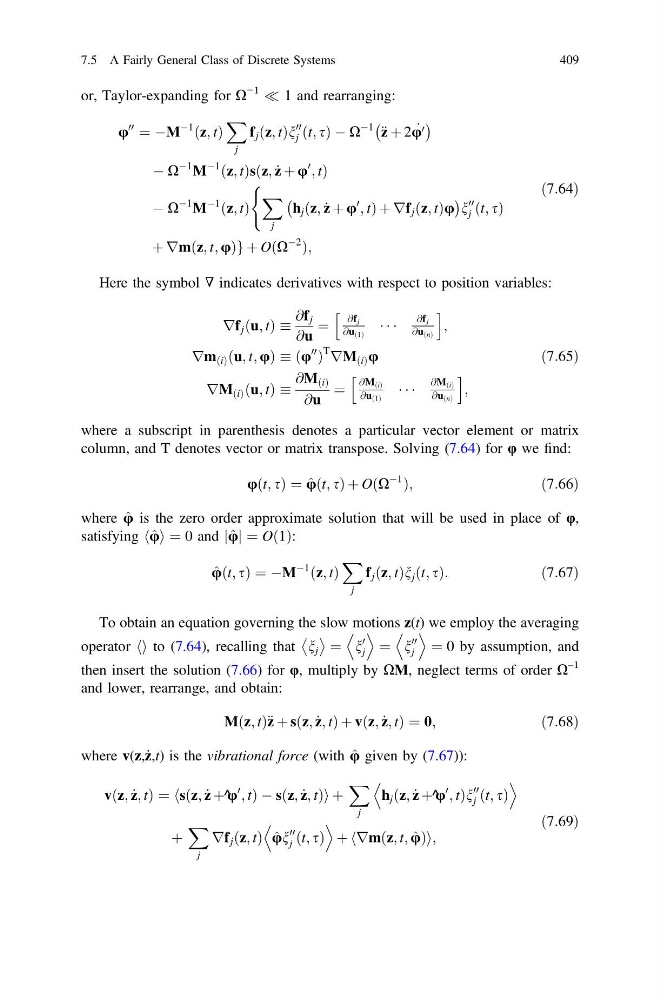
or, Taylor-expanding for X
−1
( 1 and rearranging:
u
00
¼ ÀM
À1
ðz; tÞ
X
j
f j ðz; tÞn
00
j ðt; sÞ À X
À1
€ z þ 2 _
u 0
À
Á
À X
À1
M
À1
ðz; tÞsðz; _
z þ u
0
; tÞ
À X
À1
M
À1
ðz; tÞ
X
j
h j ðz; _
z þ u
0
; tÞ þ rf j ðz; tÞu
À
Á
n
00
j ðt; sÞ
(
þ rmðz; t; uÞg þ OðX
À2
Þ;
ð7:64Þ
Here the symbol ∇ indicates derivatives with respect to position variables:
rf j ðu; tÞ
@f j
@u
¼
@f j
@u ð1Þ
Á Á Á
@f j
@u ðnÞ
h
i
;
rm ðiÞ ðu; t; uÞ ðu
00
Þ
T rM ðiÞ u
rM ðiÞ ðu; tÞ
@M ðiÞ
@u
¼
@M ðiÞ
@u ð1Þ
Á Á Á
@M ðiÞ
@u ðnÞ
h
i
;
ð7:65Þ
where a subscript in parenthesis denotes a particular vector element or matrix
column, and T denotes vector or matrix transpose. Solving (7.64) for φ we find:
uðt; sÞ ¼ ^
uðt; sÞ þ OðX
À1
Þ;
ð7:66Þ
where ^
u is the zero order approximate solution that will be used in place of φ,
satisfying ^
u
h i ¼ 0 and ^
u
j j ¼ Oð1Þ:
^
uðt; sÞ ¼ ÀM
À1
ðz; tÞ
X
j
f j ðz; tÞn j ðt; sÞ:
ð7:67Þ
To obtain an equation governing the slow motions z(t) we employ the averaging
operator hi to (7.64), recalling that n j
¼ n
0
j
D E
¼ n
00
j
D E
¼ 0 by assumption, and
then insert the solution (7.66) for φ, multiply by XM, neglect terms of order X
–1
and lower, rearrange, and obtain:
Mðz; tÞ€ z þ sðz; _
z; tÞ þ vðz; _
z; tÞ ¼ 0;
ð7:68Þ
where v(z,_ z,t) is the vibrational force (with ^
u given by (7.67)):
vðz; _
z; tÞ ¼ sðz; _
z þ^u
0
; tÞ À sðz; _
z; tÞ
h
i þ
X
j
h j ðz; _
z þ^u
0
; tÞn
00
j ðt; sÞ
D
E
þ
X
j
rf j ðz; tÞ ^
un
00
j ðt; sÞ
D
E
þ rmðz; t; ^
uÞ
h
i ;
ð7:69Þ
7.5 A Fairly General Class of Discrete Systems
409
−1
( 1 and rearranging:
u
00
¼ ÀM
À1
ðz; tÞ
X
j
f j ðz; tÞn
00
j ðt; sÞ À X
À1
€ z þ 2 _
u 0
À
Á
À X
À1
M
À1
ðz; tÞsðz; _
z þ u
0
; tÞ
À X
À1
M
À1
ðz; tÞ
X
j
h j ðz; _
z þ u
0
; tÞ þ rf j ðz; tÞu
À
Á
n
00
j ðt; sÞ
(
þ rmðz; t; uÞg þ OðX
À2
Þ;
ð7:64Þ
Here the symbol ∇ indicates derivatives with respect to position variables:
rf j ðu; tÞ
@f j
@u
¼
@f j
@u ð1Þ
Á Á Á
@f j
@u ðnÞ
h
i
;
rm ðiÞ ðu; t; uÞ ðu
00
Þ
T rM ðiÞ u
rM ðiÞ ðu; tÞ
@M ðiÞ
@u
¼
@M ðiÞ
@u ð1Þ
Á Á Á
@M ðiÞ
@u ðnÞ
h
i
;
ð7:65Þ
where a subscript in parenthesis denotes a particular vector element or matrix
column, and T denotes vector or matrix transpose. Solving (7.64) for φ we find:
uðt; sÞ ¼ ^
uðt; sÞ þ OðX
À1
Þ;
ð7:66Þ
where ^
u is the zero order approximate solution that will be used in place of φ,
satisfying ^
u
h i ¼ 0 and ^
u
j j ¼ Oð1Þ:
^
uðt; sÞ ¼ ÀM
À1
ðz; tÞ
X
j
f j ðz; tÞn j ðt; sÞ:
ð7:67Þ
To obtain an equation governing the slow motions z(t) we employ the averaging
operator hi to (7.64), recalling that n j
¼ n
0
j
D E
¼ n
00
j
D E
¼ 0 by assumption, and
then insert the solution (7.66) for φ, multiply by XM, neglect terms of order X
–1
and lower, rearrange, and obtain:
Mðz; tÞ€ z þ sðz; _
z; tÞ þ vðz; _
z; tÞ ¼ 0;
ð7:68Þ
where v(z,_ z,t) is the vibrational force (with ^
u given by (7.67)):
vðz; _
z; tÞ ¼ sðz; _
z þ^u
0
; tÞ À sðz; _
z; tÞ
h
i þ
X
j
h j ðz; _
z þ^u
0
; tÞn
00
j ðt; sÞ
D
E
þ
X
j
rf j ðz; tÞ ^
un
00
j ðt; sÞ
D
E
þ rmðz; t; ^
uÞ
h
i ;
ð7:69Þ
7.5 A Fairly General Class of Discrete Systems
409