

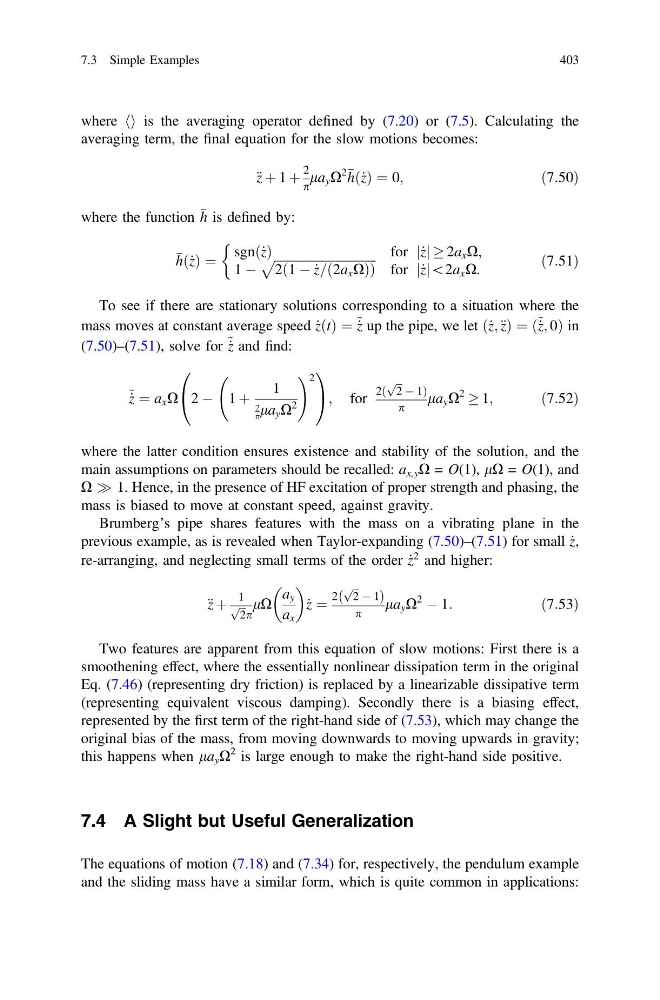
where hi is the averaging operator defined by (7.20) or (7.5). Calculating the
averaging term, the final equation for the slow motions becomes:
€ z þ 1 þ
2
p
la y X
2 hð_ zÞ ¼ 0;
ð7:50Þ
where the function h is defined by:
hð_ zÞ ¼
sgnð_ zÞ
for j_ zj ! 2a x X;
1 À
ffiffiffiffiffiffiffiffiffiffiffiffiffiffiffiffiffiffiffiffiffiffiffiffiffiffiffiffiffiffiffiffi ffi
2 1 À _
z=ð2a x XÞ
ð
Þ
p
for j_ zj\2a x X:
&
ð7:51Þ
To see if there are stationary solutions corresponding to a situation where the
mass moves at constant average speed _
zðtÞ ¼ ~ _
z up the pipe, we let ð_ z; € zÞ ¼ ð ~ _
z; 0Þ in
(7.50)–(7.51), solve for ~ _
z and find:
~ _
z ¼ a x X 2 À 1 þ
1
2
p la y X
2
! 2
0
@
1
A ; for
2ð
ffiffi ffi
2
p À 1Þ
p
la y X
2
! 1;
ð7:52Þ
where the latter condition ensures existence and stability of the solution, and the
main assumptions on parameters should be recalled: a x,y X = O(1), lX = O(1), and
X ) 1. Hence, in the presence of HF excitation of proper strength and phasing, the
mass is biased to move at constant speed, against gravity.
Brumberg’s pipe shares features with the mass on a vibrating plane in the
previous example, as is revealed when Taylor-expanding (7.50)–(7.51) for small _
z,
re-arranging, and neglecting small terms of the order _
z
2 and higher:
€ z þ
1
ffiffi ffi
2
p
p
lX
a y
a x
_
z ¼
2
ffiffi ffi
2
p À 1
À
Á
p
la y X
2
À 1:
ð7:53Þ
Two features are apparent from this equation of slow motions: First there is a
smoothening effect, where the essentially nonlinear dissipation term in the original
Eq. (7.46) (representing dry friction) is replaced by a linearizable dissipative term
(representing equivalent viscous damping). Secondly there is a biasing effect,
represented by the first term of the right-hand side of (7.53), which may change the
original bias of the mass, from moving downwards to moving upwards in gravity;
this happens when la y X
2 is large enough to make the right-hand side positive.
7.4 A Slight but Useful Generalization
The equations of motion (7.18) and (7.34) for, respectively, the pendulum example
and the sliding mass have a similar form, which is quite common in applications:
7.3 Simple Examples
403
averaging term, the final equation for the slow motions becomes:
€ z þ 1 þ
2
p
la y X
2 hð_ zÞ ¼ 0;
ð7:50Þ
where the function h is defined by:
hð_ zÞ ¼
sgnð_ zÞ
for j_ zj ! 2a x X;
1 À
ffiffiffiffiffiffiffiffiffiffiffiffiffiffiffiffiffiffiffiffiffiffiffiffiffiffiffiffiffiffiffiffi ffi
2 1 À _
z=ð2a x XÞ
ð
Þ
p
for j_ zj\2a x X:
&
ð7:51Þ
To see if there are stationary solutions corresponding to a situation where the
mass moves at constant average speed _
zðtÞ ¼ ~ _
z up the pipe, we let ð_ z; € zÞ ¼ ð ~ _
z; 0Þ in
(7.50)–(7.51), solve for ~ _
z and find:
~ _
z ¼ a x X 2 À 1 þ
1
2
p la y X
2
! 2
0
@
1
A ; for
2ð
ffiffi ffi
2
p À 1Þ
p
la y X
2
! 1;
ð7:52Þ
where the latter condition ensures existence and stability of the solution, and the
main assumptions on parameters should be recalled: a x,y X = O(1), lX = O(1), and
X ) 1. Hence, in the presence of HF excitation of proper strength and phasing, the
mass is biased to move at constant speed, against gravity.
Brumberg’s pipe shares features with the mass on a vibrating plane in the
previous example, as is revealed when Taylor-expanding (7.50)–(7.51) for small _
z,
re-arranging, and neglecting small terms of the order _
z
2 and higher:
€ z þ
1
ffiffi ffi
2
p
p
lX
a y
a x
_
z ¼
2
ffiffi ffi
2
p À 1
À
Á
p
la y X
2
À 1:
ð7:53Þ
Two features are apparent from this equation of slow motions: First there is a
smoothening effect, where the essentially nonlinear dissipation term in the original
Eq. (7.46) (representing dry friction) is replaced by a linearizable dissipative term
(representing equivalent viscous damping). Secondly there is a biasing effect,
represented by the first term of the right-hand side of (7.53), which may change the
original bias of the mass, from moving downwards to moving upwards in gravity;
this happens when la y X
2 is large enough to make the right-hand side positive.
7.4 A Slight but Useful Generalization
The equations of motion (7.18) and (7.34) for, respectively, the pendulum example
and the sliding mass have a similar form, which is quite common in applications:
7.3 Simple Examples
403