

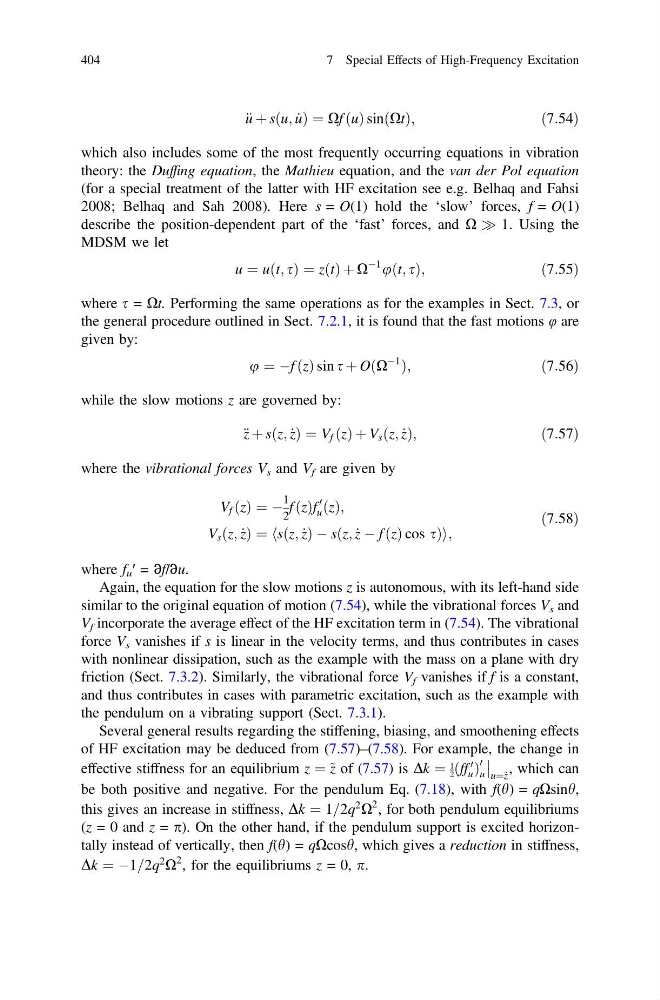
€ u þ sðu; _
uÞ ¼ Xf ðuÞ sinðXtÞ;
ð7:54Þ
which also includes some of the most frequently occurring equations in vibration
theory: the Duffing equation, the Mathieu equation, and the van der Pol equation
(for a special treatment of the latter with HF excitation see e.g. Belhaq and Fahsi
2008; Belhaq and Sah 2008). Here s = O(1) hold the ‘slow’ forces, f = O(1)
describe the position-dependent part of the ‘fast’ forces, and X ) 1. Using the
MDSM we let
u ¼ uðt; sÞ ¼ zðtÞ þ X
À1 uðt; sÞ;
ð7:55Þ
where s = Xt. Performing the same operations as for the examples in Sect. 7.3, or
the general procedure outlined in Sect. 7.2.1, it is found that the fast motions φ are
given by:
u ¼ Àf ðzÞ sin s þ OðX
À1
Þ;
ð7:56Þ
while the slow motions z are governed by:
€ z þ sðz; _
zÞ ¼ V f ðzÞ þ V s ðz; _
zÞ;
ð7:57Þ
where the vibrational forces V s and V f are given by
V f ðzÞ ¼ À
1
2
f ðzÞf
0
u ðzÞ;
V s ðz; _
zÞ ¼ s z; _
z
ð Þ À s z; _
z À f ðzÞ cos s
ð
Þ
h
i ;
ð7:58Þ
where f u ′ = ∂f/∂u.
Again, the equation for the slow motions z is autonomous, with its left-hand side
similar to the original equation of motion (7.54), while the vibrational forces V s and
V f incorporate the average effect of the HF excitation term in (7.54). The vibrational
force V s vanishes if s is linear in the velocity terms, and thus contributes in cases
with nonlinear dissipation, such as the example with the mass on a plane with dry
friction (Sect. 7.3.2). Similarly, the vibrational force V f vanishes if f is a constant,
and thus contributes in cases with parametric excitation, such as the example with
the pendulum on a vibrating support (Sect. 7.3.1).
Several general results regarding the stiffening, biasing, and smoothening effects
of HF excitation may be deduced from (7.57)–(7.58). For example, the change in
effective stiffness for an equilibrium z ¼ ~ z of (7.57) is Dk ¼
1
2 ðff
0
u Þ
0
u
u¼~ z
, which can
be both positive and negative. For the pendulum Eq. (7.18), with f(h) = qXsinh,
this gives an increase in stiffness, Dk ¼ 1=2q
2
X
2 , for both pendulum equilibriums
(z = 0 and z = p). On the other hand, if the pendulum support is excited horizontally instead of vertically, then f(h) = qXcosh, which gives a reduction in stiffness,
Dk ¼ À1=2q
2
X
2 , for the equilibriums z = 0, p.
404
7 Special Effects of High-Frequency Excitation
uÞ ¼ Xf ðuÞ sinðXtÞ;
ð7:54Þ
which also includes some of the most frequently occurring equations in vibration
theory: the Duffing equation, the Mathieu equation, and the van der Pol equation
(for a special treatment of the latter with HF excitation see e.g. Belhaq and Fahsi
2008; Belhaq and Sah 2008). Here s = O(1) hold the ‘slow’ forces, f = O(1)
describe the position-dependent part of the ‘fast’ forces, and X ) 1. Using the
MDSM we let
u ¼ uðt; sÞ ¼ zðtÞ þ X
À1 uðt; sÞ;
ð7:55Þ
where s = Xt. Performing the same operations as for the examples in Sect. 7.3, or
the general procedure outlined in Sect. 7.2.1, it is found that the fast motions φ are
given by:
u ¼ Àf ðzÞ sin s þ OðX
À1
Þ;
ð7:56Þ
while the slow motions z are governed by:
€ z þ sðz; _
zÞ ¼ V f ðzÞ þ V s ðz; _
zÞ;
ð7:57Þ
where the vibrational forces V s and V f are given by
V f ðzÞ ¼ À
1
2
f ðzÞf
0
u ðzÞ;
V s ðz; _
zÞ ¼ s z; _
z
ð Þ À s z; _
z À f ðzÞ cos s
ð
Þ
h
i ;
ð7:58Þ
where f u ′ = ∂f/∂u.
Again, the equation for the slow motions z is autonomous, with its left-hand side
similar to the original equation of motion (7.54), while the vibrational forces V s and
V f incorporate the average effect of the HF excitation term in (7.54). The vibrational
force V s vanishes if s is linear in the velocity terms, and thus contributes in cases
with nonlinear dissipation, such as the example with the mass on a plane with dry
friction (Sect. 7.3.2). Similarly, the vibrational force V f vanishes if f is a constant,
and thus contributes in cases with parametric excitation, such as the example with
the pendulum on a vibrating support (Sect. 7.3.1).
Several general results regarding the stiffening, biasing, and smoothening effects
of HF excitation may be deduced from (7.57)–(7.58). For example, the change in
effective stiffness for an equilibrium z ¼ ~ z of (7.57) is Dk ¼
1
2 ðff
0
u Þ
0
u
u¼~ z
, which can
be both positive and negative. For the pendulum Eq. (7.18), with f(h) = qXsinh,
this gives an increase in stiffness, Dk ¼ 1=2q
2
X
2 , for both pendulum equilibriums
(z = 0 and z = p). On the other hand, if the pendulum support is excited horizontally instead of vertically, then f(h) = qXcosh, which gives a reduction in stiffness,
Dk ¼ À1=2q
2
X
2 , for the equilibriums z = 0, p.
404
7 Special Effects of High-Frequency Excitation