

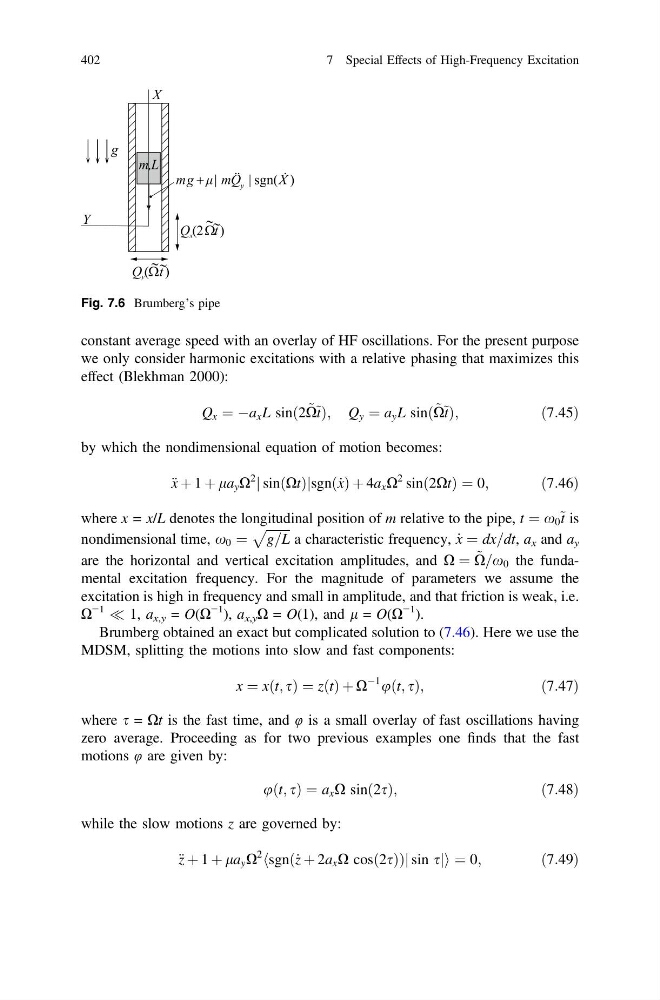
constant average speed with an overlay of HF oscillations. For the present purpose
we only consider harmonic excitations with a relative phasing that maximizes this
effect (Blekhman 2000):
Q x ¼ Àa x L sinð2 ~
X ~ tÞ; Q y ¼ a y L sinð ~
X ~ tÞ;
ð7:45Þ
by which the nondimensional equation of motion becomes:
€ x þ 1 þ la y X
2
j sinðXtÞjsgnð_ xÞ þ 4a x X
2 sinð2XtÞ ¼ 0;
ð7:46Þ
where x = x/L denotes the longitudinal position of m relative to the pipe, t ¼ x 0 ~ t is
nondimensional time, x 0 ¼
ffiffiffiffiffiffiffi ffi
g=L
p
a characteristic frequency, _
x ¼ dx=dt, a x and a y
are the horizontal and vertical excitation amplitudes, and X ¼ ~
X=x 0 the fundamental excitation frequency. For the magnitude of parameters we assume the
excitation is high in frequency and small in amplitude, and that friction is weak, i.e.
X
−1
( 1, a x,y = O(X
−1 ), a x,y X = O(1), and l = O(X
−1 ).
Brumberg obtained an exact but complicated solution to (7.46). Here we use the
MDSM, splitting the motions into slow and fast components:
x ¼ xðt; sÞ ¼ zðtÞ þ X
À1 uðt; sÞ;
ð7:47Þ
where s = Xt is the fast time, and φ is a small overlay of fast oscillations having
zero average. Proceeding as for two previous examples one finds that the fast
motions φ are given by:
uðt; sÞ ¼ a x X sinð2sÞ;
ð7:48Þ
while the slow motions z are governed by:
€ z þ 1 þ la y X
2 sgn _
z þ 2a x X cosð2sÞ
ð
Þ j sin sj
h
i ¼ 0;
ð7:49Þ
Fig. 7.6 Brumberg’s pipe
402
7 Special Effects of High-Frequency Excitation
we only consider harmonic excitations with a relative phasing that maximizes this
effect (Blekhman 2000):
Q x ¼ Àa x L sinð2 ~
X ~ tÞ; Q y ¼ a y L sinð ~
X ~ tÞ;
ð7:45Þ
by which the nondimensional equation of motion becomes:
€ x þ 1 þ la y X
2
j sinðXtÞjsgnð_ xÞ þ 4a x X
2 sinð2XtÞ ¼ 0;
ð7:46Þ
where x = x/L denotes the longitudinal position of m relative to the pipe, t ¼ x 0 ~ t is
nondimensional time, x 0 ¼
ffiffiffiffiffiffiffi ffi
g=L
p
a characteristic frequency, _
x ¼ dx=dt, a x and a y
are the horizontal and vertical excitation amplitudes, and X ¼ ~
X=x 0 the fundamental excitation frequency. For the magnitude of parameters we assume the
excitation is high in frequency and small in amplitude, and that friction is weak, i.e.
X
−1
( 1, a x,y = O(X
−1 ), a x,y X = O(1), and l = O(X
−1 ).
Brumberg obtained an exact but complicated solution to (7.46). Here we use the
MDSM, splitting the motions into slow and fast components:
x ¼ xðt; sÞ ¼ zðtÞ þ X
À1 uðt; sÞ;
ð7:47Þ
where s = Xt is the fast time, and φ is a small overlay of fast oscillations having
zero average. Proceeding as for two previous examples one finds that the fast
motions φ are given by:
uðt; sÞ ¼ a x X sinð2sÞ;
ð7:48Þ
while the slow motions z are governed by:
€ z þ 1 þ la y X
2 sgn _
z þ 2a x X cosð2sÞ
ð
Þ j sin sj
h
i ¼ 0;
ð7:49Þ
Fig. 7.6 Brumberg’s pipe
402
7 Special Effects of High-Frequency Excitation