

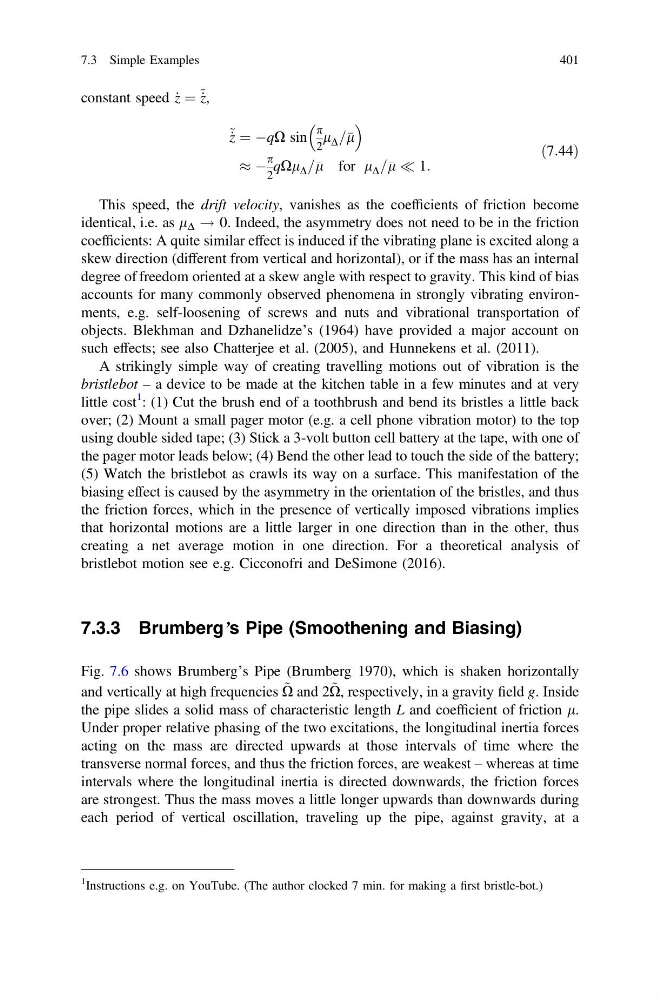
constant speed _
z ¼ ~ _
z,
~ _
z ¼ ÀqX sin
p
2
l D = l
% À
p
2
qXl D = l for l D = l ( 1:
ð7:44Þ
This speed, the drift velocity, vanishes as the coefficients of friction become
identical, i.e. as l D ! 0. Indeed, the asymmetry does not need to be in the friction
coefficients: A quite similar effect is induced if the vibrating plane is excited along a
skew direction (different from vertical and horizontal), or if the mass has an internal
degree of freedom oriented at a skew angle with respect to gravity. This kind of bias
accounts for many commonly observed phenomena in strongly vibrating environments, e.g. self-loosening of screws and nuts and vibrational transportation of
objects. Blekhman and Dzhanelidze’s (1964) have provided a major account on
such effects; see also Chatterjee et al. (2005), and Hunnekens et al. (2011).
A strikingly simple way of creating travelling motions out of vibration is the
bristlebot – a device to be made at the kitchen table in a few minutes and at very
little cost
1 : (1) Cut the brush end of a toothbrush and bend its bristles a little back
over; (2) Mount a small pager motor (e.g. a cell phone vibration motor) to the top
using double sided tape; (3) Stick a 3-volt button cell battery at the tape, with one of
the pager motor leads below; (4) Bend the other lead to touch the side of the battery;
(5) Watch the bristlebot as crawls its way on a surface. This manifestation of the
biasing effect is caused by the asymmetry in the orientation of the bristles, and thus
the friction forces, which in the presence of vertically imposed vibrations implies
that horizontal motions are a little larger in one direction than in the other, thus
creating a net average motion in one direction. For a theoretical analysis of
bristlebot motion see e.g. Cicconofri and DeSimone (2016).
7.3.3 Brumberg’s Pipe (Smoothening and Biasing)
Fig. 7.6 shows Brumberg’s Pipe (Brumberg 1970), which is shaken horizontally
and vertically at high frequencies ~
X and 2 ~
X, respectively, in a gravity field g. Inside
the pipe slides a solid mass of characteristic length L and coefficient of friction l.
Under proper relative phasing of the two excitations, the longitudinal inertia forces
acting on the mass are directed upwards at those intervals of time where the
transverse normal forces, and thus the friction forces, are weakest – whereas at time
intervals where the longitudinal inertia is directed downwards, the friction forces
are strongest. Thus the mass moves a little longer upwards than downwards during
each period of vertical oscillation, traveling up the pipe, against gravity, at a
1
Instructions e.g. on YouTube. (The author clocked 7 min. for making a first bristle-bot.)
7.3 Simple Examples
401
z ¼ ~ _
z,
~ _
z ¼ ÀqX sin
p
2
l D = l
% À
p
2
qXl D = l for l D = l ( 1:
ð7:44Þ
This speed, the drift velocity, vanishes as the coefficients of friction become
identical, i.e. as l D ! 0. Indeed, the asymmetry does not need to be in the friction
coefficients: A quite similar effect is induced if the vibrating plane is excited along a
skew direction (different from vertical and horizontal), or if the mass has an internal
degree of freedom oriented at a skew angle with respect to gravity. This kind of bias
accounts for many commonly observed phenomena in strongly vibrating environments, e.g. self-loosening of screws and nuts and vibrational transportation of
objects. Blekhman and Dzhanelidze’s (1964) have provided a major account on
such effects; see also Chatterjee et al. (2005), and Hunnekens et al. (2011).
A strikingly simple way of creating travelling motions out of vibration is the
bristlebot – a device to be made at the kitchen table in a few minutes and at very
little cost
1 : (1) Cut the brush end of a toothbrush and bend its bristles a little back
over; (2) Mount a small pager motor (e.g. a cell phone vibration motor) to the top
using double sided tape; (3) Stick a 3-volt button cell battery at the tape, with one of
the pager motor leads below; (4) Bend the other lead to touch the side of the battery;
(5) Watch the bristlebot as crawls its way on a surface. This manifestation of the
biasing effect is caused by the asymmetry in the orientation of the bristles, and thus
the friction forces, which in the presence of vertically imposed vibrations implies
that horizontal motions are a little larger in one direction than in the other, thus
creating a net average motion in one direction. For a theoretical analysis of
bristlebot motion see e.g. Cicconofri and DeSimone (2016).
7.3.3 Brumberg’s Pipe (Smoothening and Biasing)
Fig. 7.6 shows Brumberg’s Pipe (Brumberg 1970), which is shaken horizontally
and vertically at high frequencies ~
X and 2 ~
X, respectively, in a gravity field g. Inside
the pipe slides a solid mass of characteristic length L and coefficient of friction l.
Under proper relative phasing of the two excitations, the longitudinal inertia forces
acting on the mass are directed upwards at those intervals of time where the
transverse normal forces, and thus the friction forces, are weakest – whereas at time
intervals where the longitudinal inertia is directed downwards, the friction forces
are strongest. Thus the mass moves a little longer upwards than downwards during
each period of vertical oscillation, traveling up the pipe, against gravity, at a
1
Instructions e.g. on YouTube. (The author clocked 7 min. for making a first bristle-bot.)
7.3 Simple Examples
401