

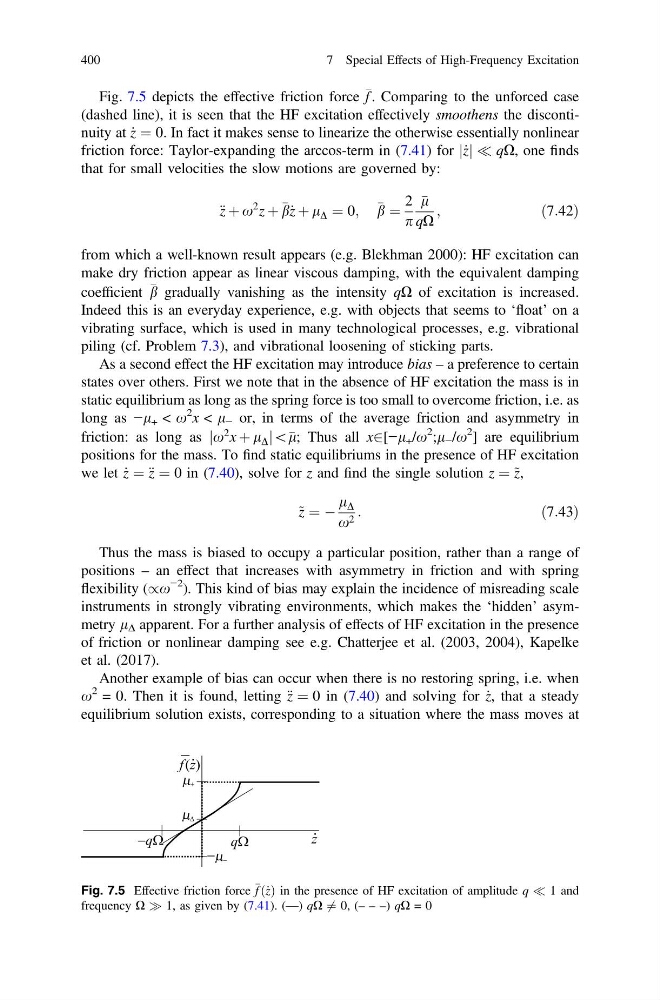
Fig. 7.5 depicts the effective friction force f . Comparing to the unforced case
(dashed line), it is seen that the HF excitation effectively smoothens the discontinuity at _
z ¼ 0. In fact it makes sense to linearize the otherwise essentially nonlinear
friction force: Taylor-expanding the arccos-term in (7.41) for _
z
j j ( qX, one finds
that for small velocities the slow motions are governed by:
€ z þ x
2 z þ
b_ z þ l D ¼ 0;
b ¼
2
p
l
qX
;
ð7:42Þ
from which a well-known result appears (e.g. Blekhman 2000): HF excitation can
make dry friction appear as linear viscous damping, with the equivalent damping
coefficient
b gradually vanishing as the intensity qX of excitation is increased.
Indeed this is an everyday experience, e.g. with objects that seems to ‘float’ on a
vibrating surface, which is used in many technological processes, e.g. vibrational
piling (cf. Problem 7.3), and vibrational loosening of sticking parts.
As a second effect the HF excitation may introduce bias – a preference to certain
states over others. First we note that in the absence of HF excitation the mass is in
static equilibrium as long as the spring force is too small to overcome friction, i.e. as
long as −l + < x
2
x < l − or, in terms of the average friction and asymmetry in
friction: as long as jx
2 x þ l D j\ l; Thus all x2[−l + /x
2 ;l − /x
2 ] are equilibrium
positions for the mass. To find static equilibriums in the presence of HF excitation
we let _
z ¼ € z ¼ 0 in (7.40), solve for z and find the single solution z ¼ ~ z,
~ z ¼ À
l D
x 2 :
ð7:43Þ
Thus the mass is biased to occupy a particular position, rather than a range of
positions – an effect that increases with asymmetry in friction and with spring
flexibility (/x
−2 ). This kind of bias may explain the incidence of misreading scale
instruments in strongly vibrating environments, which makes the ‘hidden’ asymmetry l D apparent. For a further analysis of effects of HF excitation in the presence
of friction or nonlinear damping see e.g. Chatterjee et al. (2003, 2004), Kapelke
et al. (2017).
Another example of bias can occur when there is no restoring spring, i.e. when
x
2 = 0. Then it is found, letting € z ¼ 0 in (7.40) and solving for _
z, that a steady
equilibrium solution exists, corresponding to a situation where the mass moves at
Fig. 7.5 Effective friction force f ð_ zÞ in the presence of HF excitation of amplitude q ( 1 and
frequency X ) 1, as given by (7.41). (—) qX 6 ¼ 0, (– – –) qX = 0
400
7 Special Effects of High-Frequency Excitation
(dashed line), it is seen that the HF excitation effectively smoothens the discontinuity at _
z ¼ 0. In fact it makes sense to linearize the otherwise essentially nonlinear
friction force: Taylor-expanding the arccos-term in (7.41) for _
z
j j ( qX, one finds
that for small velocities the slow motions are governed by:
€ z þ x
2 z þ
b_ z þ l D ¼ 0;
b ¼
2
p
l
qX
;
ð7:42Þ
from which a well-known result appears (e.g. Blekhman 2000): HF excitation can
make dry friction appear as linear viscous damping, with the equivalent damping
coefficient
b gradually vanishing as the intensity qX of excitation is increased.
Indeed this is an everyday experience, e.g. with objects that seems to ‘float’ on a
vibrating surface, which is used in many technological processes, e.g. vibrational
piling (cf. Problem 7.3), and vibrational loosening of sticking parts.
As a second effect the HF excitation may introduce bias – a preference to certain
states over others. First we note that in the absence of HF excitation the mass is in
static equilibrium as long as the spring force is too small to overcome friction, i.e. as
long as −l + < x
2
x < l − or, in terms of the average friction and asymmetry in
friction: as long as jx
2 x þ l D j\ l; Thus all x2[−l + /x
2 ;l − /x
2 ] are equilibrium
positions for the mass. To find static equilibriums in the presence of HF excitation
we let _
z ¼ € z ¼ 0 in (7.40), solve for z and find the single solution z ¼ ~ z,
~ z ¼ À
l D
x 2 :
ð7:43Þ
Thus the mass is biased to occupy a particular position, rather than a range of
positions – an effect that increases with asymmetry in friction and with spring
flexibility (/x
−2 ). This kind of bias may explain the incidence of misreading scale
instruments in strongly vibrating environments, which makes the ‘hidden’ asymmetry l D apparent. For a further analysis of effects of HF excitation in the presence
of friction or nonlinear damping see e.g. Chatterjee et al. (2003, 2004), Kapelke
et al. (2017).
Another example of bias can occur when there is no restoring spring, i.e. when
x
2 = 0. Then it is found, letting € z ¼ 0 in (7.40) and solving for _
z, that a steady
equilibrium solution exists, corresponding to a situation where the mass moves at
Fig. 7.5 Effective friction force f ð_ zÞ in the presence of HF excitation of amplitude q ( 1 and
frequency X ) 1, as given by (7.41). (—) qX 6 ¼ 0, (– – –) qX = 0
400
7 Special Effects of High-Frequency Excitation