

described above are pertinent for this case as well (Chelomei 1956, 1983; Jensen
2000a; Jensen, et al. 2000; Mailybaev and Seyranian 2009; Yabuno and Tsumoto
2007). Then the results for the upright pendulum equilibrium apply if the average
axial beam load exceeds the buckling load, whereas the results for the down
pointing pendulum equilibrium apply for sub-critical beam loads. The situation with
a horizontal pendulum – having no restoring force in the absence of support
excitation – corresponds to a beam that has no transverse stiffness at all, i.e. to an
untaught string.
7.3.2 Mass on a Vibrating Plane (Smoothening
and Biasing)
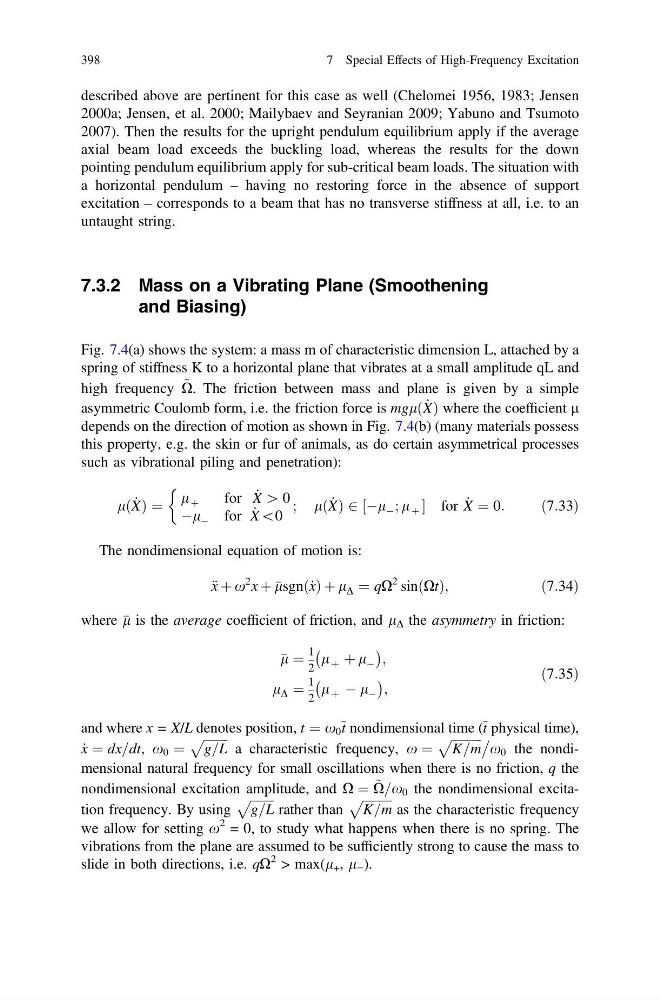
Fig. 7.4(a) shows the system: a mass m of characteristic dimension L, attached by a
spring of stiffness K to a horizontal plane that vibrates at a small amplitude qL and
high frequency ~
X. The friction between mass and plane is given by a simple
asymmetric Coulomb form, i.e. the friction force is mglð _
XÞ where the coefficient l
depends on the direction of motion as shown in Fig. 7.4(b) (many materials possess
this property, e.g. the skin or fur of animals, as do certain asymmetrical processes
such as vibrational piling and penetration):
lð _
XÞ ¼
l þ
for _
X [ 0
Àl À for _
X\0
&
; lð _
XÞ 2 ½Àl À ; l þ for _
X ¼ 0:
ð7:33Þ
The nondimensional equation of motion is:
€ x þ x
2 x þ
lsgnð_ xÞ þ l D ¼ qX
2 sinðXtÞ;
ð7:34Þ
where
l is the average coefficient of friction, and l D the asymmetry in friction:
l ¼
1
2
l þ þ l À
À
Á ;
l D ¼
1
2
l þ À l À
À
Á
;
ð7:35Þ
and where x = X/L denotes position, t ¼ x 0 ~ t nondimensional time ( ~ t physical time),
_
x ¼ dx=dt, x 0 ¼
ffiffiffiffiffiffiffiffi
g=L
p
a characteristic frequency, x ¼
ffiffiffiffiffiffiffiffiffi ffi
K=m
p
x 0 the nondimensional natural frequency for small oscillations when there is no friction, q the
nondimensional excitation amplitude, and X ¼ ~
X=x 0 the nondimensional excitation frequency. By using
ffiffiffiffiffiffiffi ffi
g=L
p
rather than
ffiffiffiffiffiffiffiffiffi ffi
K=m
p
as the characteristic frequency
we allow for setting x
2 = 0, to study what happens when there is no spring. The
vibrations from the plane are assumed to be sufficiently strong to cause the mass to
slide in both directions, i.e. qX
2 > max(l + , l − ).
398
7 Special Effects of High-Frequency Excitation
2000a; Jensen, et al. 2000; Mailybaev and Seyranian 2009; Yabuno and Tsumoto
2007). Then the results for the upright pendulum equilibrium apply if the average
axial beam load exceeds the buckling load, whereas the results for the down
pointing pendulum equilibrium apply for sub-critical beam loads. The situation with
a horizontal pendulum – having no restoring force in the absence of support
excitation – corresponds to a beam that has no transverse stiffness at all, i.e. to an
untaught string.
7.3.2 Mass on a Vibrating Plane (Smoothening
and Biasing)
Fig. 7.4(a) shows the system: a mass m of characteristic dimension L, attached by a
spring of stiffness K to a horizontal plane that vibrates at a small amplitude qL and
high frequency ~
X. The friction between mass and plane is given by a simple
asymmetric Coulomb form, i.e. the friction force is mglð _
XÞ where the coefficient l
depends on the direction of motion as shown in Fig. 7.4(b) (many materials possess
this property, e.g. the skin or fur of animals, as do certain asymmetrical processes
such as vibrational piling and penetration):
lð _
XÞ ¼
l þ
for _
X [ 0
Àl À for _
X\0
&
; lð _
XÞ 2 ½Àl À ; l þ for _
X ¼ 0:
ð7:33Þ
The nondimensional equation of motion is:
€ x þ x
2 x þ
lsgnð_ xÞ þ l D ¼ qX
2 sinðXtÞ;
ð7:34Þ
where
l is the average coefficient of friction, and l D the asymmetry in friction:
l ¼
1
2
l þ þ l À
À
Á ;
l D ¼
1
2
l þ À l À
À
Á
;
ð7:35Þ
and where x = X/L denotes position, t ¼ x 0 ~ t nondimensional time ( ~ t physical time),
_
x ¼ dx=dt, x 0 ¼
ffiffiffiffiffiffiffiffi
g=L
p
a characteristic frequency, x ¼
ffiffiffiffiffiffiffiffiffi ffi
K=m
p
x 0 the nondimensional natural frequency for small oscillations when there is no friction, q the
nondimensional excitation amplitude, and X ¼ ~
X=x 0 the nondimensional excitation frequency. By using
ffiffiffiffiffiffiffi ffi
g=L
p
rather than
ffiffiffiffiffiffiffiffiffi ffi
K=m
p
as the characteristic frequency
we allow for setting x
2 = 0, to study what happens when there is no spring. The
vibrations from the plane are assumed to be sufficiently strong to cause the mass to
slide in both directions, i.e. qX
2 > max(l + , l − ).
398
7 Special Effects of High-Frequency Excitation