

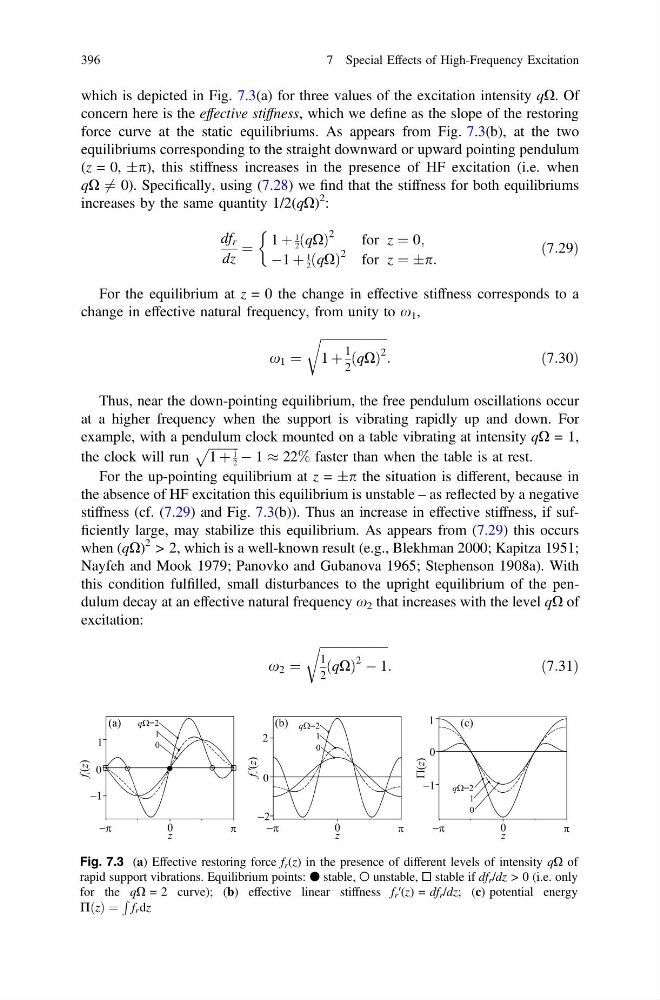
which is depicted in Fig. 7.3(a) for three values of the excitation intensity qX. Of
concern here is the effective stiffness, which we define as the slope of the restoring
force curve at the static equilibriums. As appears from Fig. 7.3(b), at the two
equilibriums corresponding to the straight downward or upward pointing pendulum
(z = 0, ±p), this stiffness increases in the presence of HF excitation (i.e. when
qX 6 ¼ 0). Specifically, using (7.28) we find that the stiffness for both equilibriums
increases by the same quantity 1/2(qX)
2 :
df r
dz
¼
1 þ
1
2 ðqXÞ
2
for z ¼ 0;
À1 þ
1
2 ðqXÞ
2 for z ¼ Æp:
&
ð7:29Þ
For the equilibrium at z = 0 the change in effective stiffness corresponds to a
change in effective natural frequency, from unity to x 1 ,
x 1 ¼
ffiffiffiffiffiffiffiffiffiffiffiffiffiffiffiffiffiffiffiffiffi ffi
1 þ
1
2
ðqXÞ
2
r
:
ð7:30Þ
Thus, near the down-pointing equilibrium, the free pendulum oscillations occur
at a higher frequency when the support is vibrating rapidly up and down. For
example, with a pendulum clock mounted on a table vibrating at intensity qX = 1,
the clock will run
ffiffiffiffiffiffiffiffiffi ffi
1 þ
1
2
p
À 1 % 22% faster than when the table is at rest.
For the up-pointing equilibrium at z = ±p the situation is different, because in
the absence of HF excitation this equilibrium is unstable – as reflected by a negative
stiffness (cf. (7.29) and Fig. 7.3(b)). Thus an increase in effective stiffness, if sufficiently large, may stabilize this equilibrium. As appears from (7.29) this occurs
when (qX)
2 > 2, which is a well-known result (e.g., Blekhman 2000; Kapitza 1951;
Nayfeh and Mook 1979; Panovko and Gubanova 1965; Stephenson 1908a). With
this condition fulfilled, small disturbances to the upright equilibrium of the pendulum decay at an effective natural frequency x 2 that increases with the level qX of
excitation:
x 2 ¼
ffiffiffiffiffiffiffiffiffiffiffiffiffiffiffiffiffiffiffiffiffiffi
1
2
ðqXÞ
2 À 1
r
:
ð7:31Þ
Fig. 7.3 (a) Effective restoring force f r (z) in the presence of different levels of intensity qX of
rapid support vibrations. Equilibrium points: ● stable, ○ unstable, □ stable if df r /dz > 0 (i.e. only
for the qX = 2 curve); (b) effective linear stiffness f r ′(z) = df r /dz; (c) potential energy
PðzÞ ¼
R
f r dz
396
7 Special Effects of High-Frequency Excitation
concern here is the effective stiffness, which we define as the slope of the restoring
force curve at the static equilibriums. As appears from Fig. 7.3(b), at the two
equilibriums corresponding to the straight downward or upward pointing pendulum
(z = 0, ±p), this stiffness increases in the presence of HF excitation (i.e. when
qX 6 ¼ 0). Specifically, using (7.28) we find that the stiffness for both equilibriums
increases by the same quantity 1/2(qX)
2 :
df r
dz
¼
1 þ
1
2 ðqXÞ
2
for z ¼ 0;
À1 þ
1
2 ðqXÞ
2 for z ¼ Æp:
&
ð7:29Þ
For the equilibrium at z = 0 the change in effective stiffness corresponds to a
change in effective natural frequency, from unity to x 1 ,
x 1 ¼
ffiffiffiffiffiffiffiffiffiffiffiffiffiffiffiffiffiffiffiffiffi ffi
1 þ
1
2
ðqXÞ
2
r
:
ð7:30Þ
Thus, near the down-pointing equilibrium, the free pendulum oscillations occur
at a higher frequency when the support is vibrating rapidly up and down. For
example, with a pendulum clock mounted on a table vibrating at intensity qX = 1,
the clock will run
ffiffiffiffiffiffiffiffiffi ffi
1 þ
1
2
p
À 1 % 22% faster than when the table is at rest.
For the up-pointing equilibrium at z = ±p the situation is different, because in
the absence of HF excitation this equilibrium is unstable – as reflected by a negative
stiffness (cf. (7.29) and Fig. 7.3(b)). Thus an increase in effective stiffness, if sufficiently large, may stabilize this equilibrium. As appears from (7.29) this occurs
when (qX)
2 > 2, which is a well-known result (e.g., Blekhman 2000; Kapitza 1951;
Nayfeh and Mook 1979; Panovko and Gubanova 1965; Stephenson 1908a). With
this condition fulfilled, small disturbances to the upright equilibrium of the pendulum decay at an effective natural frequency x 2 that increases with the level qX of
excitation:
x 2 ¼
ffiffiffiffiffiffiffiffiffiffiffiffiffiffiffiffiffiffiffiffiffiffi
1
2
ðqXÞ
2 À 1
r
:
ð7:31Þ
Fig. 7.3 (a) Effective restoring force f r (z) in the presence of different levels of intensity qX of
rapid support vibrations. Equilibrium points: ● stable, ○ unstable, □ stable if df r /dz > 0 (i.e. only
for the qX = 2 curve); (b) effective linear stiffness f r ′(z) = df r /dz; (c) potential energy
PðzÞ ¼
R
f r dz
396
7 Special Effects of High-Frequency Excitation