

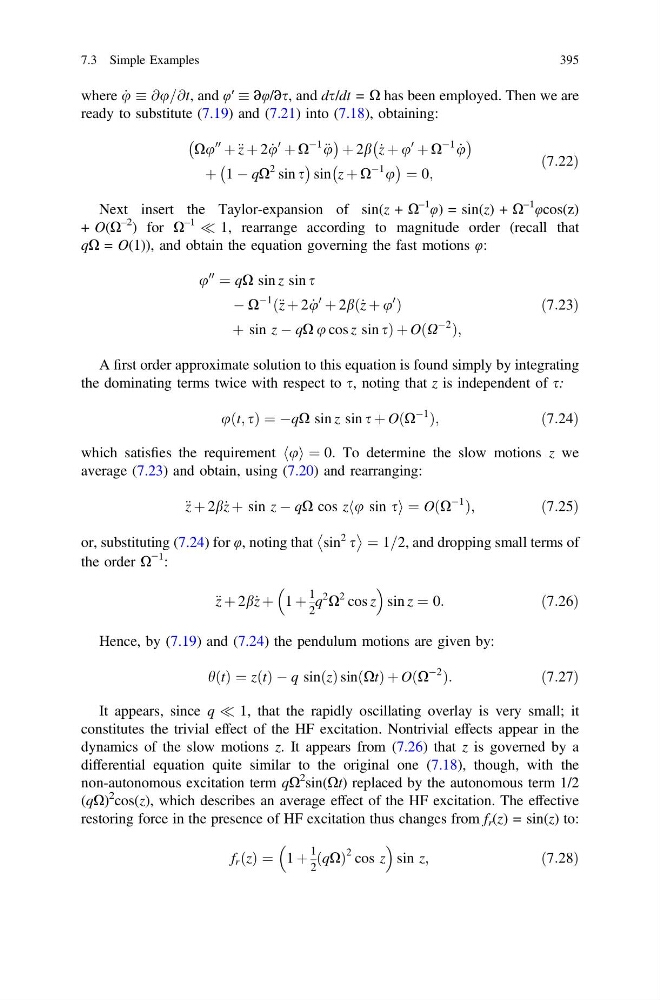
where _
u @u=@t, and φ′ ∂φ/∂s, and ds/dt = X has been employed. Then we are
ready to substitute (7.19) and (7.21) into (7.18), obtaining:
Xu
00
þ € z þ 2 _
u
0
þ X
À1
€
u
À
Á þ 2b _
z þ u
0
þ X
À1
_
u
À
Á
þ 1 À qX
2 sin s
À
Á
sin z þ X
À1 u
À
Á ¼ 0;
ð7:22Þ
Next insert the Taylor-expansion of sin(z + X
–1
φ) = sin(z) + X
–1
φcos(z)
+ O(X
–2 ) for X
–1
( 1, rearrange according to magnitude order (recall that
qX = O(1)), and obtain the equation governing the fast motions φ:
u
00
¼ qX sin z sin s
À X
À1
€ z þ 2 _
u
0
þ 2bð_ z þ u
0
Þ
ð
þ sin z À qX u cos z sin sÞ þ OðX
À2
Þ;
ð7:23Þ
A first order approximate solution to this equation is found simply by integrating
the dominating terms twice with respect to s, noting that z is independent of s:
uðt; sÞ ¼ ÀqX sin z sin s þ OðX
À1
Þ;
ð7:24Þ
which satisfies the requirement u
h i ¼ 0. To determine the slow motions z we
average (7.23) and obtain, using (7.20) and rearranging:
€ z þ 2b_ z þ sin z À qX cos z u sin s
h
i¼ OðX
À1
Þ;
ð7:25Þ
or, substituting (7.24) for φ, noting that sin
2 s
¼ 1=2, and dropping small terms of
the order X
−1 :
€ z þ 2b_ z þ 1 þ
1
2
q
2
X
2 cos z
sin z ¼ 0:
ð7:26Þ
Hence, by (7.19) and (7.24) the pendulum motions are given by:
hðtÞ ¼ zðtÞ À q sinðzÞ sinðXtÞ þ OðX
À2
Þ:
ð7:27Þ
It appears, since q ( 1, that the rapidly oscillating overlay is very small; it
constitutes the trivial effect of the HF excitation. Nontrivial effects appear in the
dynamics of the slow motions z. It appears from (7.26) that z is governed by a
differential equation quite similar to the original one (7.18), though, with the
non-autonomous excitation term qX
2 sin(Xt) replaced by the autonomous term 1/2
(qX)
2 cos(z), which describes an average effect of the HF excitation. The effective
restoring force in the presence of HF excitation thus changes from f r (z) = sin(z) to:
f r ðzÞ ¼ 1 þ
1
2
ðqXÞ
2 cos z
sin z;
ð7:28Þ
7.3 Simple Examples
395
u @u=@t, and φ′ ∂φ/∂s, and ds/dt = X has been employed. Then we are
ready to substitute (7.19) and (7.21) into (7.18), obtaining:
Xu
00
þ € z þ 2 _
u
0
þ X
À1
€
u
À
Á þ 2b _
z þ u
0
þ X
À1
_
u
À
Á
þ 1 À qX
2 sin s
À
Á
sin z þ X
À1 u
À
Á ¼ 0;
ð7:22Þ
Next insert the Taylor-expansion of sin(z + X
–1
φ) = sin(z) + X
–1
φcos(z)
+ O(X
–2 ) for X
–1
( 1, rearrange according to magnitude order (recall that
qX = O(1)), and obtain the equation governing the fast motions φ:
u
00
¼ qX sin z sin s
À X
À1
€ z þ 2 _
u
0
þ 2bð_ z þ u
0
Þ
ð
þ sin z À qX u cos z sin sÞ þ OðX
À2
Þ;
ð7:23Þ
A first order approximate solution to this equation is found simply by integrating
the dominating terms twice with respect to s, noting that z is independent of s:
uðt; sÞ ¼ ÀqX sin z sin s þ OðX
À1
Þ;
ð7:24Þ
which satisfies the requirement u
h i ¼ 0. To determine the slow motions z we
average (7.23) and obtain, using (7.20) and rearranging:
€ z þ 2b_ z þ sin z À qX cos z u sin s
h
i¼ OðX
À1
Þ;
ð7:25Þ
or, substituting (7.24) for φ, noting that sin
2 s
¼ 1=2, and dropping small terms of
the order X
−1 :
€ z þ 2b_ z þ 1 þ
1
2
q
2
X
2 cos z
sin z ¼ 0:
ð7:26Þ
Hence, by (7.19) and (7.24) the pendulum motions are given by:
hðtÞ ¼ zðtÞ À q sinðzÞ sinðXtÞ þ OðX
À2
Þ:
ð7:27Þ
It appears, since q ( 1, that the rapidly oscillating overlay is very small; it
constitutes the trivial effect of the HF excitation. Nontrivial effects appear in the
dynamics of the slow motions z. It appears from (7.26) that z is governed by a
differential equation quite similar to the original one (7.18), though, with the
non-autonomous excitation term qX
2 sin(Xt) replaced by the autonomous term 1/2
(qX)
2 cos(z), which describes an average effect of the HF excitation. The effective
restoring force in the presence of HF excitation thus changes from f r (z) = sin(z) to:
f r ðzÞ ¼ 1 þ
1
2
ðqXÞ
2 cos z
sin z;
ð7:28Þ
7.3 Simple Examples
395