

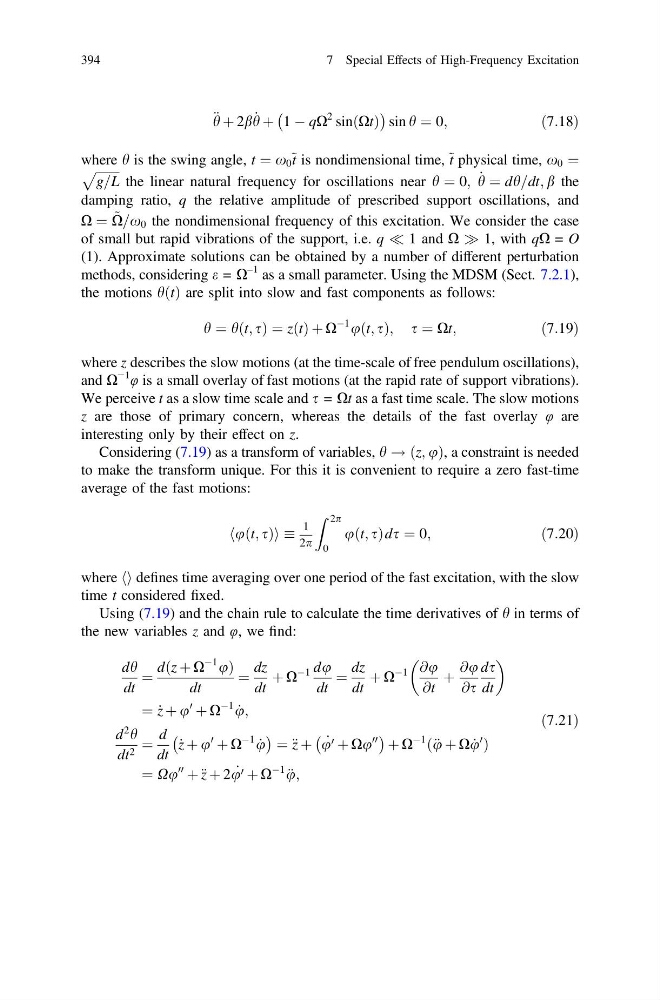
€ h þ 2b _
h þ 1 À qX
2 sinðXtÞ
À
Á
sin h ¼ 0;
ð7:18Þ
where h is the swing angle, t ¼ x 0 ~ t is nondimensional time, ~ t physical time, x 0 ¼
ffiffiffiffiffiffiffiffi
g=L
p
the linear natural frequency for oscillations near h ¼ 0; _
h ¼ dh=dt; b the
damping ratio, q the relative amplitude of prescribed support oscillations, and
X ¼ ~
X=x 0 the nondimensional frequency of this excitation. We consider the case
of small but rapid vibrations of the support, i.e. q ( 1 and X ) 1, with qX = O
(1). Approximate solutions can be obtained by a number of different perturbation
methods, considering e = X
–1 as a small parameter. Using the MDSM (Sect. 7.2.1),
the motions hðtÞ are split into slow and fast components as follows:
h ¼ hðt; sÞ ¼ zðtÞ þ X
À1 uðt; sÞ; s ¼ Xt;
ð7:19Þ
where z describes the slow motions (at the time-scale of free pendulum oscillations),
and X
−1
φ is a small overlay of fast motions (at the rapid rate of support vibrations).
We perceive t as a slow time scale and s = Xt as a fast time scale. The slow motions
z are those of primary concern, whereas the details of the fast overlay φ are
interesting only by their effect on z.
Considering (7.19) as a transform of variables, h ! ðz; uÞ, a constraint is needed
to make the transform unique. For this it is convenient to require a zero fast-time
average of the fast motions:
uðt; sÞ
h
i
1
2p
Z 2p
0
uðt; sÞds ¼ 0;
ð7:20Þ
where hi defines time averaging over one period of the fast excitation, with the slow
time t considered fixed.
Using (7.19) and the chain rule to calculate the time derivatives of h in terms of
the new variables z and φ, we find:
dh
dt
¼
dðz þ X
À1 uÞ
dt
¼
dz
dt
þ X
À1 du
dt
¼
dz
dt
þ X
À1 @u
@t
þ
@u
@s
ds
dt
¼ _
z þ u
0
þ X
À1
_
u;
d
2 h
dt 2 ¼
d
dt
_
z þ u
0
þ X
À1
_
u
À
Á ¼ € z þ _
u 0 þ Xu
00
À
Á þ X
À1
€
u þ X _
u
0
ð
Þ
¼ Xu
00
þ € z þ 2 _
u 0 þ X
À1
€
u;
ð7:21Þ
394
7 Special Effects of High-Frequency Excitation
h þ 1 À qX
2 sinðXtÞ
À
Á
sin h ¼ 0;
ð7:18Þ
where h is the swing angle, t ¼ x 0 ~ t is nondimensional time, ~ t physical time, x 0 ¼
ffiffiffiffiffiffiffiffi
g=L
p
the linear natural frequency for oscillations near h ¼ 0; _
h ¼ dh=dt; b the
damping ratio, q the relative amplitude of prescribed support oscillations, and
X ¼ ~
X=x 0 the nondimensional frequency of this excitation. We consider the case
of small but rapid vibrations of the support, i.e. q ( 1 and X ) 1, with qX = O
(1). Approximate solutions can be obtained by a number of different perturbation
methods, considering e = X
–1 as a small parameter. Using the MDSM (Sect. 7.2.1),
the motions hðtÞ are split into slow and fast components as follows:
h ¼ hðt; sÞ ¼ zðtÞ þ X
À1 uðt; sÞ; s ¼ Xt;
ð7:19Þ
where z describes the slow motions (at the time-scale of free pendulum oscillations),
and X
−1
φ is a small overlay of fast motions (at the rapid rate of support vibrations).
We perceive t as a slow time scale and s = Xt as a fast time scale. The slow motions
z are those of primary concern, whereas the details of the fast overlay φ are
interesting only by their effect on z.
Considering (7.19) as a transform of variables, h ! ðz; uÞ, a constraint is needed
to make the transform unique. For this it is convenient to require a zero fast-time
average of the fast motions:
uðt; sÞ
h
i
1
2p
Z 2p
0
uðt; sÞds ¼ 0;
ð7:20Þ
where hi defines time averaging over one period of the fast excitation, with the slow
time t considered fixed.
Using (7.19) and the chain rule to calculate the time derivatives of h in terms of
the new variables z and φ, we find:
dh
dt
¼
dðz þ X
À1 uÞ
dt
¼
dz
dt
þ X
À1 du
dt
¼
dz
dt
þ X
À1 @u
@t
þ
@u
@s
ds
dt
¼ _
z þ u
0
þ X
À1
_
u;
d
2 h
dt 2 ¼
d
dt
_
z þ u
0
þ X
À1
_
u
À
Á ¼ € z þ _
u 0 þ Xu
00
À
Á þ X
À1
€
u þ X _
u
0
ð
Þ
¼ Xu
00
þ € z þ 2 _
u 0 þ X
À1
€
u;
ð7:21Þ
394
7 Special Effects of High-Frequency Excitation