

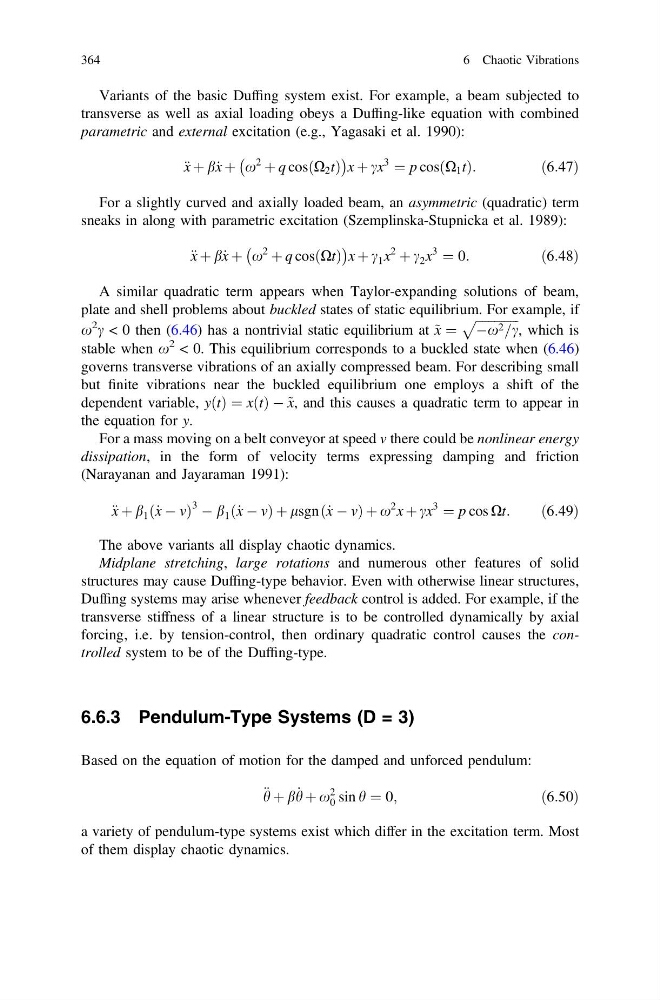
Variants of the basic Duffing system exist. For example, a beam subjected to
transverse as well as axial loading obeys a Duffing-like equation with combined
parametric and external excitation (e.g., Yagasaki et al. 1990):
€ x þ b_ x þ x
2
þ q cosðX 2 tÞ
À
Á
x þ cx
3
¼ p cosðX 1 tÞ:
ð6:47Þ
For a slightly curved and axially loaded beam, an asymmetric (quadratic) term
sneaks in along with parametric excitation (Szemplinska-Stupnicka et al. 1989):
€ x þ b_ x þ x
2
þ q cosðXtÞ
À
Á
x þ c 1 x
2
þ c 2 x
3
¼ 0:
ð6:48Þ
A similar quadratic term appears when Taylor-expanding solutions of beam,
plate and shell problems about buckled states of static equilibrium. For example, if
x
2 c < 0 then (6.46) has a nontrivial static equilibrium at ~ x ¼
ffiffiffiffiffiffiffiffiffiffiffiffiffiffi
Àx 2 =c
p
, which is
stable when x
2 < 0. This equilibrium corresponds to a buckled state when (6.46)
governs transverse vibrations of an axially compressed beam. For describing small
but finite vibrations near the buckled equilibrium one employs a shift of the
dependent variable, yðtÞ ¼ xðtÞ À ~ x, and this causes a quadratic term to appear in
the equation for y.
For a mass moving on a belt conveyor at speed v there could be nonlinear energy
dissipation, in the form of velocity terms expressing damping and friction
(Narayanan and Jayaraman 1991):
€ x þ b 1 ð_ x À vÞ
3 À b 1 ð_ x À vÞ þ lsgn ð_ x À vÞ þ x
2 x þ cx
3
¼ p cos Xt:
ð6:49Þ
The above variants all display chaotic dynamics.
Midplane stretching, large rotations and numerous other features of solid
structures may cause Duffing-type behavior. Even with otherwise linear structures,
Duffing systems may arise whenever feedback control is added. For example, if the
transverse stiffness of a linear structure is to be controlled dynamically by axial
forcing, i.e. by tension-control, then ordinary quadratic control causes the controlled system to be of the Duffing-type.
6.6.3 Pendulum-Type Systems (D = 3)
Based on the equation of motion for the damped and unforced pendulum:
€ h þ b _
h þ x
2
0 sin h ¼ 0;
ð6:50Þ
a variety of pendulum-type systems exist which differ in the excitation term. Most
of them display chaotic dynamics.
364
6 Chaotic Vibrations
transverse as well as axial loading obeys a Duffing-like equation with combined
parametric and external excitation (e.g., Yagasaki et al. 1990):
€ x þ b_ x þ x
2
þ q cosðX 2 tÞ
À
Á
x þ cx
3
¼ p cosðX 1 tÞ:
ð6:47Þ
For a slightly curved and axially loaded beam, an asymmetric (quadratic) term
sneaks in along with parametric excitation (Szemplinska-Stupnicka et al. 1989):
€ x þ b_ x þ x
2
þ q cosðXtÞ
À
Á
x þ c 1 x
2
þ c 2 x
3
¼ 0:
ð6:48Þ
A similar quadratic term appears when Taylor-expanding solutions of beam,
plate and shell problems about buckled states of static equilibrium. For example, if
x
2 c < 0 then (6.46) has a nontrivial static equilibrium at ~ x ¼
ffiffiffiffiffiffiffiffiffiffiffiffiffiffi
Àx 2 =c
p
, which is
stable when x
2 < 0. This equilibrium corresponds to a buckled state when (6.46)
governs transverse vibrations of an axially compressed beam. For describing small
but finite vibrations near the buckled equilibrium one employs a shift of the
dependent variable, yðtÞ ¼ xðtÞ À ~ x, and this causes a quadratic term to appear in
the equation for y.
For a mass moving on a belt conveyor at speed v there could be nonlinear energy
dissipation, in the form of velocity terms expressing damping and friction
(Narayanan and Jayaraman 1991):
€ x þ b 1 ð_ x À vÞ
3 À b 1 ð_ x À vÞ þ lsgn ð_ x À vÞ þ x
2 x þ cx
3
¼ p cos Xt:
ð6:49Þ
The above variants all display chaotic dynamics.
Midplane stretching, large rotations and numerous other features of solid
structures may cause Duffing-type behavior. Even with otherwise linear structures,
Duffing systems may arise whenever feedback control is added. For example, if the
transverse stiffness of a linear structure is to be controlled dynamically by axial
forcing, i.e. by tension-control, then ordinary quadratic control causes the controlled system to be of the Duffing-type.
6.6.3 Pendulum-Type Systems (D = 3)
Based on the equation of motion for the damped and unforced pendulum:
€ h þ b _
h þ x
2
0 sin h ¼ 0;
ð6:50Þ
a variety of pendulum-type systems exist which differ in the excitation term. Most
of them display chaotic dynamics.
364
6 Chaotic Vibrations