

6.6.1 The Lorenz System (D = 3)
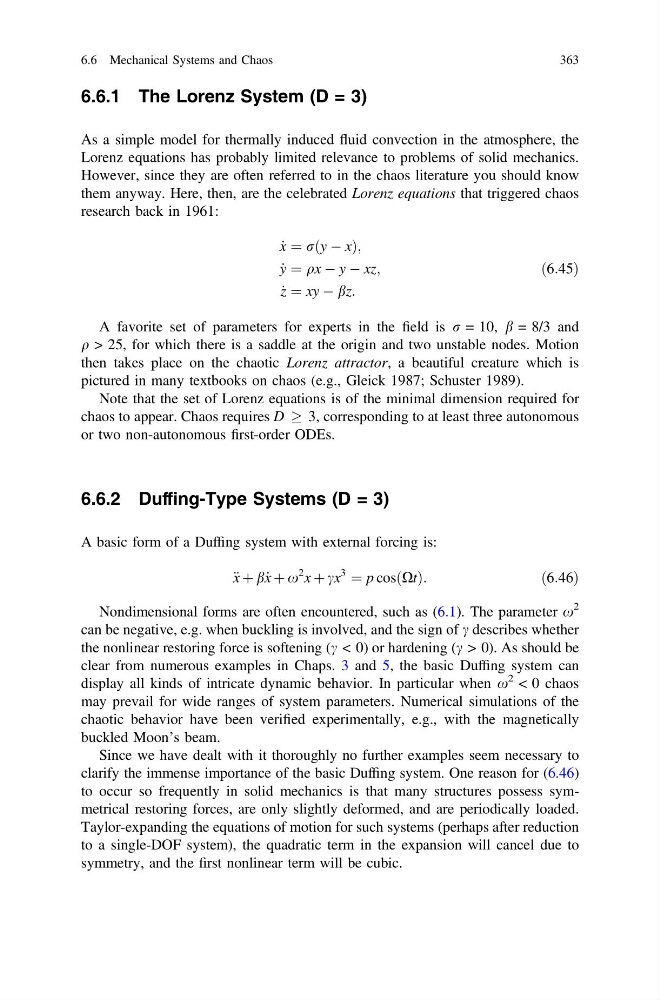
As a simple model for thermally induced fluid convection in the atmosphere, the
Lorenz equations has probably limited relevance to problems of solid mechanics.
However, since they are often referred to in the chaos literature you should know
them anyway. Here, then, are the celebrated Lorenz equations that triggered chaos
research back in 1961:
_
x ¼ rðy À xÞ;
_
y ¼ qx À y À xz;
_
z ¼ xy À bz:
ð6:45Þ
A favorite set of parameters for experts in the field is r = 10, b = 8/3 and
q > 25, for which there is a saddle at the origin and two unstable nodes. Motion
then takes place on the chaotic Lorenz attractor, a beautiful creature which is
pictured in many textbooks on chaos (e.g., Gleick 1987; Schuster 1989).
Note that the set of Lorenz equations is of the minimal dimension required for
chaos to appear. Chaos requires D ! 3, corresponding to at least three autonomous
or two non-autonomous first-order ODEs.
6.6.2 Duffing-Type Systems (D = 3)
A basic form of a Duffing system with external forcing is:
€ x þ b_ x þ x
2 x þ cx
3
¼ p cosðXtÞ:
ð6:46Þ
Nondimensional forms are often encountered, such as (6.1). The parameter x
2
can be negative, e.g. when buckling is involved, and the sign of c describes whether
the nonlinear restoring force is softening (c < 0) or hardening (c > 0). As should be
clear from numerous examples in Chaps. 3 and 5, the basic Duffing system can
display all kinds of intricate dynamic behavior. In particular when x
2 < 0 chaos
may prevail for wide ranges of system parameters. Numerical simulations of the
chaotic behavior have been verified experimentally, e.g., with the magnetically
buckled Moon’s beam.
Since we have dealt with it thoroughly no further examples seem necessary to
clarify the immense importance of the basic Duffing system. One reason for (6.46)
to occur so frequently in solid mechanics is that many structures possess symmetrical restoring forces, are only slightly deformed, and are periodically loaded.
Taylor-expanding the equations of motion for such systems (perhaps after reduction
to a single-DOF system), the quadratic term in the expansion will cancel due to
symmetry, and the first nonlinear term will be cubic.
6.6 Mechanical Systems and Chaos
363
As a simple model for thermally induced fluid convection in the atmosphere, the
Lorenz equations has probably limited relevance to problems of solid mechanics.
However, since they are often referred to in the chaos literature you should know
them anyway. Here, then, are the celebrated Lorenz equations that triggered chaos
research back in 1961:
_
x ¼ rðy À xÞ;
_
y ¼ qx À y À xz;
_
z ¼ xy À bz:
ð6:45Þ
A favorite set of parameters for experts in the field is r = 10, b = 8/3 and
q > 25, for which there is a saddle at the origin and two unstable nodes. Motion
then takes place on the chaotic Lorenz attractor, a beautiful creature which is
pictured in many textbooks on chaos (e.g., Gleick 1987; Schuster 1989).
Note that the set of Lorenz equations is of the minimal dimension required for
chaos to appear. Chaos requires D ! 3, corresponding to at least three autonomous
or two non-autonomous first-order ODEs.
6.6.2 Duffing-Type Systems (D = 3)
A basic form of a Duffing system with external forcing is:
€ x þ b_ x þ x
2 x þ cx
3
¼ p cosðXtÞ:
ð6:46Þ
Nondimensional forms are often encountered, such as (6.1). The parameter x
2
can be negative, e.g. when buckling is involved, and the sign of c describes whether
the nonlinear restoring force is softening (c < 0) or hardening (c > 0). As should be
clear from numerous examples in Chaps. 3 and 5, the basic Duffing system can
display all kinds of intricate dynamic behavior. In particular when x
2 < 0 chaos
may prevail for wide ranges of system parameters. Numerical simulations of the
chaotic behavior have been verified experimentally, e.g., with the magnetically
buckled Moon’s beam.
Since we have dealt with it thoroughly no further examples seem necessary to
clarify the immense importance of the basic Duffing system. One reason for (6.46)
to occur so frequently in solid mechanics is that many structures possess symmetrical restoring forces, are only slightly deformed, and are periodically loaded.
Taylor-expanding the equations of motion for such systems (perhaps after reduction
to a single-DOF system), the quadratic term in the expansion will cancel due to
symmetry, and the first nonlinear term will be cubic.
6.6 Mechanical Systems and Chaos
363