

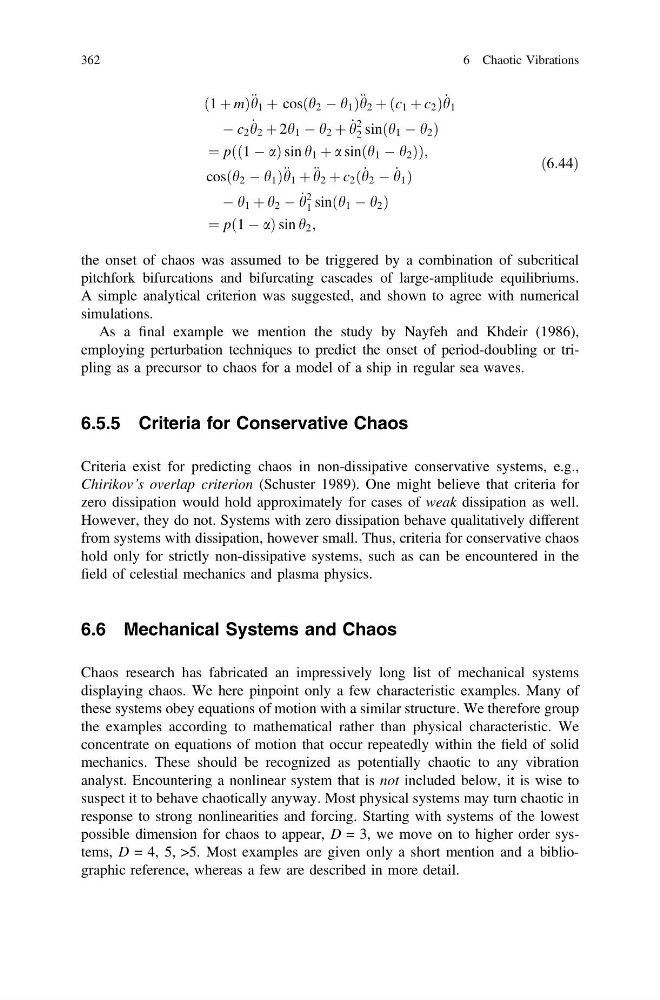
ð1 þ mÞ € h 1 þ cosðh 2 À h 1 Þ € h 2 þ ðc 1 þ c 2 Þ _
h 1
À c 2 _
h 2 þ 2h 1 À h 2 þ _
h
2
2 sinðh 1 À h 2 Þ
¼ p ð1 À aÞ sin h 1 þ a sinðh 1 À h 2 Þ
ð
Þ ;
cosðh 2 À h 1 Þ € h 1 þ € h 2 þ c 2 ð _
h 2 À _
h 1 Þ
À h 1 þ h 2 À _
h
2
1 sinðh 1 À h 2 Þ
¼ pð1 À aÞ sin h 2 ;
ð6:44Þ
the onset of chaos was assumed to be triggered by a combination of subcritical
pitchfork bifurcations and bifurcating cascades of large-amplitude equilibriums.
A simple analytical criterion was suggested, and shown to agree with numerical
simulations.
As a final example we mention the study by Nayfeh and Khdeir (1986),
employing perturbation techniques to predict the onset of period-doubling or tripling as a precursor to chaos for a model of a ship in regular sea waves.
6.5.5 Criteria for Conservative Chaos
Criteria exist for predicting chaos in non-dissipative conservative systems, e.g.,
Chirikov’s overlap criterion (Schuster 1989). One might believe that criteria for
zero dissipation would hold approximately for cases of weak dissipation as well.
However, they do not. Systems with zero dissipation behave qualitatively different
from systems with dissipation, however small. Thus, criteria for conservative chaos
hold only for strictly non-dissipative systems, such as can be encountered in the
field of celestial mechanics and plasma physics.
6.6 Mechanical Systems and Chaos
Chaos research has fabricated an impressively long list of mechanical systems
displaying chaos. We here pinpoint only a few characteristic examples. Many of
these systems obey equations of motion with a similar structure. We therefore group
the examples according to mathematical rather than physical characteristic. We
concentrate on equations of motion that occur repeatedly within the field of solid
mechanics. These should be recognized as potentially chaotic to any vibration
analyst. Encountering a nonlinear system that is not included below, it is wise to
suspect it to behave chaotically anyway. Most physical systems may turn chaotic in
response to strong nonlinearities and forcing. Starting with systems of the lowest
possible dimension for chaos to appear, D = 3, we move on to higher order systems, D = 4, 5, >5. Most examples are given only a short mention and a bibliographic reference, whereas a few are described in more detail.
362
6 Chaotic Vibrations
h 1
À c 2 _
h 2 þ 2h 1 À h 2 þ _
h
2
2 sinðh 1 À h 2 Þ
¼ p ð1 À aÞ sin h 1 þ a sinðh 1 À h 2 Þ
ð
Þ ;
cosðh 2 À h 1 Þ € h 1 þ € h 2 þ c 2 ð _
h 2 À _
h 1 Þ
À h 1 þ h 2 À _
h
2
1 sinðh 1 À h 2 Þ
¼ pð1 À aÞ sin h 2 ;
ð6:44Þ
the onset of chaos was assumed to be triggered by a combination of subcritical
pitchfork bifurcations and bifurcating cascades of large-amplitude equilibriums.
A simple analytical criterion was suggested, and shown to agree with numerical
simulations.
As a final example we mention the study by Nayfeh and Khdeir (1986),
employing perturbation techniques to predict the onset of period-doubling or tripling as a precursor to chaos for a model of a ship in regular sea waves.
6.5.5 Criteria for Conservative Chaos
Criteria exist for predicting chaos in non-dissipative conservative systems, e.g.,
Chirikov’s overlap criterion (Schuster 1989). One might believe that criteria for
zero dissipation would hold approximately for cases of weak dissipation as well.
However, they do not. Systems with zero dissipation behave qualitatively different
from systems with dissipation, however small. Thus, criteria for conservative chaos
hold only for strictly non-dissipative systems, such as can be encountered in the
field of celestial mechanics and plasma physics.
6.6 Mechanical Systems and Chaos
Chaos research has fabricated an impressively long list of mechanical systems
displaying chaos. We here pinpoint only a few characteristic examples. Many of
these systems obey equations of motion with a similar structure. We therefore group
the examples according to mathematical rather than physical characteristic. We
concentrate on equations of motion that occur repeatedly within the field of solid
mechanics. These should be recognized as potentially chaotic to any vibration
analyst. Encountering a nonlinear system that is not included below, it is wise to
suspect it to behave chaotically anyway. Most physical systems may turn chaotic in
response to strong nonlinearities and forcing. Starting with systems of the lowest
possible dimension for chaos to appear, D = 3, we move on to higher order systems, D = 4, 5, >5. Most examples are given only a short mention and a bibliographic reference, whereas a few are described in more detail.
362
6 Chaotic Vibrations