

€ x þ b_ x À
1
2
x þ
1
2
x
3
¼ p cosðXtÞ;
ð6:41Þ
and links the onset of chaos to the loss of stability of certain periodic orbits (e.g.,
Szemplinska-Stupnicka 1992; Szemplinska-Stupnicka and Rudowski 1992;
Rudowski and Szemplinska-Stupnicka 1987). Their criterion agrees more closely
with numerical simulation than does the Melnikov criterion.
A similar criterion was given for the following asymmetric and parametrically
excited Duffing system (Szemplinska-Stupnicka et al. 1989):
€ x þ 2b_ x þ k 2 þ k 3 cosðXtÞ
ð
Þ x þ ax
2
þ bx
3
¼ 0:
ð6:42Þ
Dowell and Pezeshki (1986, 1988) too considered criteria for the Duffing
equation with negative linear stiffness. Numerical evidence was given in Dowell
and Pezeshki (1988) that, for this particular system, chaos occurs when there is a
near intersection of stable and unstable limit cycles in the phase space.
Thomsen (1992) provided a perturbation-based criterion for a non-shallow arch
governed by the coupled equations:
€ f þ 2b _
f þ ð1 À mx
2 uÞf ¼ 0;
€ u þ 2bx _
u þ x
2 u þ jðf € f þ _
f
2
Þ ¼ ðq=mÞ cosðXsÞ:
ð6:43Þ
The criterion, showing good agreement with numerical simulation, links the
onset of chaos to loss of limit cycle stability near primary resonance X % x.
In a study (Thomsen 1995) of chaos for a follower-loaded elastic double pendulum governed by:
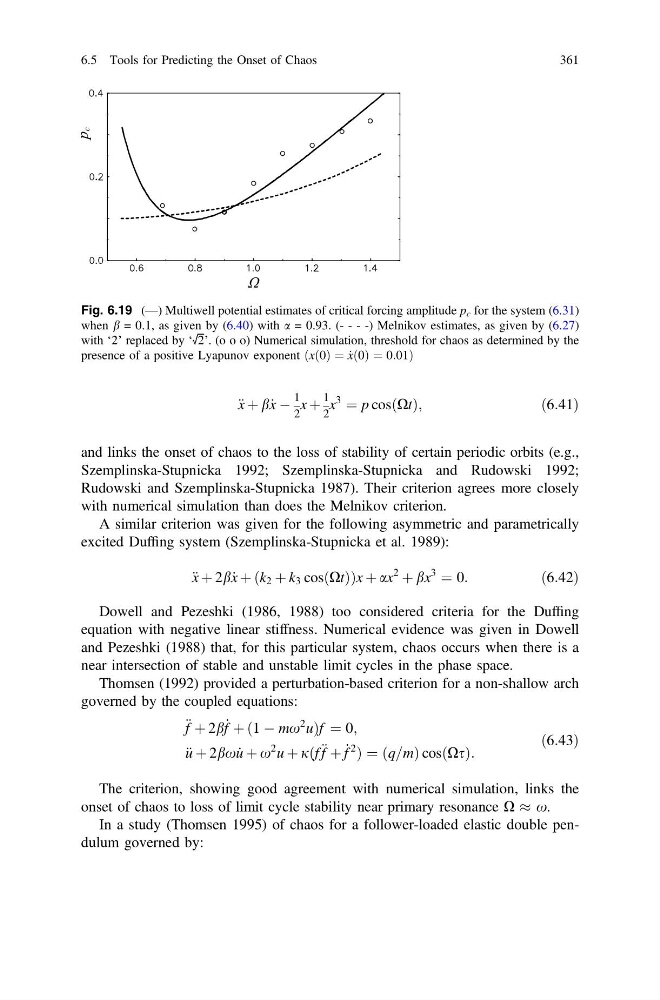
Fig. 6.19 (—) Multiwell potential estimates of critical forcing amplitude p c for the system (6.31)
when b = 0.1, as given by (6.40) with a = 0.93. (- - - -) Melnikov estimates, as given by (6.27)
with ‘2’ replaced by ‘√2’. (o o o) Numerical simulation, threshold for chaos as determined by the
presence of a positive Lyapunov exponent ðx 0
ð Þ ¼ _
xð0Þ ¼ 0:01Þ
6.5 Tools for Predicting the Onset of Chaos
361
1
2
x þ
1
2
x
3
¼ p cosðXtÞ;
ð6:41Þ
and links the onset of chaos to the loss of stability of certain periodic orbits (e.g.,
Szemplinska-Stupnicka 1992; Szemplinska-Stupnicka and Rudowski 1992;
Rudowski and Szemplinska-Stupnicka 1987). Their criterion agrees more closely
with numerical simulation than does the Melnikov criterion.
A similar criterion was given for the following asymmetric and parametrically
excited Duffing system (Szemplinska-Stupnicka et al. 1989):
€ x þ 2b_ x þ k 2 þ k 3 cosðXtÞ
ð
Þ x þ ax
2
þ bx
3
¼ 0:
ð6:42Þ
Dowell and Pezeshki (1986, 1988) too considered criteria for the Duffing
equation with negative linear stiffness. Numerical evidence was given in Dowell
and Pezeshki (1988) that, for this particular system, chaos occurs when there is a
near intersection of stable and unstable limit cycles in the phase space.
Thomsen (1992) provided a perturbation-based criterion for a non-shallow arch
governed by the coupled equations:
€ f þ 2b _
f þ ð1 À mx
2 uÞf ¼ 0;
€ u þ 2bx _
u þ x
2 u þ jðf € f þ _
f
2
Þ ¼ ðq=mÞ cosðXsÞ:
ð6:43Þ
The criterion, showing good agreement with numerical simulation, links the
onset of chaos to loss of limit cycle stability near primary resonance X % x.
In a study (Thomsen 1995) of chaos for a follower-loaded elastic double pendulum governed by:
Fig. 6.19 (—) Multiwell potential estimates of critical forcing amplitude p c for the system (6.31)
when b = 0.1, as given by (6.40) with a = 0.93. (- - - -) Melnikov estimates, as given by (6.27)
with ‘2’ replaced by ‘√2’. (o o o) Numerical simulation, threshold for chaos as determined by the
presence of a positive Lyapunov exponent ðx 0
ð Þ ¼ _
xð0Þ ¼ 0:01Þ
6.5 Tools for Predicting the Onset of Chaos
361