

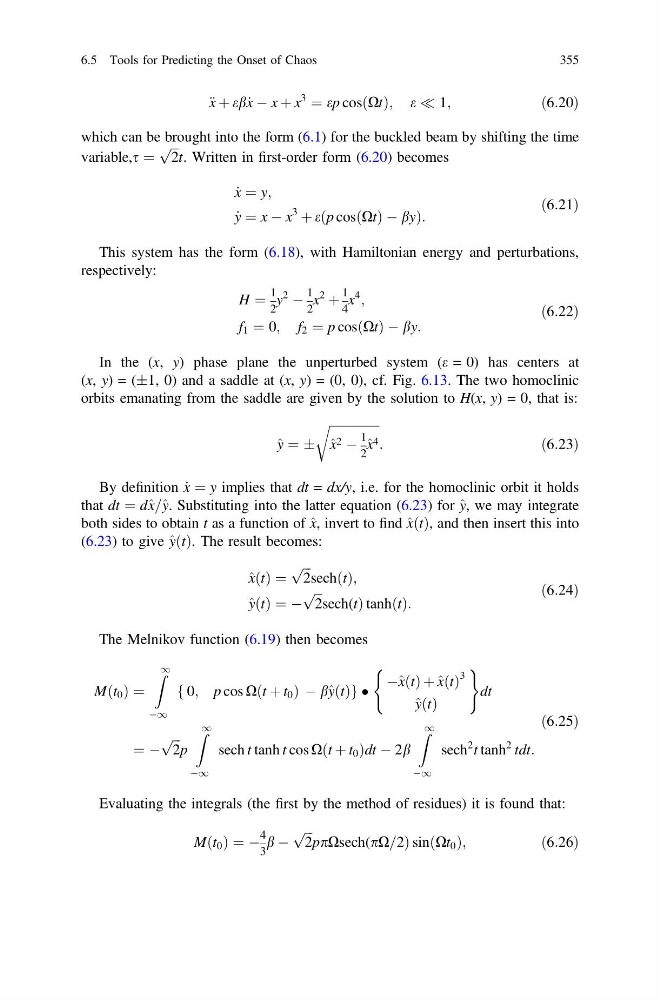
€ x þ eb_ x À x þ x
3
¼ ep cosðXtÞ; e ( 1;
ð6:20Þ
which can be brought into the form (6.1) for the buckled beam by shifting the time
variable,s ¼
ffiffi ffi
2
p
t. Written in first-order form (6.20) becomes
_
x ¼ y;
_
y ¼ x À x
3
þ e p cosðXtÞ À by
ð
Þ :
ð6:21Þ
This system has the form (6.18), with Hamiltonian energy and perturbations,
respectively:
H ¼
1
2
y
2
À
1
2
x
2
þ
1
4
x
4
;
f 1 ¼ 0; f 2 ¼ p cosðXtÞ À by:
ð6:22Þ
In the (x, y) phase plane the unperturbed system (e = 0) has centers at
(x, y) = (±1, 0) and a saddle at (x, y) = (0, 0), cf. Fig. 6.13. The two homoclinic
orbits emanating from the saddle are given by the solution to H(x, y) = 0, that is:
^ y ¼ Æ
ffiffiffiffiffiffiffiffiffiffiffiffiffiffiffiffi
^ x 2 À
1
2
^ x 4
r
:
ð6:23Þ
By definition _
x ¼ y implies that dt = dx/y, i.e. for the homoclinic orbit it holds
that dt ¼ d^ x=^ y. Substituting into the latter equation (6.23) for ^ y, we may integrate
both sides to obtain t as a function of ^ x, invert to find ^ xðtÞ, and then insert this into
(6.23) to give ^ yðtÞ. The result becomes:
^ xðtÞ ¼
ffiffi ffi
2
p
sechðtÞ;
^ yðtÞ ¼ À
ffiffi ffi
2
p
sech(tÞ tanhðtÞ:
ð6:24Þ
The Melnikov function (6.19) then becomes
Mðt 0 Þ ¼
Z 1
À1
0; p cos Xðt þ t 0 Þ À b^ yðtÞ
f
g
À^ xðtÞ þ ^ xðtÞ
3
^ yðtÞ
(
)
dt
¼ À
ffiffi ffi
2
p
p
Z 1
À1
sech t tanh t cos Xðt þ t 0 Þdt À 2b
Z 1
À1
sech
2 t tanh
2 tdt:
ð6:25Þ
Evaluating the integrals (the first by the method of residues) it is found that:
Mðt 0 Þ ¼ À
4
3
b À
ffiffi ffi
2
p
ppXsech(pX=2Þ sinðXt 0 Þ;
ð6:26Þ
6.5 Tools for Predicting the Onset of Chaos
355
3
¼ ep cosðXtÞ; e ( 1;
ð6:20Þ
which can be brought into the form (6.1) for the buckled beam by shifting the time
variable,s ¼
ffiffi ffi
2
p
t. Written in first-order form (6.20) becomes
_
x ¼ y;
_
y ¼ x À x
3
þ e p cosðXtÞ À by
ð
Þ :
ð6:21Þ
This system has the form (6.18), with Hamiltonian energy and perturbations,
respectively:
H ¼
1
2
y
2
À
1
2
x
2
þ
1
4
x
4
;
f 1 ¼ 0; f 2 ¼ p cosðXtÞ À by:
ð6:22Þ
In the (x, y) phase plane the unperturbed system (e = 0) has centers at
(x, y) = (±1, 0) and a saddle at (x, y) = (0, 0), cf. Fig. 6.13. The two homoclinic
orbits emanating from the saddle are given by the solution to H(x, y) = 0, that is:
^ y ¼ Æ
ffiffiffiffiffiffiffiffiffiffiffiffiffiffiffiffi
^ x 2 À
1
2
^ x 4
r
:
ð6:23Þ
By definition _
x ¼ y implies that dt = dx/y, i.e. for the homoclinic orbit it holds
that dt ¼ d^ x=^ y. Substituting into the latter equation (6.23) for ^ y, we may integrate
both sides to obtain t as a function of ^ x, invert to find ^ xðtÞ, and then insert this into
(6.23) to give ^ yðtÞ. The result becomes:
^ xðtÞ ¼
ffiffi ffi
2
p
sechðtÞ;
^ yðtÞ ¼ À
ffiffi ffi
2
p
sech(tÞ tanhðtÞ:
ð6:24Þ
The Melnikov function (6.19) then becomes
Mðt 0 Þ ¼
Z 1
À1
0; p cos Xðt þ t 0 Þ À b^ yðtÞ
f
g
À^ xðtÞ þ ^ xðtÞ
3
^ yðtÞ
(
)
dt
¼ À
ffiffi ffi
2
p
p
Z 1
À1
sech t tanh t cos Xðt þ t 0 Þdt À 2b
Z 1
À1
sech
2 t tanh
2 tdt:
ð6:25Þ
Evaluating the integrals (the first by the method of residues) it is found that:
Mðt 0 Þ ¼ À
4
3
b À
ffiffi ffi
2
p
ppXsech(pX=2Þ sinðXt 0 Þ;
ð6:26Þ
6.5 Tools for Predicting the Onset of Chaos
355