

the Melnikov function has a simple zero, that is, when the stable and unstable
saddle manifolds of the Poincaré map intersect transversely.
We present here a Melnikov function for systems that can be expressed in the
following form:
_
x ¼
@H
@y
þ ef 1 ðx; y; tÞ;
_
y ¼ À
@H
@x
þ ef 2 ðx; y; tÞ;
ð6:18Þ
where H(x, y) is the Hamiltonian of the corresponding undamped and unforced
system, e is a small parameter, and the functions f i are T-periodic in time,
f i (t + T) = f i (t). It is further assumed that a saddle-point exists for the unperturbed
Hamiltonian problem, i.e. when e = 0 in (6.18). A Poincaré map obtained in phase
with the periodic terms f i then too has a saddle-point, with stable and unstable
manifolds W
s and W
u (Guckenheimer and Holmes 1983). The separation between
W
s and W
u in the Poincaré map is given by the Melnikov function:
Mðt 0 Þ ¼
Z 1
À1
f
T
ð^ x; ^ y; t þ t 0 Þ Á rHð^ x; ^ yÞdt;
ð6:19Þ
where f
T = {f 1 , f 2 }, ∇H is the gradient of H; ð^ xðtÞ; ^ yðtÞÞ describes the homoclinic (or
heteroclinic) saddle orbit of the unperturbed Hamiltonian system, and t 0 measures
the distance along the unperturbed homoclinic (or heteroclinic) orbit. Homoclinic
intersections occur when M(t 0 ) = 0.
As an application example we consider a Duffing equation with negative linear
stiffness, weak damping and small forcing:
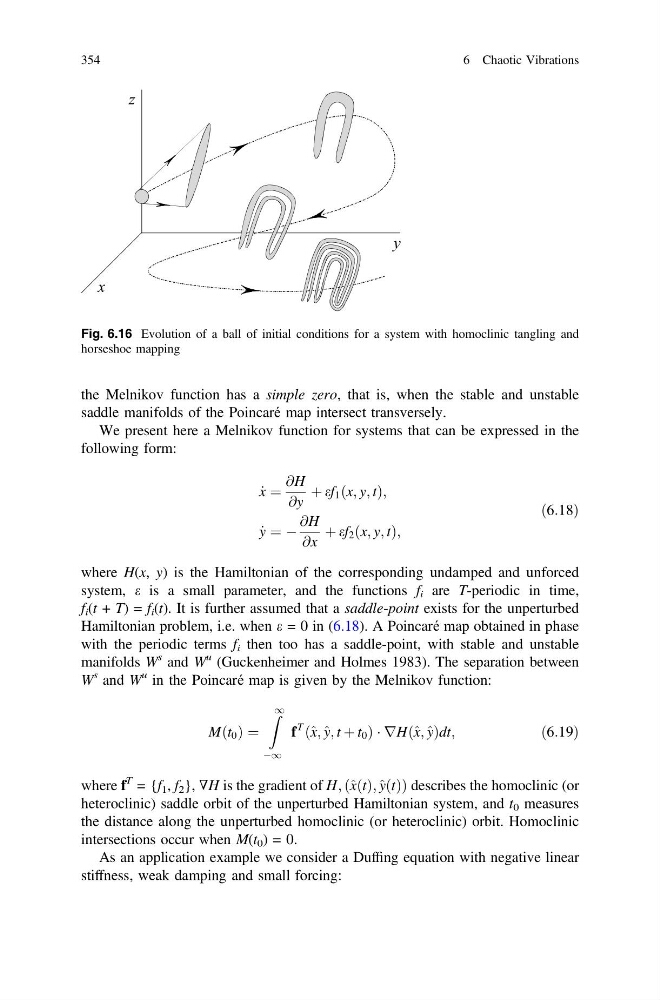
Fig. 6.16 Evolution of a ball of initial conditions for a system with homoclinic tangling and
horseshoe mapping
354
6 Chaotic Vibrations
saddle manifolds of the Poincaré map intersect transversely.
We present here a Melnikov function for systems that can be expressed in the
following form:
_
x ¼
@H
@y
þ ef 1 ðx; y; tÞ;
_
y ¼ À
@H
@x
þ ef 2 ðx; y; tÞ;
ð6:18Þ
where H(x, y) is the Hamiltonian of the corresponding undamped and unforced
system, e is a small parameter, and the functions f i are T-periodic in time,
f i (t + T) = f i (t). It is further assumed that a saddle-point exists for the unperturbed
Hamiltonian problem, i.e. when e = 0 in (6.18). A Poincaré map obtained in phase
with the periodic terms f i then too has a saddle-point, with stable and unstable
manifolds W
s and W
u (Guckenheimer and Holmes 1983). The separation between
W
s and W
u in the Poincaré map is given by the Melnikov function:
Mðt 0 Þ ¼
Z 1
À1
f
T
ð^ x; ^ y; t þ t 0 Þ Á rHð^ x; ^ yÞdt;
ð6:19Þ
where f
T = {f 1 , f 2 }, ∇H is the gradient of H; ð^ xðtÞ; ^ yðtÞÞ describes the homoclinic (or
heteroclinic) saddle orbit of the unperturbed Hamiltonian system, and t 0 measures
the distance along the unperturbed homoclinic (or heteroclinic) orbit. Homoclinic
intersections occur when M(t 0 ) = 0.
As an application example we consider a Duffing equation with negative linear
stiffness, weak damping and small forcing:
Fig. 6.16 Evolution of a ball of initial conditions for a system with homoclinic tangling and
horseshoe mapping
354
6 Chaotic Vibrations