

Horseshoes Homoclinic tangling leads to Smale horseshoes in the dynamics of
the PM (e.g., Guckenheimer and Holmes 1983). Horseshoes are just the geometrical descriptors of the process of stretching and folding of initial conditions, and
Stephen Smale (1967) was the one to uncover their importance for the chaotic
dynamics of maps.
If a system is governed by a map of the horseshoe type, then a ball of initial
conditions in phase space is mapped onto a new shape in which the original ball is
stretched and folded (Fig. 6.16). For dissipative systems _
x ¼ fðxÞ, the divergence of
the vector field f(x) is always negative, so that volumes get mapped onto smaller
volumes. We say that dissipative systems are volume contracting. However, near the
unstable manifolds of a Poincaré map saddle, volumes are stretched in the direction
of the manifold. Since the total volume must decrease, the ball of initial conditions
must contract more than it stretches. Near homoclinic points, if present, the volume
is also folded – and a horseshoe appears (at least we visualize it this way).
After many iterations of the map this process of repeated stretching and folding
produces a fractal-like structure, and the precise information as to which orbit
originated where is lost. For each subsequent stretch and fold, more and more
precision is required to relate initial conditions to later states of the system. With
finite precision devices (computers, humans, rulers, watches, etc.) accurate prediction becomes impossible.
6.5.3 The Melnikov Criterion
As appears from the above discussion, homoclinic tangling is likely to produce
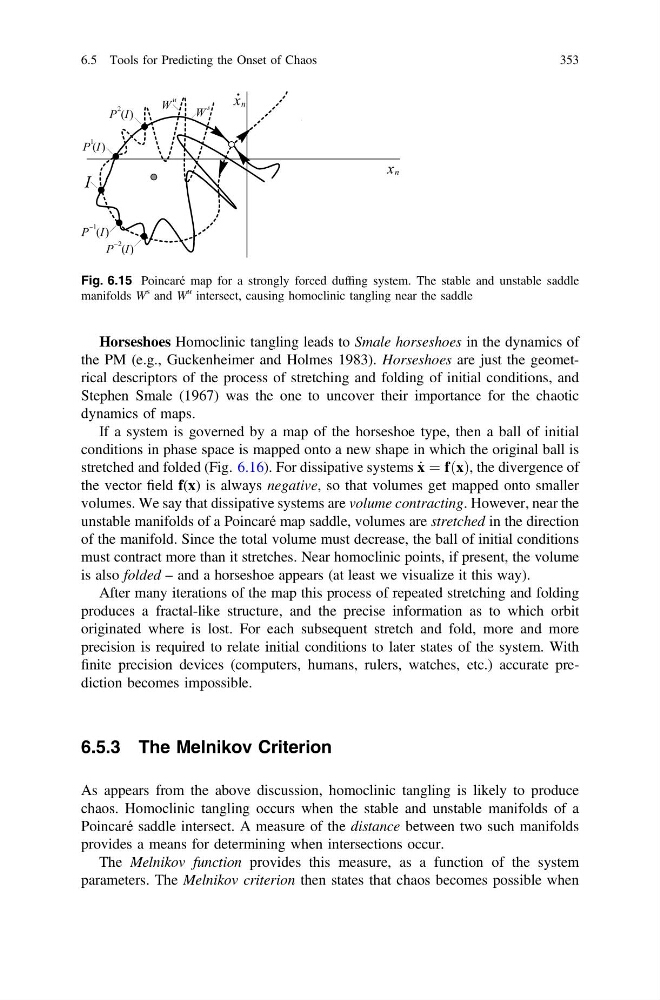
chaos. Homoclinic tangling occurs when the stable and unstable manifolds of a
Poincaré saddle intersect. A measure of the distance between two such manifolds
provides a means for determining when intersections occur.
The Melnikov function provides this measure, as a function of the system
parameters. The Melnikov criterion then states that chaos becomes possible when
Fig. 6.15 Poincaré map for a strongly forced duffing system. The stable and unstable saddle
manifolds W
s and W
u intersect, causing homoclinic tangling near the saddle
6.5 Tools for Predicting the Onset of Chaos
353
the PM (e.g., Guckenheimer and Holmes 1983). Horseshoes are just the geometrical descriptors of the process of stretching and folding of initial conditions, and
Stephen Smale (1967) was the one to uncover their importance for the chaotic
dynamics of maps.
If a system is governed by a map of the horseshoe type, then a ball of initial
conditions in phase space is mapped onto a new shape in which the original ball is
stretched and folded (Fig. 6.16). For dissipative systems _
x ¼ fðxÞ, the divergence of
the vector field f(x) is always negative, so that volumes get mapped onto smaller
volumes. We say that dissipative systems are volume contracting. However, near the
unstable manifolds of a Poincaré map saddle, volumes are stretched in the direction
of the manifold. Since the total volume must decrease, the ball of initial conditions
must contract more than it stretches. Near homoclinic points, if present, the volume
is also folded – and a horseshoe appears (at least we visualize it this way).
After many iterations of the map this process of repeated stretching and folding
produces a fractal-like structure, and the precise information as to which orbit
originated where is lost. For each subsequent stretch and fold, more and more
precision is required to relate initial conditions to later states of the system. With
finite precision devices (computers, humans, rulers, watches, etc.) accurate prediction becomes impossible.
6.5.3 The Melnikov Criterion
As appears from the above discussion, homoclinic tangling is likely to produce
chaos. Homoclinic tangling occurs when the stable and unstable manifolds of a
Poincaré saddle intersect. A measure of the distance between two such manifolds
provides a means for determining when intersections occur.
The Melnikov function provides this measure, as a function of the system
parameters. The Melnikov criterion then states that chaos becomes possible when
Fig. 6.15 Poincaré map for a strongly forced duffing system. The stable and unstable saddle
manifolds W
s and W
u intersect, causing homoclinic tangling near the saddle
6.5 Tools for Predicting the Onset of Chaos
353