

falls on W
s which is an invariant manifold, the next iterate of the map, P
1 (I), must
also fall on W
s . By the same argument P
1 (I) must also fall on W
u
. But then P
1 (I) must
fall on an intersection between W
s and W
u , because this is the only way to fall on
both manifolds. We can continue this reasoning and show that subsequent PM points
P
2 (I), P
3 (I), … will all fall on manifold intersections, as will the backward iterates
P
−1 (I), P
−2 (I), …. Hence, if the stable and unstable manifolds intersect once, they
will continue to do so an infinite number of times. Further, the forward iterates P
2
(I),
P
3 (I), … approach the saddle along the stable manifold, whereas the backward
iterates P
−1 (I), P
−2 (I), … approach the saddle along the unstable manifold. Hence,
the homoclinic points fall on an orbit of the PM originating from and ending at the
saddle. Naturally, this orbit is called the homoclinic orbit for the PM.
Homoclinic Tangling As originally observed by Poincaré, homoclinic intersections
always cause wild oscillations near the saddle. Near the saddle, as appears from
Fig. 6.15, the stable and unstable manifolds get bunched up, creating an image
known as homoclinic tangling. These tangles beat at the heart of chaos, because in
the region of homoclinic tangling initial conditions are subjected to a process of
violent stretching and folding. We refer to this stretching and folding as extreme
sensitivity to initial conditions.
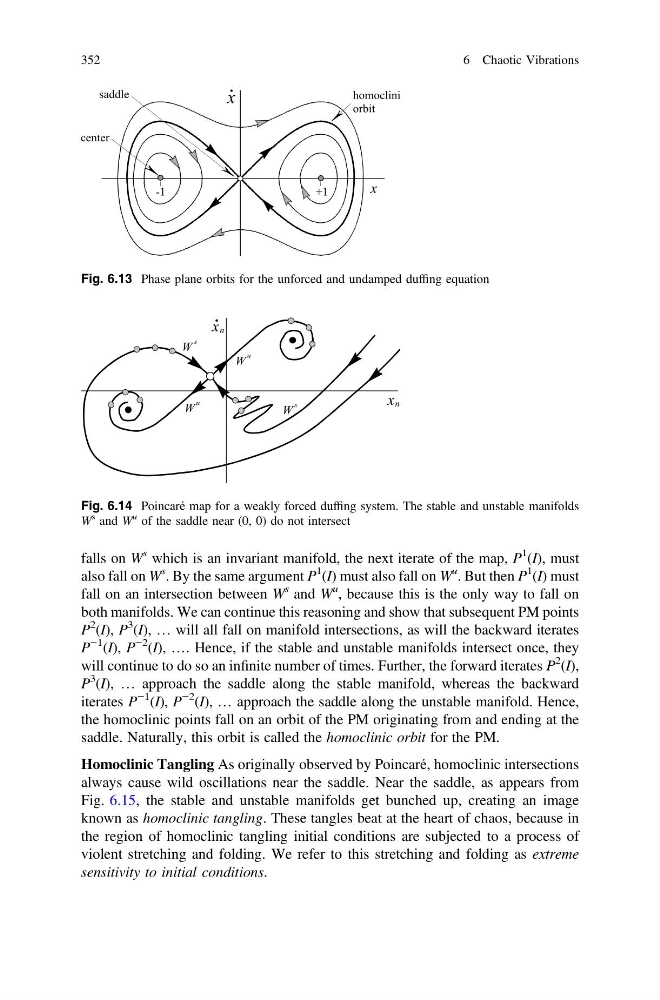
Fig. 6.13 Phase plane orbits for the unforced and undamped duffing equation
Fig. 6.14 Poincaré map for a weakly forced duffing system. The stable and unstable manifolds
W
s and W
u of the saddle near (0, 0) do not intersect
352
6 Chaotic Vibrations
s which is an invariant manifold, the next iterate of the map, P
1 (I), must
also fall on W
s . By the same argument P
1 (I) must also fall on W
u
. But then P
1 (I) must
fall on an intersection between W
s and W
u , because this is the only way to fall on
both manifolds. We can continue this reasoning and show that subsequent PM points
P
2 (I), P
3 (I), … will all fall on manifold intersections, as will the backward iterates
P
−1 (I), P
−2 (I), …. Hence, if the stable and unstable manifolds intersect once, they
will continue to do so an infinite number of times. Further, the forward iterates P
2
(I),
P
3 (I), … approach the saddle along the stable manifold, whereas the backward
iterates P
−1 (I), P
−2 (I), … approach the saddle along the unstable manifold. Hence,
the homoclinic points fall on an orbit of the PM originating from and ending at the
saddle. Naturally, this orbit is called the homoclinic orbit for the PM.
Homoclinic Tangling As originally observed by Poincaré, homoclinic intersections
always cause wild oscillations near the saddle. Near the saddle, as appears from
Fig. 6.15, the stable and unstable manifolds get bunched up, creating an image
known as homoclinic tangling. These tangles beat at the heart of chaos, because in
the region of homoclinic tangling initial conditions are subjected to a process of
violent stretching and folding. We refer to this stretching and folding as extreme
sensitivity to initial conditions.
Fig. 6.13 Phase plane orbits for the unforced and undamped duffing equation
Fig. 6.14 Poincaré map for a weakly forced duffing system. The stable and unstable manifolds
W
s and W
u of the saddle near (0, 0) do not intersect
352
6 Chaotic Vibrations