

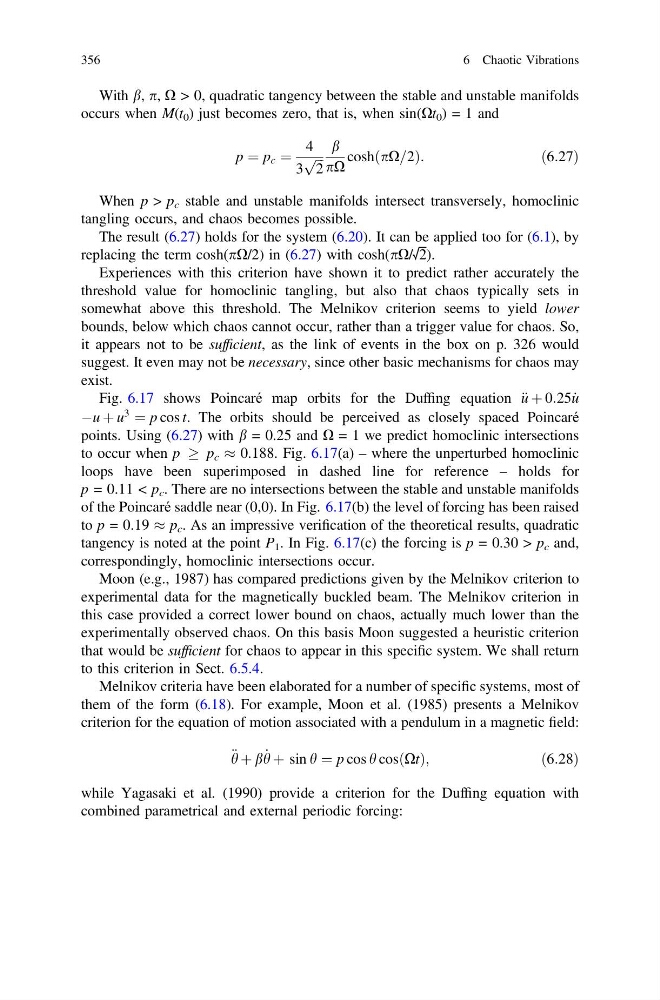
With b, p, X > 0, quadratic tangency between the stable and unstable manifolds
occurs when M(t 0 ) just becomes zero, that is, when sin(Xt 0 ) = 1 and
p ¼ p c ¼
4
3
ffiffi ffi
2
p
b
pX
coshðpX=2Þ:
ð6:27Þ
When p > p c stable and unstable manifolds intersect transversely, homoclinic
tangling occurs, and chaos becomes possible.
The result (6.27) holds for the system (6.20). It can be applied too for (6.1), by
replacing the term cosh(pX/2) in (6.27) with cosh(pX/√2).
Experiences with this criterion have shown it to predict rather accurately the
threshold value for homoclinic tangling, but also that chaos typically sets in
somewhat above this threshold. The Melnikov criterion seems to yield lower
bounds, below which chaos cannot occur, rather than a trigger value for chaos. So,
it appears not to be sufficient, as the link of events in the box on p. 326 would
suggest. It even may not be necessary, since other basic mechanisms for chaos may
exist.
Fig. 6.17 shows Poincaré map orbits for the Duffing equation € u þ 0:25 _
u
Àu þ u
3
¼ p cos t. The orbits should be perceived as closely spaced Poincaré
points. Using (6.27) with b = 0.25 and X = 1 we predict homoclinic intersections
to occur when p ! p c % 0.188. Fig. 6.17(a) – where the unperturbed homoclinic
loops have been superimposed in dashed line for reference – holds for
p = 0.11 < p c . There are no intersections between the stable and unstable manifolds
of the Poincaré saddle near (0,0). In Fig. 6.17(b) the level of forcing has been raised
to p = 0.19 % p c . As an impressive verification of the theoretical results, quadratic
tangency is noted at the point P 1 . In Fig. 6.17(c) the forcing is p = 0.30 > p c and,
correspondingly, homoclinic intersections occur.
Moon (e.g., 1987) has compared predictions given by the Melnikov criterion to
experimental data for the magnetically buckled beam. The Melnikov criterion in
this case provided a correct lower bound on chaos, actually much lower than the
experimentally observed chaos. On this basis Moon suggested a heuristic criterion
that would be sufficient for chaos to appear in this specific system. We shall return
to this criterion in Sect. 6.5.4.
Melnikov criteria have been elaborated for a number of specific systems, most of
them of the form (6.18). For example, Moon et al. (1985) presents a Melnikov
criterion for the equation of motion associated with a pendulum in a magnetic field:
€ h þ b _
h þ sin h ¼ p cos h cosðXtÞ;
ð6:28Þ
while Yagasaki et al. (1990) provide a criterion for the Duffing equation with
combined parametrical and external periodic forcing:
356
6 Chaotic Vibrations
occurs when M(t 0 ) just becomes zero, that is, when sin(Xt 0 ) = 1 and
p ¼ p c ¼
4
3
ffiffi ffi
2
p
b
pX
coshðpX=2Þ:
ð6:27Þ
When p > p c stable and unstable manifolds intersect transversely, homoclinic
tangling occurs, and chaos becomes possible.
The result (6.27) holds for the system (6.20). It can be applied too for (6.1), by
replacing the term cosh(pX/2) in (6.27) with cosh(pX/√2).
Experiences with this criterion have shown it to predict rather accurately the
threshold value for homoclinic tangling, but also that chaos typically sets in
somewhat above this threshold. The Melnikov criterion seems to yield lower
bounds, below which chaos cannot occur, rather than a trigger value for chaos. So,
it appears not to be sufficient, as the link of events in the box on p. 326 would
suggest. It even may not be necessary, since other basic mechanisms for chaos may
exist.
Fig. 6.17 shows Poincaré map orbits for the Duffing equation € u þ 0:25 _
u
Àu þ u
3
¼ p cos t. The orbits should be perceived as closely spaced Poincaré
points. Using (6.27) with b = 0.25 and X = 1 we predict homoclinic intersections
to occur when p ! p c % 0.188. Fig. 6.17(a) – where the unperturbed homoclinic
loops have been superimposed in dashed line for reference – holds for
p = 0.11 < p c . There are no intersections between the stable and unstable manifolds
of the Poincaré saddle near (0,0). In Fig. 6.17(b) the level of forcing has been raised
to p = 0.19 % p c . As an impressive verification of the theoretical results, quadratic
tangency is noted at the point P 1 . In Fig. 6.17(c) the forcing is p = 0.30 > p c and,
correspondingly, homoclinic intersections occur.
Moon (e.g., 1987) has compared predictions given by the Melnikov criterion to
experimental data for the magnetically buckled beam. The Melnikov criterion in
this case provided a correct lower bound on chaos, actually much lower than the
experimentally observed chaos. On this basis Moon suggested a heuristic criterion
that would be sufficient for chaos to appear in this specific system. We shall return
to this criterion in Sect. 6.5.4.
Melnikov criteria have been elaborated for a number of specific systems, most of
them of the form (6.18). For example, Moon et al. (1985) presents a Melnikov
criterion for the equation of motion associated with a pendulum in a magnetic field:
€ h þ b _
h þ sin h ¼ p cos h cosðXtÞ;
ð6:28Þ
while Yagasaki et al. (1990) provide a criterion for the Duffing equation with
combined parametrical and external periodic forcing:
356
6 Chaotic Vibrations