

6.5 Tools for Predicting the Onset of Chaos
Given a set of model equations for a dynamical system, it would be nice having a
general tool for predicting if chaos could occur. And, in case it could, for which
values of system parameters and initial conditions. Unfortunately there is no such
tool.
While awaiting the invention of a generally applicable predictive tool, we have
to rely on less powerful methods. None of these methods are universally applicable,
nor are they particularly simple to apply.
6.5.1 Criteria Related to the Universal Routes
of Chaos
These criteria take as their starting point the postulated universality of certain routes
to chaos: the period-doubling, quasiperiodic, transient and intermittency- routes
described in Sect. 6.4. Observing characteristic events related to any particular
route (e.g., period-doublings), one can attempt predicting critical values for chaos to
occur by employing the corresponding universal scaling law.
Though in some cases predictions of acceptable quality have been obtained, one
has to raise a flag of caution as to the uncritical employment of such procedures. It
should be kept in mind that the term universal is to be associated with certain
classes of systems. For example, Feigenbaum (1978, 1980) proved the
period-doubling route to chaos to be a universal feature of systems that can be
approximated by one-dimensional maps with a zero tangent. Many nonlinear systems cannot be approximated by such a map. Though such systems may display
accumulating period-doublings, there is no guarantee that they will do so according
to the Feigenbaum law (6.12).
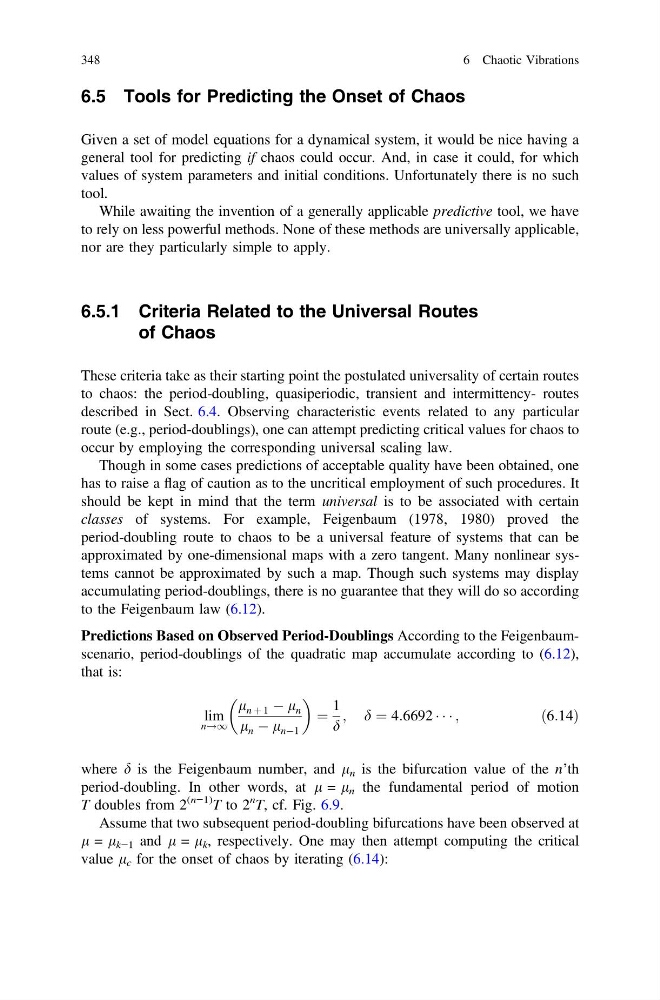
Predictions Based on Observed Period-Doublings According to the Feigenbaumscenario, period-doublings of the quadratic map accumulate according to (6.12),
that is:
lim
n!1
l n þ 1 À l n
l n À l nÀ1
¼
1
d
; d ¼ 4:6692 Á Á Á ;
ð6:14Þ
where d is the Feigenbaum number, and l n is the bifurcation value of the n’th
period-doubling. In other words, at l = l n the fundamental period of motion
T doubles from 2
(n−1)
T to 2
n T, cf. Fig. 6.9.
Assume that two subsequent period-doubling bifurcations have been observed at
l = l k−1 and l = l k , respectively. One may then attempt computing the critical
value l c for the onset of chaos by iterating (6.14):
348
6 Chaotic Vibrations
Given a set of model equations for a dynamical system, it would be nice having a
general tool for predicting if chaos could occur. And, in case it could, for which
values of system parameters and initial conditions. Unfortunately there is no such
tool.
While awaiting the invention of a generally applicable predictive tool, we have
to rely on less powerful methods. None of these methods are universally applicable,
nor are they particularly simple to apply.
6.5.1 Criteria Related to the Universal Routes
of Chaos
These criteria take as their starting point the postulated universality of certain routes
to chaos: the period-doubling, quasiperiodic, transient and intermittency- routes
described in Sect. 6.4. Observing characteristic events related to any particular
route (e.g., period-doublings), one can attempt predicting critical values for chaos to
occur by employing the corresponding universal scaling law.
Though in some cases predictions of acceptable quality have been obtained, one
has to raise a flag of caution as to the uncritical employment of such procedures. It
should be kept in mind that the term universal is to be associated with certain
classes of systems. For example, Feigenbaum (1978, 1980) proved the
period-doubling route to chaos to be a universal feature of systems that can be
approximated by one-dimensional maps with a zero tangent. Many nonlinear systems cannot be approximated by such a map. Though such systems may display
accumulating period-doublings, there is no guarantee that they will do so according
to the Feigenbaum law (6.12).
Predictions Based on Observed Period-Doublings According to the Feigenbaumscenario, period-doublings of the quadratic map accumulate according to (6.12),
that is:
lim
n!1
l n þ 1 À l n
l n À l nÀ1
¼
1
d
; d ¼ 4:6692 Á Á Á ;
ð6:14Þ
where d is the Feigenbaum number, and l n is the bifurcation value of the n’th
period-doubling. In other words, at l = l n the fundamental period of motion
T doubles from 2
(n−1)
T to 2
n T, cf. Fig. 6.9.
Assume that two subsequent period-doubling bifurcations have been observed at
l = l k−1 and l = l k , respectively. One may then attempt computing the critical
value l c for the onset of chaos by iterating (6.14):
348
6 Chaotic Vibrations