

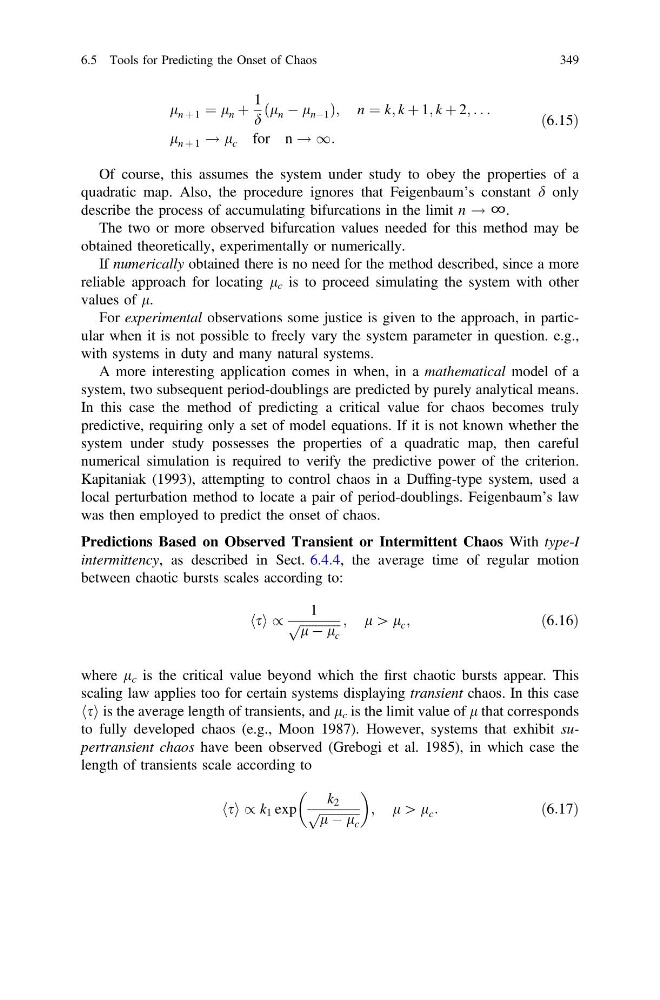
l n þ 1 ¼ l n þ
1
d
ðl n À l nÀ1 Þ; n ¼ k; k þ 1; k þ 2; . . .
l n þ 1 ! l c for n ! 1:
ð6:15Þ
Of course, this assumes the system under study to obey the properties of a
quadratic map. Also, the procedure ignores that Feigenbaum’s constant d only
describe the process of accumulating bifurcations in the limit n ! ∞.
The two or more observed bifurcation values needed for this method may be
obtained theoretically, experimentally or numerically.
If numerically obtained there is no need for the method described, since a more
reliable approach for locating l c is to proceed simulating the system with other
values of l.
For experimental observations some justice is given to the approach, in particular when it is not possible to freely vary the system parameter in question. e.g.,
with systems in duty and many natural systems.
A more interesting application comes in when, in a mathematical model of a
system, two subsequent period-doublings are predicted by purely analytical means.
In this case the method of predicting a critical value for chaos becomes truly
predictive, requiring only a set of model equations. If it is not known whether the
system under study possesses the properties of a quadratic map, then careful
numerical simulation is required to verify the predictive power of the criterion.
Kapitaniak (1993), attempting to control chaos in a Duffing-type system, used a
local perturbation method to locate a pair of period-doublings. Feigenbaum’s law
was then employed to predict the onset of chaos.
Predictions Based on Observed Transient or Intermittent Chaos With type-I
intermittency, as described in Sect. 6.4.4, the average time of regular motion
between chaotic bursts scales according to:
s
h i /
1
ffiffiffiffiffiffiffiffiffiffiffiffiffi
l À l c
p
; l [ l c ;
ð6:16Þ
where l c is the critical value beyond which the first chaotic bursts appear. This
scaling law applies too for certain systems displaying transient chaos. In this case
s
h i is the average length of transients, and l c is the limit value of l that corresponds
to fully developed chaos (e.g., Moon 1987). However, systems that exhibit supertransient chaos have been observed (Grebogi et al. 1985), in which case the
length of transients scale according to
s
h i / k 1 exp
k 2
ffiffiffiffiffiffiffiffiffiffiffiffiffi
l À l c
p
; l [ l c :
ð6:17Þ
6.5 Tools for Predicting the Onset of Chaos
349
1
d
ðl n À l nÀ1 Þ; n ¼ k; k þ 1; k þ 2; . . .
l n þ 1 ! l c for n ! 1:
ð6:15Þ
Of course, this assumes the system under study to obey the properties of a
quadratic map. Also, the procedure ignores that Feigenbaum’s constant d only
describe the process of accumulating bifurcations in the limit n ! ∞.
The two or more observed bifurcation values needed for this method may be
obtained theoretically, experimentally or numerically.
If numerically obtained there is no need for the method described, since a more
reliable approach for locating l c is to proceed simulating the system with other
values of l.
For experimental observations some justice is given to the approach, in particular when it is not possible to freely vary the system parameter in question. e.g.,
with systems in duty and many natural systems.
A more interesting application comes in when, in a mathematical model of a
system, two subsequent period-doublings are predicted by purely analytical means.
In this case the method of predicting a critical value for chaos becomes truly
predictive, requiring only a set of model equations. If it is not known whether the
system under study possesses the properties of a quadratic map, then careful
numerical simulation is required to verify the predictive power of the criterion.
Kapitaniak (1993), attempting to control chaos in a Duffing-type system, used a
local perturbation method to locate a pair of period-doublings. Feigenbaum’s law
was then employed to predict the onset of chaos.
Predictions Based on Observed Transient or Intermittent Chaos With type-I
intermittency, as described in Sect. 6.4.4, the average time of regular motion
between chaotic bursts scales according to:
s
h i /
1
ffiffiffiffiffiffiffiffiffiffiffiffiffi
l À l c
p
; l [ l c ;
ð6:16Þ
where l c is the critical value beyond which the first chaotic bursts appear. This
scaling law applies too for certain systems displaying transient chaos. In this case
s
h i is the average length of transients, and l c is the limit value of l that corresponds
to fully developed chaos (e.g., Moon 1987). However, systems that exhibit supertransient chaos have been observed (Grebogi et al. 1985), in which case the
length of transients scale according to
s
h i / k 1 exp
k 2
ffiffiffiffiffiffiffiffiffiffiffiffiffi
l À l c
p
; l [ l c :
ð6:17Þ
6.5 Tools for Predicting the Onset of Chaos
349