

s
h i /
1
ffiffiffiffiffiffiffiffiffiffiffiffiffi
l À l c
p
; l [ l c ;
ð6:13Þ
where l c is a critical value beyond which chaotic bursts start to appear. As l is
increased beyond l c the average length of laminar regions (with regular motion)
decreases, giving leave for increasingly long periods of chaotic motion.
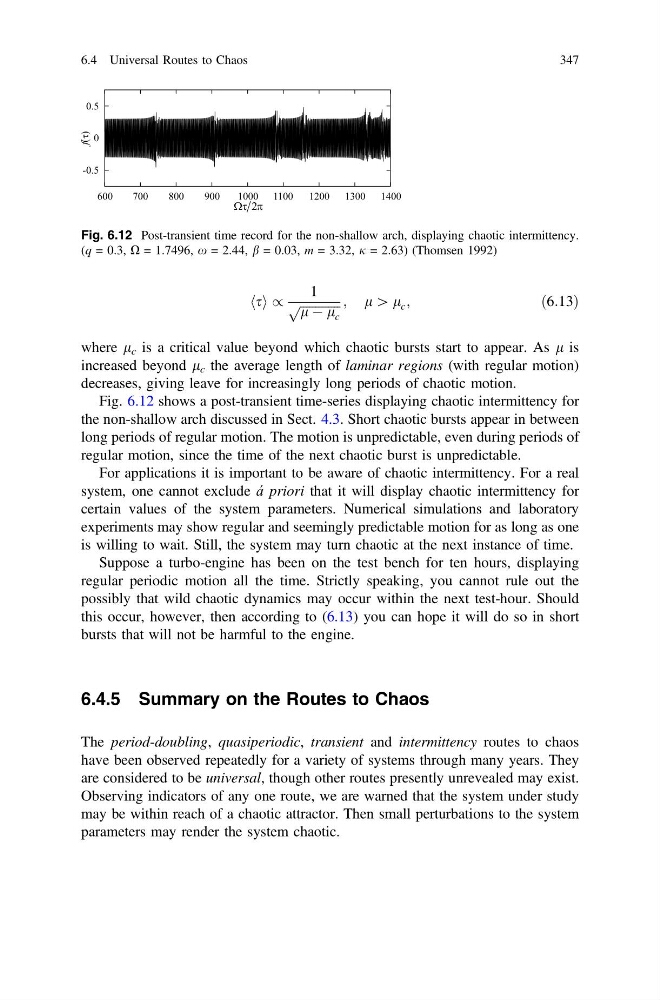
Fig. 6.12 shows a post-transient time-series displaying chaotic intermittency for
the non-shallow arch discussed in Sect. 4.3. Short chaotic bursts appear in between
long periods of regular motion. The motion is unpredictable, even during periods of
regular motion, since the time of the next chaotic burst is unpredictable.
For applications it is important to be aware of chaotic intermittency. For a real
system, one cannot exclude á priori that it will display chaotic intermittency for
certain values of the system parameters. Numerical simulations and laboratory
experiments may show regular and seemingly predictable motion for as long as one
is willing to wait. Still, the system may turn chaotic at the next instance of time.
Suppose a turbo-engine has been on the test bench for ten hours, displaying
regular periodic motion all the time. Strictly speaking, you cannot rule out the
possibly that wild chaotic dynamics may occur within the next test-hour. Should
this occur, however, then according to (6.13) you can hope it will do so in short
bursts that will not be harmful to the engine.
6.4.5 Summary on the Routes to Chaos
The period-doubling, quasiperiodic, transient and intermittency routes to chaos
have been observed repeatedly for a variety of systems through many years. They
are considered to be universal, though other routes presently unrevealed may exist.
Observing indicators of any one route, we are warned that the system under study
may be within reach of a chaotic attractor. Then small perturbations to the system
parameters may render the system chaotic.
Fig. 6.12 Post-transient time record for the non-shallow arch, displaying chaotic intermittency.
(q = 0.3, X = 1.7496, x = 2.44, b = 0.03, m = 3.32, j = 2.63) (Thomsen 1992)
6.4 Universal Routes to Chaos
347
h i /
1
ffiffiffiffiffiffiffiffiffiffiffiffiffi
l À l c
p
; l [ l c ;
ð6:13Þ
where l c is a critical value beyond which chaotic bursts start to appear. As l is
increased beyond l c the average length of laminar regions (with regular motion)
decreases, giving leave for increasingly long periods of chaotic motion.
Fig. 6.12 shows a post-transient time-series displaying chaotic intermittency for
the non-shallow arch discussed in Sect. 4.3. Short chaotic bursts appear in between
long periods of regular motion. The motion is unpredictable, even during periods of
regular motion, since the time of the next chaotic burst is unpredictable.
For applications it is important to be aware of chaotic intermittency. For a real
system, one cannot exclude á priori that it will display chaotic intermittency for
certain values of the system parameters. Numerical simulations and laboratory
experiments may show regular and seemingly predictable motion for as long as one
is willing to wait. Still, the system may turn chaotic at the next instance of time.
Suppose a turbo-engine has been on the test bench for ten hours, displaying
regular periodic motion all the time. Strictly speaking, you cannot rule out the
possibly that wild chaotic dynamics may occur within the next test-hour. Should
this occur, however, then according to (6.13) you can hope it will do so in short
bursts that will not be harmful to the engine.
6.4.5 Summary on the Routes to Chaos
The period-doubling, quasiperiodic, transient and intermittency routes to chaos
have been observed repeatedly for a variety of systems through many years. They
are considered to be universal, though other routes presently unrevealed may exist.
Observing indicators of any one route, we are warned that the system under study
may be within reach of a chaotic attractor. Then small perturbations to the system
parameters may render the system chaotic.
Fig. 6.12 Post-transient time record for the non-shallow arch, displaying chaotic intermittency.
(q = 0.3, X = 1.7496, x = 2.44, b = 0.03, m = 3.32, j = 2.63) (Thomsen 1992)
6.4 Universal Routes to Chaos
347